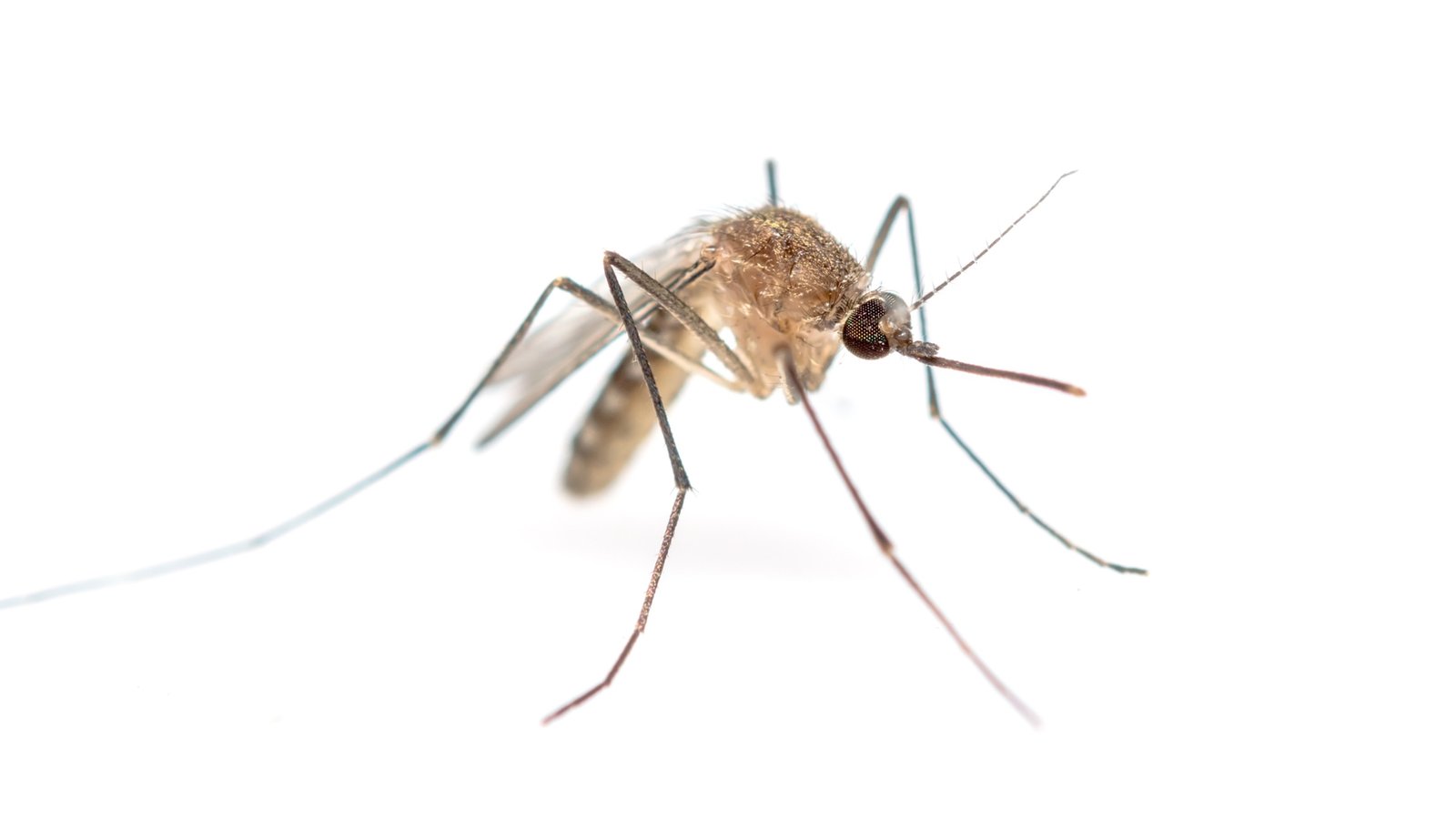
Mosquito science comes with its own vocabulary, from the names of the genera that bite you to the chemistry of the sprays that stop them. This glossary defines the terms you are most likely to meet on this site and in public-health guidance, in plain language, with the sources listed at the end. Fuller explanations live on the linked pages.
A to C
Adulticide. A pesticide used to kill adult, flying mosquitoes. It is often applied as an ultra-low-volume (ULV) aerosol from trucks or aircraft to knock down an outbreak or a heavy nuisance infestation. More on fogging and adulticides
Aedes. A mosquito genus whose females lay eggs singly on damp surfaces above the waterline; the eggs hatch after flooding. It includes container-breeding and floodwater species, several of which can carry viruses.
Anopheles. A mosquito genus that lays single eggs bearing small lateral floats on the water surface. It is the only group able to transmit the parasites that cause human malaria.
Arbovirus. Short for “arthropod-borne virus,” a virus kept alive in nature by cycling between blood-feeding arthropods (such as mosquitoes) and vertebrate animals. People usually become infected through an infected bite. Arboviral encephalitis overview
Autogenous. Describes a female mosquito able to develop her first batch of eggs without a blood meal, drawing on reserves carried over from the larval stage. Most species instead require blood before they can lay (anautogenous).
Bti (Bacillus thuringiensis israelensis). A naturally occurring soil bacterium used as a larvicide. Larvae that eat its protein crystals suffer fatal damage to the midgut lining, and it is highly specific to mosquitoes, black flies, and some midges. How Bti dunks work
Bridge vector. A mosquito that feeds on both birds and mammals and can therefore carry a virus out of its bird-and-mosquito cycle to people or horses.
Carbon dioxide. The gas in exhaled breath that mosquitoes detect from a distance. It is one of the main cues, along with body heat and skin odor, that guides host-seeking females toward a blood host. How mosquitoes find you
Culex. A mosquito genus that lays eggs stuck together in floating rafts on standing water. Culex species are the main vectors of West Nile virus.
Culiseta. A mosquito genus of cooler and more permanent waters. Culiseta melanura is the enzootic (bird-to-bird) vector that maintains eastern equine encephalitis virus in swamps.
D to F
Dead-end host. An animal, such as a human or a horse, that can be infected but does not build up enough virus in its blood to pass the infection back to biting mosquitoes.
DEET. N,N-diethyl-meta-toluamide, the active ingredient in more than 500 EPA-registered skin repellents and one of the most widely used and studied mosquito repellents. More on DEET
Diapause. A programmed dormant state that lets mosquitoes pause development to survive winter or drought, for example as eggs that wait to hatch until spring or tidal flooding.
Eastern equine encephalitis (EEE). A rare but often severe mosquito-borne brain infection maintained between birds and Culiseta melanura in freshwater swamps and carried to people and horses by bridge vectors. More on EEE
Egg raft. A floating cluster of eggs, laid by genera such as Culex, that sticks together on the water surface and can hold from about 100 to 300 eggs.
Enzootic vector. A mosquito that keeps a virus circulating within its natural animal reservoir (for EEE, from bird to bird) without normally biting people.
Extrinsic incubation period. The time after a mosquito takes an infected blood meal before it can pass the virus on. Warmer temperatures generally shorten it.
Floodwater mosquito. A mosquito, such as many Aedes and Psorophora species, whose eggs are laid on damp soil and hatch in large numbers when rain or tides flood the ground.
G to L
Gravid. Describes a female carrying a batch of developed eggs and ready to lay. Surveillance programs use “gravid traps” to sample egg-laying Culex for virus testing.
Host. An animal that a mosquito feeds on, or, for a pathogen, the animal in which it lives and multiplies. Birds, mammals, and people can all serve as hosts. How transmission works
IR3535. 3-[N-butyl-N-acetyl]-aminopropionic acid ethyl ester, a synthetic repellent active ingredient found in about 45 EPA-registered products. More on IR3535
Larva (wriggler). The second, aquatic life stage that hatches from the egg. It feeds and molts through four instars and wriggles in the water, which is the source of the nickname “wriggler.” Mosquito life cycle
Larvicide. A pesticide applied to water to kill mosquito larvae before they can become biting adults, reducing the next generation at its source.
M to P
Methoprene. An insect growth regulator used as a larvicide. It mimics a juvenile hormone so that treated larvae cannot mature into adults. More on methoprene
Neuroinvasive disease. The severe form of an arboviral infection that reaches the nervous system, causing meningitis, encephalitis, or acute flaccid paralysis.
Oviposition. The act of egg-laying. Mosquitoes oviposit on or near water, singly or in rafts depending on the species.
Permethrin. A synthetic pyrethroid insecticide used to treat clothing and gear (not skin) and in some adult mosquito control sprays. Permethrin-treated clothing
Picaridin. Also called icaridin or KBR 3023, a synthetic repellent active ingredient in about 40 EPA-registered products. More on picaridin
PMD (oil of lemon eucalyptus). Para-menthane-3,8-diol, the active compound in oil of lemon eucalyptus (OLE). EPA registers OLE and PMD as skin-applied repellents. More on oil of lemon eucalyptus
Proboscis. The long, tube-like mouthpart a female mosquito uses to pierce skin and draw blood. Males, which do not bite, feed only on nectar. Mosquito anatomy
Psorophora. A genus of large floodwater mosquitoes that appear after spring and summer rains and are aggressive biters.
Pupa (tumbler). The third, non-feeding aquatic stage, comma-shaped and active, that tumbles through the water for one to four days before the adult emerges. Mosquito life cycle
Q to Z
Reservoir host. The animal population that maintains a pathogen in nature. For West Nile and eastern equine encephalitis viruses, wild birds are the main reservoir.
Saltmarsh mosquito. A floodwater species (such as Aedes sollicitans) that breeds in coastal salt marsh pools, is a strong flier and pest, and can carry EEE.
Source reduction. Removing or emptying the standing water where mosquitoes breed (buckets, tires, gutters, and other containers). It is usually the first and most effective step in mosquito control. More on source reduction
Vector. An organism, such as a mosquito, that carries and transmits a pathogen from one host to another.
Vector competence. The physiological ability of a given mosquito population to become infected with a pathogen and then transmit it.
West Nile virus. A virus cycled between Culex mosquitoes and birds and the most frequently reported mosquito-borne illness nationally. Most infections cause no symptoms, but a few become neuroinvasive. More on West Nile virus
Sources
- EPA, “Controlling Adult Mosquitoes,” https://www.epa.gov/mosquitocontrol/controlling-adult-mosquitoes (adulticides, ULV application, pyrethroids, permethrin).
- EPA, “Controlling Mosquitoes at the Larval Stage,” https://www.epa.gov/mosquitocontrol/controlling-mosquitoes-larval-stage (larvicides, Bti, methoprene as a growth inhibitor).
- EPA, “Ingredients in Skin-Applied Insect Repellents,” https://www.epa.gov/insect-repellents/skin-applied-repellent-ingredients (DEET, picaridin, IR3535, oil of lemon eucalyptus, PMD).
- EPA, “Success in Mosquito Control: An Integrated Approach,” https://www.epa.gov/mosquitocontrol/success-mosquito-control-integrated-approach (source reduction, eliminating standing water). Accessed via search summary.
- CDC, “Integrated Mosquito Management,” https://www.cdc.gov/mosquitoes/php/toolkit/integrated-mosquito-management-1.html (source reduction, surveillance). Accessed via search summary.
- American Mosquito Control Association, “Mosquito Biology,” https://www.mosquito.org/mosquito-biology/ (egg raft, larval instars, pupa “tumbler,” blood meal needed for eggs, overwintering).
- Oklahoma State University Extension, “Mosquitoes,” https://extension.okstate.edu/programs/digital-diagnostics/insects-and-arthropods/mosquitoes (genera; floodwater vs permanent-water mosquitoes; Aedes, Anopheles, Culex, Culiseta, Psorophora). Page returned 403; accessed via search summary.
- CDC, “Transmission of West Nile Virus,” https://www.cdc.gov/west-nile-virus/php/transmission/index.html (Culex as primary vector, bird reservoir, dead-end hosts). Accessed via search summary.
- CDC, “Arboviral Diseases, Neuroinvasive and Non-neuroinvasive (2015 Case Definition),” https://ndc.services.cdc.gov/case-definitions/arboviral-diseases-neuroinvasive-and-non-neuroinvasive-2015/ (arbovirus, encephalitis, neuroinvasive disease). Accessed via search summary.
- Emerging Infectious Diseases (CDC), “Eastern Equine Encephalitis Virus in Mosquitoes and Their Role as Bridge Vectors,” vol. 16, no. 12, https://wwwnc.cdc.gov/eid/article/16/12/10-0640_article (EEE, Culiseta melanura enzootic vector, bridge vectors, dead-end hosts). Accessed via search summary.
- Rutgers Center for Vector Biology, “Aedes sollicitans (Eastern Saltmarsh Mosquito),” https://vectorbio.rutgers.edu/outreach/species/sp7.htm (saltmarsh floodwater breeding, overwintering egg diapause, proboscis marking, EEE vector).
- Frontiers in Microbiology (2019), “Arbovirus-Mosquito Vector-Host Interactions and the Impact on Transmission and Disease Pathogenesis of Arboviruses,” https://www.frontiersin.org/journals/microbiology/articles/10.3389/fmicb.2019.00022/full (vector competence, extrinsic incubation period). Accessed via search summary.
- Toxins (2014), “Bacillus thuringiensis subsp. israelensis and Its Dipteran-Specific Toxins,” https://www.ncbi.nlm.nih.gov/pmc/articles/PMC4014730/ (Bti mode of action in the larval midgut, target specificity).
- Washington State Department of Health, “Mosquito Larvicide – Bti,” https://doh.wa.gov/community-and-environment/pests/mosquitoes/bti (Bti as a larvicide, safety profile). Accessed via search summary.
- Nature (1977), “Autogeny in saltmarsh mosquitoes induced by a substance from the male accessory gland,” https://www.nature.com/articles/267342a0 (autogeny defined against anautogeny). Accessed via search summary.
- “Human attractive cues and mosquito host-seeking behavior,” https://pmc.ncbi.nlm.nih.gov/articles/PMC10789295/ (carbon dioxide as the primary long-distance host-seeking cue). Accessed via search summary.
- CDC, “Mosquito Surveillance Traps,” https://www.cdc.gov/mosquitoes/php/toolkit/mosquito-surveillance-traps.html (gravid females, gravid traps). Accessed via search summary.
These are short working definitions. Fuller explanations, with their own sources, live on the linked pages.
Last reviewed 20 July 2026.