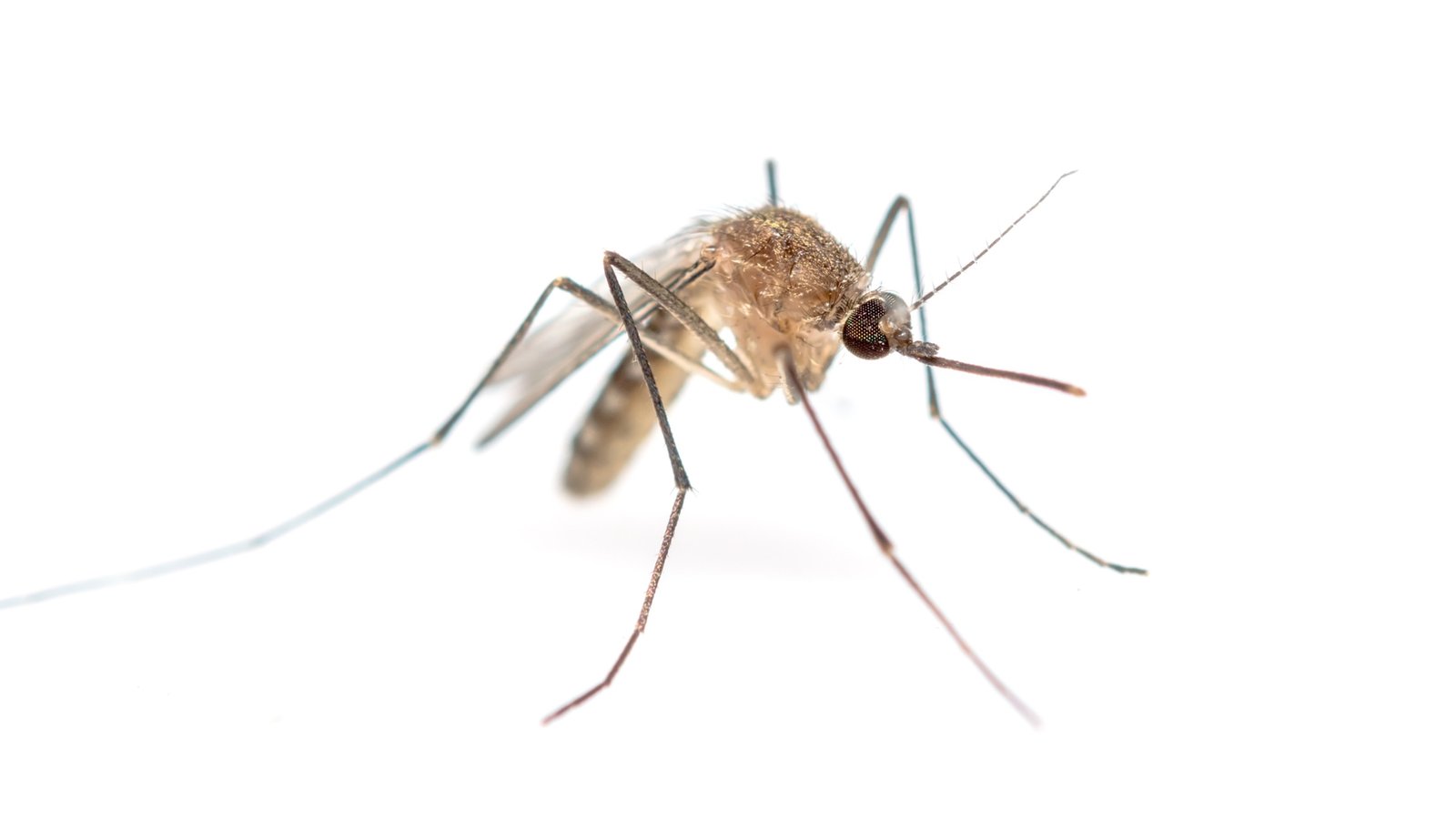
The short answer
Most mosquito questions in this country come down to four genera: Aedes (aggressive container and floodwater biters), Culex (the house mosquitoes behind West Nile virus), Anopheles (the malaria mosquitoes), and Psorophora (large, painful floodwater biters). But several smaller genera matter too, and a few of them matter a great deal.
The most important is Culiseta. One species in that genus, Culiseta melanura, is the engine that keeps Eastern equine encephalitis (EEE) virus circulating in the wild [1][3]. Other genera on this page fill narrower roles: Coquillettidia and Mansonia larvae breathe through plant roots and act as bridges that move viruses from birds to people, Wyeomyia lives its whole life inside a carnivorous plant, Deinocerites hides in crab burrows, and Toxorhynchites is a giant mosquito that never bites and whose larvae eat other mosquitoes.
Culiseta: the cool-weather mosquitoes behind EEE
Culiseta are generally cold-tolerant mosquitoes, active in the cooler parts of the year when most other species have gone quiet. The genus draws attention because of one member, Culiseta melanura, described by researchers as the principal vector of Eastern equine encephalitis virus in this country [3].
Here is how the cycle works. EEE virus is maintained in a loop between Culiseta melanura and wild birds in freshwater hardwood swamps [1]. Culiseta melanura feeds almost exclusively on birds, so it is very good at keeping the virus moving among the bird population but is not, by itself, considered an important vector of EEE to people [1]. It amplifies the virus in the swamp. Getting the virus out of the swamp and into a horse or a person takes a second, mammal-biting mosquito. That is where the next genera come in.
Learn more on the Culiseta melanura page and the Eastern equine encephalitis page.
Coquillettidia: the cattail mosquito and EEE bridge
Coquillettidia perturbans, the cattail mosquito, is the only species of its genus established in this country, and it is widely distributed across the eastern half of the United States, southern Canada, and parts of the West [4].
Its larvae have an unusual trick. Instead of coming to the surface to breathe, they carry a saw-like siphon that pierces the hollow roots and submersed stems of aquatic plants, especially cattails in the genus Typha, and draw oxygen directly from the plant [4]. The larvae stay attached below the waterline for much of their development, which makes them hard to reach with conventional larval control.
Coquillettidia perturbans transmits both West Nile virus and Eastern equine encephalomyelitis virus [4]. Because it will feed on birds but readily bites mammals, it is one of the classic bridge vectors of EEE, carrying virus out of the bird cycle to horses and people [1][2]. The adults are strong fliers that can travel several miles from where they hatched and are aggressive enough to bite through clothing [4].
Mansonia, Wyeomyia, and Deinocerites in brief
Mansonia. Two Mansonia species live in the continental United States, Mansonia titillans and its close relative Mansonia dyari [8]. Like the cattail mosquito, Mansonia larvae use a hardened, cone-shaped siphon to attach to the roots of floating plants such as water hyacinth and water lettuce and breathe through them [8]. Mansonia titillans has been recorded across the southern tier, including Texas, Florida, Mississippi, Georgia, South Carolina, Louisiana, and Alabama [8]. Worldwide the genus is best known for transmitting the filarial worms that cause lymphatic filariasis, and wild-caught females here have tested positive for several encephalitis viruses, though their vector role in this country is not fully worked out [8].
Wyeomyia (the pitcher-plant mosquito). Wyeomyia smithii spends its entire immature life inside the water held by the northern pitcher plant, Sarracenia purpurea [7]. The larvae feed on the carcasses of insects and spiders that the plant has trapped and is digesting, and the mosquito overwinters as a larva frozen in a block of ice inside the plant [7]. It ranges from Newfoundland south to Delaware and west toward northern Illinois and Saskatchewan [7]. It is essentially a biological curiosity with no medical or economic importance, and northern populations do not need a blood meal to lay eggs [7].
Deinocerites (the crabhole mosquito). Deinocerites cancer breeds and rests inside the burrows of land crabs, where adults shelter by day and the immature stages develop in the water at the bottom of the burrow [6]. It looks much like a Culex mosquito but has noticeably longer antennae [6]. In this country it is found along Florida’s east coast, in mangrove swamps and saltmarshes as far north as St. Johns County [6]. It feeds mainly on birds but also on mammals and reptiles, and it has not been implicated in the transmission of any human pathogen [6].
Toxorhynchites: the elephant mosquito that does not bite
Toxorhynchites is the exception to almost everything people assume about mosquitoes. Toxorhynchites rutilus is one of the largest mosquitoes in North America, found across the eastern half of the country [5]. The adults never bite. The females get all the nutrients they need from their larval stage and feed only on carbohydrate-rich sources such as nectar, honeydew, and fruit, never on blood, which makes them harmless as disease vectors [5].
The larvae are the opposite of harmless if you are another mosquito. They are aquatic predators that hunt other insect larvae, with a strong preference for the larvae of other mosquitoes, and a single Toxorhynchites larva can consume thousands of prey items over the course of its development [5]. That appetite, plus an ability to survive weeks without food, is why researchers study the genus as a biological control agent against container-breeding pests like Aedes aegypti and Aedes albopictus [5].
Why these genera matter
Two themes tie this group together.
The first is bridge transmission. Some of the most dangerous mosquito-borne viruses are not spread to people by the mosquito that keeps them alive in nature. EEE lives in a bird-and-Culiseta loop deep in the swamp, and it takes a second, mammal-biting mosquito such as Coquillettidia perturbans (and species in the Aedes and Culex genera) to bridge that gap and reach horses and people [1][2]. Understanding which genera bite birds, which bite mammals, and which bite both is central to predicting and preventing outbreaks.
The second is biological control. Toxorhynchites shows that a mosquito can be an ally rather than a pest, and Wyeomyia and Deinocerites are reminders that most of the roughly 200 mosquito species in this country are specialists tied to odd habitats, not biting nuisances at all. Knowing the quiet genera makes it easier to focus attention on the few that actually threaten health.
Sources
- CDC, “Transmission of Eastern Equine Encephalitis Virus.” https://www.cdc.gov/eastern-equine-encephalitis/php/transmission/index.html (accessed 2026-07-20). Page returned HTTP 403 on direct fetch; text drawn from the CDC-published search result excerpt of this page. Supports: EEE virus maintained in a cycle between Culiseta melanura and birds in freshwater hardwood swamps; Cs. melanura feeds almost exclusively on birds and is not an important vector of EEE to people; transmission to people requires a bridge mosquito, with most bridge species in the Aedes, Coquillettidia, and Culex genera.
- Armstrong PM, Andreadis TG, “Eastern Equine Encephalitis Virus in Mosquitoes and Their Role as Bridge Vectors,” Emerging Infectious Diseases 16(12), December 2010, CDC. https://wwwnc.cdc.gov/eid/article/16/12/10-0640_article (accessed 2026-07-20). Supports: the bridge-vector concept; competent bridge vectors including Aedes vexans, Coquillettidia perturbans, Ochlerotatus canadensis, and Oc. sollicitans that feed occasionally on birds but prefer mammalian hosts.
- Soghigian J, et al., “Population genomics of Culiseta melanura, the principal vector of Eastern equine encephalitis virus in the United States,” PMC6114928. https://www.ncbi.nlm.nih.gov/pmc/articles/PMC6114928/ (accessed 2026-07-20). Supports: Culiseta melanura described as the principal vector of EEE virus in this country.
- UF/IFAS Featured Creatures / EDIS (Johnson, Cuda, and Burkett-Cadena), “Cattail Mosquito, Coquillettidia perturbans.” https://ask.ifas.ufl.edu/publication/IN1192 (accessed 2026-07-20). Supports: saw-like siphon projections pierce the hollow roots of submersed plant stems, especially cattails in the genus Typha; only Coquillettidia species established in the USA and Canada; distribution across the eastern half of the US, southern Canada, and parts of the West; transmits West Nile virus and Eastern equine encephalomyelitis virus; strong fliers able to travel up to five miles and capable of penetrating clothing.
- UF/IFAS Featured Creatures, “Elephant Mosquito, Toxorhynchites rutilus.” https://ask.ifas.ufl.edu/publication/IN1380 (accessed 2026-07-20). Supports: one of the largest mosquito species in North America; distribution across the eastern half of the US; autogenous females feed only on carbohydrate sources (nectar, honeydew, fruit) and not blood, making them harmless as vectors; larvae are aquatic predators that prefer other mosquito larvae and can consume thousands of prey during development; ability to resist starvation for weeks; studied as a biological control agent.
- UF/IFAS Featured Creatures / EDIS, “Crabhole Mosquito, Deinocerites cancer Theobald” (EENY-134/IN291). https://ask.ifas.ufl.edu/publication/IN291 (accessed 2026-07-20). Supports: adults rest in the upper portions of land crab burrows and immature stages develop in water at the bottom; similar to Culex but with much longer antennae; found in Florida’s east-coast mangrove swamps and saltmarshes as far north as St. Johns County (plus the Bahamas, Greater Antilles, and coastal Central America); blood-feeds primarily on birds and also on mammals and reptiles; not implicated in the transmission of any human pathogen.
- Rutgers Center for Vector Biology, “Wyeomyia smithii (Coquillett).” https://vectorbio.rutgers.edu/outreach/species/sp27.htm (accessed 2026-07-20). Supports: obligate inhabitant of the northern pitcher plant, Sarracenia purpurea; larvae live in the plant’s liquid and feed on the carcasses of insects and spiders being digested by the plant’s enzymes; overwinters as a larva frozen in a block of ice within the plant; distribution from Newfoundland to Delaware, west to northern Illinois and Saskatchewan; autogenous with no economic or medical importance.
- UF/IFAS Featured Creatures, “Mansonia titillans.” https://ask.ifas.ufl.edu/publication/IN1314 (accessed 2026-07-20). Supports: two Mansonia species in the continental US (Mansonia titillans and Mansonia dyari); larvae attach to the roots of floating freshwater plants (water hyacinth, water lettuce) using a heavily sclerotized conical siphon to obtain oxygen; M. titillans recorded in Texas, Florida, Mississippi, Georgia, South Carolina, Louisiana, and Alabama; known vector of filarial nematodes that cause lymphatic filariasis, with wild females testing positive for Venezuelan equine encephalitis, West Nile, and St. Louis encephalitis viruses though vector competence is unassessed; females fly several miles from breeding sites.
Related
- Culiseta melanura (black-tailed mosquito) [species page, placeholder]
- Eastern equine encephalitis [disease page, placeholder]
- Coquillettidia perturbans (cattail mosquito) [species page, placeholder]
- Toxorhynchites rutilus (elephant mosquito) [species page, placeholder]
- The Aedes mosquitoes [species page, placeholder]
This page is an educational reference and is not medical or pest-control advice. For a suspected disease exposure, consult a clinician; for infestations, consult your local mosquito control district or a licensed professional.
Last reviewed 20 July 2026.