The short answer
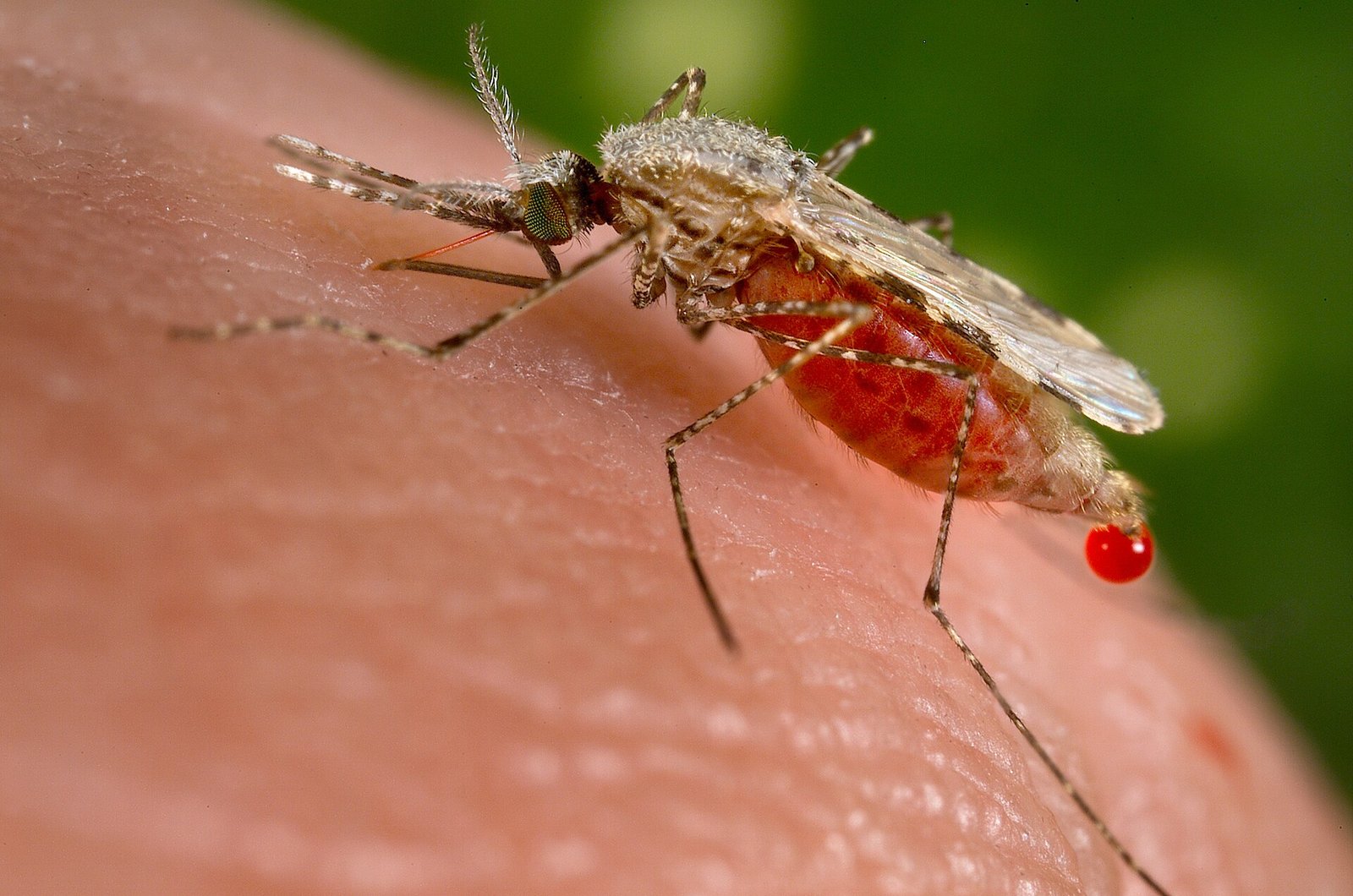
Anopheles is the genus of the malaria mosquitoes. Human malaria is transmitted only by female mosquitoes in this genus, and no other mosquito in North America can carry the parasite. The fastest way to recognize one is its posture at rest. Where most mosquitoes hold their body roughly parallel to the surface they land on, an Anopheles tips its abdomen up into the air and points its head down, so the whole insect sits at a sharp angle to your skin or a wall. That head-down stance, together with long mouthpart palps and often speckled wings, is the field signature of the genus.
The mosquito pictured above is Anopheles stephensi, an Asian species, shown here only to illustrate the genus and its steep resting posture. It is not a species found in the wild in the US, but the angled stance is the same one you would see on the US species described below.
Shared identification traits
No single mark defines every Anopheles, but a short list of features works together.
- The resting angle. Anopheline adults rest with the abdomen held at a discrete angle to the surface, while mosquitoes in other genera keep the body more or less parallel to the surface. When one is sitting on skin, the raised tail end is easy to spot.
- Long palps. In the genus Anopheles the palps are roughly equal in length to the proboscis. In female Culex and Aedes the palps are much shorter than the proboscis, so a pair of “feelers” as long as the biting tube alongside it points to Anopheles.
- Spotted wings. Many Anopheles carry patches of dark scales that form spots on the wings. Anopheles quadrimaculatus is named for the four dark spots its wing scales form, and Anopheles freeborni likewise shows four dark wing spots.
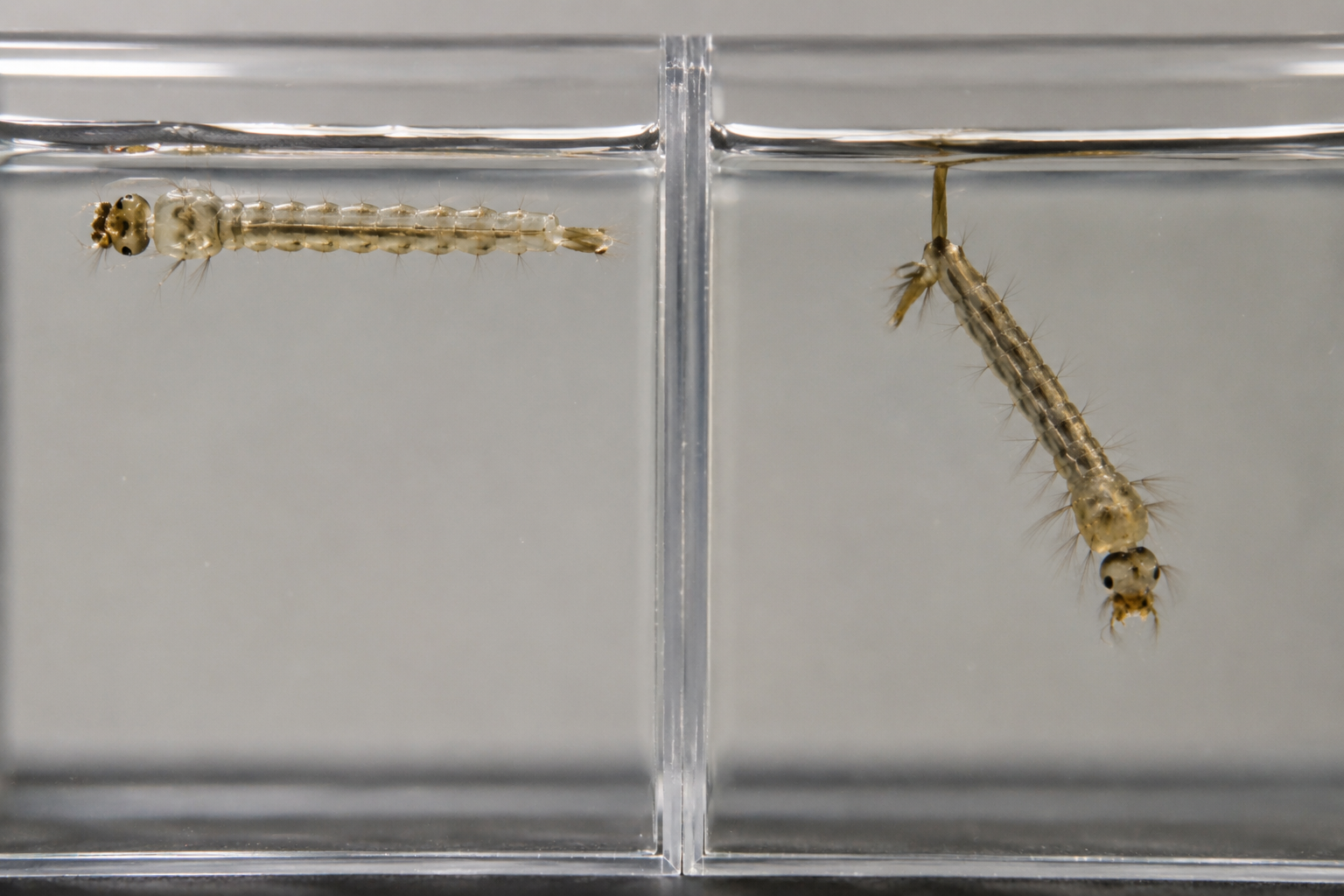
- Flat-lying larvae with no siphon. The larvae are as distinctive as the adults. An Anopheles larva lies horizontally, parallel to and flush against the water surface, and it lacks the breathing tube (siphon) that Culex and Aedes larvae use to hang head-down from the surface film. Instead it breathes through spiracles set on the abdomen and uses palmate hairs to lie flat at the surface while it filter feeds.
Breeding and behavior
Anopheles females lay their eggs one at a time directly on the water. Each egg carries a pair of floats on its sides that keep it at the surface, which is different from the egg rafts of Culex or the above-waterline eggs of Aedes. The preferred water is generally clean or only lightly vegetated rather than foul. Anopheles quadrimaculatus favors fresh water streams, ponds, and lakes with aquatic vegetation, and Anopheles freeborni breeds in clear, open, sunlit pools, ponds, ditches, seepage areas, and rice fields. Like all mosquitoes, they pass through four stages, egg, larva, pupa, and adult, with the first three living in water.
Biting runs mostly from dusk into the night. Anopheles quadrimaculatus feeds after dark, with flight activity peaking shortly after nightfall, and rests by day in dark corners of buildings and shelters. Anopheles freeborni will enter houses to feed at dusk and through the night, and on cloudy days or in heavy shade it may bite during the day as well. In cooler parts of the range the adult females overwinter in a resting state.
Key US Anopheles species
A handful of species account for most of the Anopheles people meet in the US.
- Anopheles quadrimaculatus, the common malaria mosquito. The main Anopheles of eastern North America, most abundant in the Southeast, named for the four dark spots on its wings. Historically the most important malaria vector in the eastern part of the country. (See the Anopheles quadrimaculatus species page.)
- Anopheles freeborni, the western malaria mosquito. A fairly large brown mosquito with four dark wing spots and long legs, found across the arid and semiarid West and along the Pacific Coast. Historically the primary malaria vector in the western states. (See the Anopheles freeborni species page.)
- Anopheles crucians. A southeastern species of swampy areas, slow water, and acidic pools with vegetation. It is actually part of a closely related group (the Crucians Complex) whose members cannot be told apart as adults without larval or molecular characters. It is considered a competent vector, and during the 2023 Florida cases some Anopheles crucians tested positive for malaria parasite DNA. (See the Anopheles crucians species page.)
Disease relevance
Anopheles mosquitoes are the only mosquitoes in the US that can transmit human malaria. Of roughly 430 Anopheles species worldwide, only about 30 to 40 transmit malaria in nature, but the genus is the sole route for the parasite, so wherever competent Anopheles overlap with an infected person the transmission chain can close.
In practice, domestic malaria is now rare. Malaria was eliminated as an established disease in the country in the early 1950s. In a typical recent year about 2,000 malaria cases are diagnosed here, and more than 99 percent of them are travel associated, in people who were infected abroad and diagnosed after returning. Locally acquired, mosquito-transmitted malaria is the exception. Before 2023 the last such episode was in 2003 in Palm Beach County, Florida. In 2023 a small cluster of locally acquired Plasmodium vivax cases occurred in Florida and Texas, with an additional Plasmodium falciparum case in Maryland, and public health agencies still rated the overall risk of locally acquired malaria as very low. For how the parasite and the disease work, see the malaria page.
Why the resting angle and larval posture are the giveaways
Most mosquito genera are separated on fine details such as scale patterns and wing venation that take a hand lens and practice to read. Anopheles is unusual because two of its most reliable clues are visible to the naked eye and hold across the genus. An adult that sits head-down at a steep angle, rather than flat, is almost certainly an Anopheline, and the long palps beside the proboscis confirm it. In the water, a larva lying flat against the surface with no breathing siphon is the matching sign, because every other common US genus hangs at an angle from a siphon tube. Together the angled adult and the flat larva let you place a mosquito in this genus without dissecting it, which matters because this is the one genus that carries human malaria.
Sources
- University of Florida IFAS Featured Creatures, “Common Malaria Mosquito Anopheles quadrimaculatus Say” (EENY-491/IN791). Anophelines rest with the abdomen at a discrete angle while other genera hold the body parallel; palps roughly equal in length to the proboscis; wing scales form four dark spots; larvae lie horizontally at the water surface and lack a breathing siphon, using palmate hairs and abdominal spiracles; eggs laid singly on the water surface; breeds in fresh water streams, ponds, and lakes with aquatic vegetation; feeds at night, rests by day in dark shelters, flight peaks shortly after dark; primarily eastern North America, most abundant in the Southeast; historically the most important malaria vector in the eastern US. https://ask.ifas.ufl.edu/publication/IN791 (accessed 2026-07-20)
- CDC, “Life Cycle of Anopheles Mosquitoes.” Human malaria is transmitted only by females of the genus Anopheles; of roughly 430 Anopheles species only about 30 to 40 transmit malaria in nature; eggs laid singly directly on water with floats on either side; four life stages with the first three aquatic. https://www.cdc.gov/mosquitoes/about/life-cycle-of-anopheles-mosquitoes.html (accessed 2026-07-20)
- CDC, “About Malaria.” Malaria was eliminated as an established disease in the US in the early 1950s; about 2,000 malaria cases are diagnosed in the US in a typical year with more than 99 percent travel associated; before 2023 the last locally acquired mosquito-borne malaria was in 2003 in Palm Beach County, Florida. https://www.cdc.gov/malaria/about/index.html (accessed 2026-07-20)
- CDC MMWR, “Outbreak of Locally Acquired Mosquito-Transmitted (Autochthonous) Malaria, Florida and Texas, May-July 2023” (Vol. 72, No. 36). Eight locally acquired Plasmodium vivax cases in Florida and Texas; Anopheles crucians abdomens tested positive for P. vivax DNA; risk of locally acquired malaria remains very low. https://www.cdc.gov/mmwr/volumes/72/wr/mm7236a1.htm (accessed 2026-07-20)
- CDC Health Alert Network, “HAN 00496: Important Updates on Locally Acquired Malaria Cases Identified in Florida, Texas, and Maryland” (2023). Additional single locally acquired Plasmodium falciparum case in Maryland; the local cases were unrelated to travel and to one another. https://www.cdc.gov/han/2023/han00496.html (accessed 2026-07-20)
- Placer Mosquito and Vector Control District, “Anopheles freeborni, The Western Malaria Mosquito.” Large brown mosquito with long legs and four dark wing spots; breeds in clear, open, sunlit pools, ponds, ditches, seepage, and rice fields; enters houses to feed at dusk and through the night, may bite by day in shade; overwinters as adults; historically the primary malaria vector in the western US. https://placermosquito.org/wp-content/uploads/2020/10/PMVCD-Anopheles-WEB.pdf (accessed 2026-07-20)
- Malaria Journal, “Presence and abundance of malaria vector species in Miami-Dade County, Florida” (2024), via PMC. Anopheles crucians inhabits swampy areas, slow water, and acidic pools with vegetation in the Southeast; belongs to the Crucians Complex whose members are indistinguishable as adults; considered a competent vector alongside the more anthropophilic Anopheles quadrimaculatus. https://www.ncbi.nlm.nih.gov/pmc/articles/PMC10797977/ (accessed 2026-07-20)
Related
- Anopheles quadrimaculatus (common malaria mosquito) [species page, placeholder]
- Anopheles freeborni (western malaria mosquito) [species page, placeholder]
- Anopheles crucians [species page, placeholder]
- Malaria [disease page, placeholder]
Educational note: This page is a general reference for identifying and understanding mosquitoes. It is not medical advice or a pest-control treatment plan. For a suspected disease exposure, contact a clinician or your local health department. For control questions, contact your local mosquito control district.
Last reviewed 20 July 2026.