The short answer
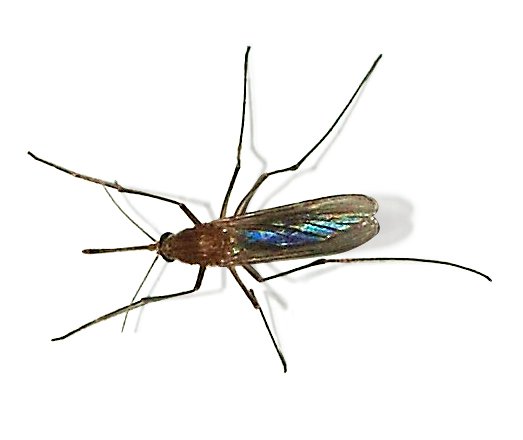
Culex are the plain, drab brown mosquitoes most people picture when they think of a house mosquito. They tend to be dull and unmarked rather than boldly striped, they bite mainly from dusk into the night, and they feed on both birds and mammals. That combination matters for public health, because Culex species are the main carriers of West Nile virus and St. Louis encephalitis virus in the United States. West Nile virus is maintained in a cycle between Culex mosquitoes and wild birds, and people are infected through the bite of a mosquito that has already fed on an infected bird.
Shared identification traits
Most Culex you meet in the yard share a “generic mosquito” look, which is part of why they get overlooked.
- Size is small to medium. The northern house mosquito, Culex pipiens, is described by University of Florida entomologists as a small to medium-sized mosquito.
- Color is dull. Culex are typically light to medium brown with scattered pale scales, without the crisp black-and-white pattern seen on Aedes.
- The proboscis is usually plain and dark, without a bright pale band around the middle. (Culex tarsalis is a western exception, and it is discussed below.)
- The tip of the abdomen tends to look blunt or rounded from above, rather than tapering to a point.
- They lay their eggs in floating rafts on the water surface rather than one at a time.
Because several Culex species look almost identical, specialists often cannot separate them by eye alone and instead identify them only to genus or species group.
Breeding and eggs
Culex favor still, organically rich water. Larvae thrive where there is a high load of decaying organic matter, so common sites include stagnant ponds, roadside ditches, storm drains, catch basins, neglected water in buckets, cans, and rain barrels, and water fouled by sewage or seepage.
The signature trait is the egg raft. Instead of scattering eggs singly, a female Culex glues her eggs together into a small oval raft that floats on the surface until the larvae hatch. Raft size varies by species. Culex pipiens rafts typically hold about 150 to 300 eggs, and Culex tarsalis rafts average roughly 190 eggs, so figures on the order of 100 to 300 eggs per raft are normal for the genus.
This is a useful contrast with Aedes mosquitoes, which do not build rafts. Aedes lay their eggs singly, above the waterline on damp surfaces, where the eggs can sit dry and dormant for long periods before flooding triggers hatching. If you find a floating raft of eggs, you are almost certainly looking at Culex, not Aedes.
Behavior
Culex are mainly evening and night biters. Activity typically climbs after sunset and continues into the night and early morning, which is different from the day-active habits of many Aedes.
Their host choices help drive disease spread. Many Culex will feed on both birds and mammals. Culex tarsalis, for example, feeds heavily on birds in spring when populations are low, then shifts toward mammals, including horses, cattle, and people, later in summer as numbers rise and birds begin to avoid the mosquitoes. This shift from feeding on birds to feeding on mammals is one reason Culex act as “bridge” vectors, moving bird viruses into people and other mammals.
Some Culex also survive winter as adults. Culex pipiens can overwinter as fertilized adult females sheltering in protected spots such as basements and caves, and northern Culex tarsalis overwinter as inseminated females in diapause. Overwintering females can carry virus through to spring, helping the transmission cycle restart each year.
Key US Culex species
- Culex pipiens, the northern house mosquito, found across the northern United States and a leading West Nile virus vector in the East and Midwest. See the Culex pipiens page.
- Culex quinquefasciatus, the southern house mosquito, a dull brown, unbanded mosquito of the South that breeds in organically polluted standing water and bites at night. See the Culex quinquefasciatus page.
- Culex tarsalis, the western encephalitis mosquito, recognizable by a white band on the proboscis and white bands at the leg joints, and the most important arbovirus vector in the western states. See the Culex tarsalis page.
- Culex nigripalpus, the primary encephalitis vector in Florida, known for synchronized, rain-driven emergence and a feeding shift from birds toward mammals. See the Culex nigripalpus page.
- Culex restuans, the white-dotted mosquito, an early-season species that closely resembles Culex pipiens but shows pale dots on the thorax and is an important early West Nile virus vector. See the Culex restuans page.
Disease relevance
Culex mosquitoes are central to several mosquito-borne diseases in the United States.
- West Nile virus. This is the most common mosquito-borne disease in the country, cycled between Culex mosquitoes and birds, with Culex pipiens, Culex quinquefasciatus, and Culex tarsalis as primary vectors and species such as Culex restuans, Culex salinarius, and Culex nigripalpus contributing as well. Learn more on the West Nile virus page.
- St. Louis encephalitis. This virus also cycles through Culex mosquitoes and birds. The principal vectors are Culex pipiens and Culex quinquefasciatus in eastern states, Culex nigripalpus in Florida, and Culex tarsalis and the Culex pipiens complex in western states. Learn more on the St. Louis encephalitis page.
- Western equine encephalitis. In the western states, Culex tarsalis is the key mosquito responsible for maintaining and amplifying this virus. Learn more on the western equine encephalitis page.
For all three, people are considered dead-end hosts, meaning an infected person does not build up enough virus in the blood to pass it back to biting mosquitoes.
Sources
- UF/IFAS Featured Creatures, “Northern House Mosquito, Culex pipiens.” https://ask.ifas.ufl.edu/publication/IN1324 (accessed 2026-07-20). Supports: small to medium size, light brown color with pale scales, rounded abdomen tip, egg rafts of 150 to 300 eggs, breeding in organically rich stagnant water and containers, biting birds and mammals, overwintering as fertilized adult females, and vectoring West Nile and St. Louis encephalitis viruses.
- Rutgers Center for Vector Biology, “Culex tarsalis Coquillett.” https://vectorbio.rutgers.edu/outreach/species/sp6.htm (accessed 2026-07-20). Supports: white band on proboscis and white bands at tarsal joints, egg rafts averaging about 190 eggs, spring bird feeding shifting to mammals in late summer, overwintering as inseminated females in diapause, and status as the most important arbovirus vector in western North America for St. Louis and western equine encephalitis.
- CDC, “Transmission of St. Louis Encephalitis Virus.” https://www.cdc.gov/sle/php/transmission/index.html (accessed 2026-07-20). Supports: virus cycles between Culex mosquitoes and birds; principal vectors are Cx. pipiens and Cx. quinquefasciatus in eastern states, Cx. nigripalpus in Florida, and Cx. tarsalis and the Cx. pipiens complex in western states; people are dead-end hosts.
- CDC Emerging Infectious Diseases, Turell et al., “Vector Competence of Selected North American Culex and Coquillettidia Mosquitoes for West Nile Virus.” https://wwwnc.cdc.gov/eid/article/7/6/01-0617_article (accessed 2026-07-20). Supports: West Nile enzootic cycle among Culex mosquitoes and wild birds; Cx. pipiens, Cx. quinquefasciatus, and Cx. tarsalis as primary vectors; Cx. restuans and Cx. salinarius as efficient vectors.
- CDC, “West Nile Virus Surveillance and Control Guidelines.” https://cdc.gov/west-nile-virus/php/surveillance-and-control-guidelines/ (accessed 2026-07-20). Supports: West Nile virus maintained in an enzootic cycle between Culex mosquitoes and wild birds; Cx. pipiens dominant in the East, Cx. tarsalis in the West.
- UF/IFAS Featured Creatures, “Southern House Mosquito, Culex quinquefasciatus Say” (EENY457/IN837). https://ask.ifas.ufl.edu/publication/IN837 (accessed 2026-07-20). Supports: dull brown, delicate mosquito lacking bands on tarsi and proboscis, breeding in nutrient-rich polluted standing water, night biting, and role in West Nile, St. Louis encephalitis, and filariasis transmission.
- Rutledge Connelly et al., “Arbovirus Transmission by Culex nigripalpus in Florida,” PMC. https://ncbi.nlm.nih.gov/pmc/articles/PMC2770802 (accessed 2026-07-20). Supports: Culex nigripalpus as a primary vector of encephalitis viruses in Florida, including St. Louis encephalitis and West Nile, with rain-driven synchronized emergence and host-feeding shifts.
- Molaei et al., “Microsatellite loci for the white-dotted mosquito (Culex restuans), a principal vector of West Nile virus in North America,” PMC. https://pmc.ncbi.nlm.nih.gov/articles/PMC3241966/ (accessed 2026-07-20). Supports: Culex restuans as an early-season, medium brown mosquito that resembles Culex pipiens and is a principal West Nile virus vector in North America.
Related
Educational note: This page is a non-commercial, scientifically sourced reference for general education. It is not medical, pest control, or public health advice. For diagnosis, treatment, or a local mosquito problem, consult a qualified professional or your regional mosquito control district.
Last reviewed 20 July 2026.