The short answer
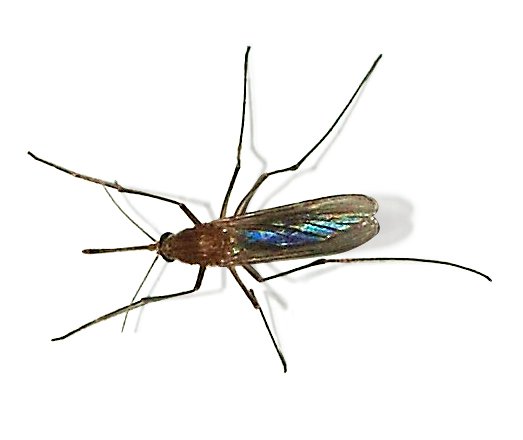
Culex pipiens is the common brown house mosquito you are most likely to meet after dark in temperate regions. It is a plain, medium-sized, dull brown mosquito that breeds in stagnant, dirty water close to where people live. It matters for public health because it is the main mosquito that spreads West Nile virus across northern regions, where it is considered a major vector of disease-causing pathogens [1]. It also carries St. Louis encephalitis virus [1].
How to identify it
Culex pipiens is a plain-looking mosquito, which is part of how you tell it apart from flashier species. Adults are small to medium sized and light brown, with scattered patches of pale scales and wings that measure about 3.5 to 4.0 mm long [1]. The proboscis (the long feeding tube) is dark and unbanded, and each abdominal segment has pale bands at its base rather than showy stripes down the middle [1].
The easiest way to separate it from Aedes mosquitoes is by how it lays eggs. Culex females stick their eggs together into a floating raft of roughly 100 to 300 eggs that looks like a small speck of soot on the water surface, while Aedes and related mosquitoes lay their eggs singly, usually on damp soil rather than on open water [4], [1]. Aedes species (such as the yellow fever and Asian tiger mosquitoes) also tend to be strongly patterned with white markings and are aggressive daytime biters, whereas Culex pipiens is drab and comes out mainly at night.
Where it lives
In North America, Culex pipiens is found across the northern regions and southern Canada, generally in areas above 39 degrees north latitude [1]. Below that band it is gradually replaced by the closely related southern house mosquito, Culex quinquefasciatus [1]. It is common in urban, suburban, and rural settings, and it does well around human activity.
Its larvae favor stagnant water that is rich in organic matter. Typical breeding sites include ponds, roadside ditches, sewage seepage, and water-filled containers such as buckets, rain barrels, and cans [1]. The larvae tolerate water with high levels of organic content, which is why storm drains and street catch basins full of decaying leaves and debris are such productive habitat [1].
Behavior
Culex pipiens is mostly a night biter. It becomes active around dusk and feeds through the night, so most bites happen in the evening and after dark rather than in midday sun. Females need a blood meal to develop eggs and will feed on birds and mammals, including humans [1]. This willingness to bite both birds and people is exactly what makes the species important for disease, because it can pick up a virus from an infected bird and later bite a person.
Unlike many mosquitoes, Culex pipiens survives winter as an adult. A mated female can overwinter in sheltered places such as caves and basements, then emerge to lay eggs when warm weather returns [1]. This overwintering habit is one way West Nile virus can persist locally from one season to the next.
Diseases it can carry
The main concern with Culex pipiens is West Nile virus. West Nile virus circulates in nature between mosquitoes and birds, and people become infected when a mosquito feeds on an infected bird and then bites a person [3]. Culex species are the primary mosquitoes that spread it [2], [3]. People are dead-end hosts, meaning they do not build up enough virus to pass it back to biting mosquitoes [3].
Most people who are infected never feel sick. About 80 percent of those infected develop no symptoms, and roughly 20 percent develop a fever with headache, body aches, joint pain, vomiting, diarrhea, or rash [2]. A small share of infections become severe and can cause inflammation of the brain (encephalitis) or of the membranes around the brain and spinal cord (meningitis), with higher risk for older adults and people with certain medical conditions [2]. There are no licensed vaccines or medicines to prevent West Nile virus in people, so prevention rests on mosquito control and personal protection [3].
Culex pipiens can also transmit St. Louis encephalitis virus, along with other pathogens in various parts of the world [1].
See the [West Nile virus] and [St. Louis encephalitis] disease pages for full detail on symptoms, testing, and risk.
How to control it
Because this mosquito breeds in stagnant water near homes, the most effective step is source reduction: get rid of standing water so larvae have nowhere to grow. Empty, cover, or turn over buckets, rain barrels, cans, old tires, and anything else that holds water, and keep gutters and ditches draining freely. In the absence of a human vaccine, West Nile virus prevention depends on community-level mosquito control together with household and personal protective measures [3].
Some breeding sites cannot simply be drained. Street stormwater catch basins are a major source of Culex pipiens, and mosquito control programs routinely treat them with larvicides such as Bacillus thuringiensis israelensis (Bti), a biological product toxic to mosquito larvae but not to fish, wildlife, or people [5]. For personal protection, use an EPA-registered repellent and wear long sleeves and pants during the evening and nighttime hours when this species is active, and keep window and door screens in good repair [5].
Sources
- University of Florida IFAS, Featured Creatures, “Northern House Mosquito Culex pipiens Linnaeus, 1758” (EENY-765/IN1324). https://ask.ifas.ufl.edu/publication/IN1324 (accessed 2026-07-20). Supports: physical description (small to medium, light brown, dark unbanded proboscis, basal pale abdominal bands, wings 3.5 to 4.0 mm); egg rafts of 150 to 300 eggs; larval habitat in organically rich stagnant water, containers, ditches, and sewage seepage; feeds on birds and mammals including humans; overwinters as a fertilized adult female in caves and basements; distribution above 39 degrees north latitude; transmits West Nile virus and St. Louis encephalitis virus.
- CDC, “About West Nile.” https://www.cdc.gov/west-nile-virus/about/index.html (accessed 2026-07-20; page returned HTTP 403, claims verified from CDC search-result text). Supports: Culex species are the primary vector; about 80 percent of infected people have no symptoms and about 20 percent develop febrile illness; severe cases can cause encephalitis and meningitis; higher risk for older adults.
- CDC, “West Nile: Causes and How It Spreads.” https://www.cdc.gov/west-nile-virus/causes/index.html (accessed 2026-07-20). Supports: transmission cycle between mosquitoes (primarily Culex) and birds; people infected when mosquitoes feed on infected birds then bite people; people are dead-end hosts; no licensed vaccines or medicines; prevention depends on community mosquito control and personal protection.
- American Mosquito Control Association, “Life Cycle.” https://www.mosquito.org/life-cycle/ (accessed 2026-07-20). Supports: Culex lay eggs stuck together in a raft of 100 to 300 eggs that looks like a speck of soot on the water; Aedes lay eggs singly on damp soil.
- CDC, “Guidelines for West Nile Virus Surveillance and Control.” https://www.cdc.gov/west-nile-virus/php/surveillance-and-control-guidelines/ (accessed 2026-07-20). Supports: catch basins as productive larval sites treated with larvicides including Bti; source reduction and personal protective measures (repellent, long sleeves, screens) for prevention.
Related
- [West Nile virus]
- [St. Louis encephalitis]
- [Culex quinquefasciatus (southern house mosquito)]
- [How to get rid of standing water around your home]
- [Aedes vs Culex: how to tell mosquito groups apart]
- [Mosquito larvicides explained]
Educational note: This page is a general reference for identification and public health awareness. It is not medical advice. If you have symptoms of a mosquito-borne illness, contact a healthcare provider, and for local mosquito problems contact your county or regional mosquito control program.
Last reviewed 20 July 2026.