The short answer
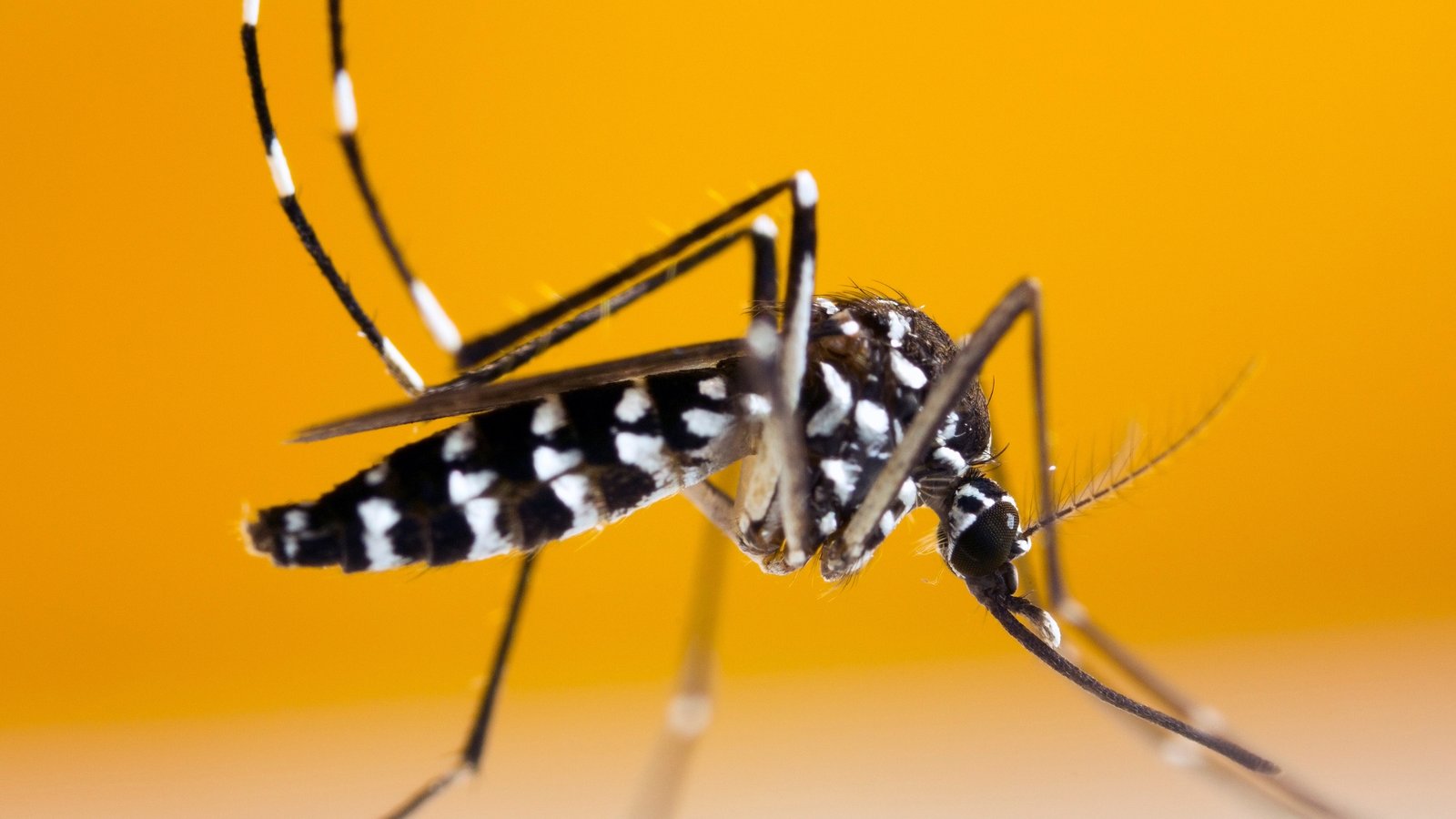
Aedes is the genus of mosquito most people picture when they think of a biting mosquito in a backyard or on a porch. Several members are boldly patterned in black and white, they tend to bite during the day rather than only at dusk, and they are aggressive, persistent feeders. What sets the genus apart biologically is the egg. Instead of dropping eggs onto open water, an Aedes female lays them one at a time on damp surfaces just above the waterline, in a container or a low spot that is likely to flood later. Those eggs can survive drying out for months and hatch only when water rises to cover them. That single habit is why Aedes species are so common around homes and so hard to control.
Shared identification traits
No single feature names every Aedes, but a few show up again and again.
- Patterned bodies. Many of the best known Aedes are dark with contrasting white or silver scales. Aedes aegypti carries white scales on top of the thorax arranged in the shape of a violin or lyre. Aedes albopictus wears a single bright white stripe running down the center of the head and thorax.
- Banded legs. The legs are dark with pale bands of white scales at the base of each tarsal (foot) segment, giving a striped look. This banding is one of the quickest field cues.
- Pointed abdomen tip. In the Culicinae, Aedes and its relative Psorophora have a tapered, pointed abdomen, while Culex and Culiseta females have a blunt, rounded tip. In Aedes and Psorophora females the cerci protrude from the end, adding to the pointed shape.
- Small to medium size. Aedes aegypti runs roughly 4 to 7 mm; Aedes albopictus adults are small mosquitoes with bold black and silver-white scaling.
Egg and breeding strategy
The Aedes egg is the heart of the story. Females do not lay on the water surface. They deposit eggs singly on damp surfaces in places likely to flood later, such as tree holes and man-made containers, and they place them at varying heights above the current waterline. A single female may lay in the range of 100 to 200 eggs per batch and produce several batches in her life.
Once laid, the eggs can survive drying out. Aedes aegypti eggs can survive desiccation for months and hatch once they are submerged. Aedes albopictus eggs can withstand desiccation for up to a year, and flooding with low-oxygen water is part of what triggers hatching. Floodwater species such as Aedes vexans follow the same logic outdoors, laying on moist soil above the waterline in ditches, depressions, and floodplains, then waiting for rain or rising water to hatch.
This is exactly what makes the genus hard to control. Eggs sit dormant and dry through inhospitable weeks or months, invisible on the walls of a bucket, a tire, a birdbath, or a clogged gutter. A single rain or a refilled container can trigger a hatch. Because the eggs tolerate drying, they also travel well, which is part of how container species have spread through shipments of used tires and other goods. Dumping standing water and scrubbing container walls matters more than spraying, because the eggs above the current waterline are the reservoir.
Behavior
Many Aedes bite during daylight. Aedes aegypti readily bites during the day, indoors and out, and feeds primarily on people. Aedes albopictus feeds most in the early morning and late afternoon and is an opportunistic, aggressive biter with a wide host range that includes humans, domestic animals, and wildlife. That daytime activity is one reason Aedes bites are so noticeable: they happen while people are outdoors and active, not just at dusk. Host range varies by species, from the strongly human-focused Aedes aegypti to generalists that feed on many mammals and birds.
Key US Aedes species
The genus is large, but a handful of species account for most of the mosquitoes people encounter and most of the disease concern.
- Aedes aegypti, the yellow fever mosquito. A dark container-breeder with lyre-shaped thoracic markings that prefers to bite people and lives closely with humans. Primary vector of yellow fever, dengue, Zika, and chikungunya. (See the Aedes aegypti species page.)
- Aedes albopictus, the Asian tiger mosquito. Marked by a single white stripe down the thorax, an aggressive daytime biter with a very wide host range and a strong ability to invade new regions. (See the Aedes albopictus species page.)
- Aedes vexans, the inland floodwater mosquito. A widespread pest that lays on damp soil in flood-prone ground and can emerge in large numbers after rain or flooding. (See the Aedes vexans species page.)
- Others worth knowing. Aedes triseriatus, the eastern treehole mosquito, breeds in water-filled tree cavities and is the primary vector of La Crosse virus, a leading cause of pediatric arboviral encephalitis in the region. Aedes sollicitans, the eastern saltmarsh mosquito, is a strong-flying coastal pest and a vector of Eastern equine encephalitis. (See the Aedes triseriatus and Aedes sollicitans species pages.)
Disease relevance
Aedes matters to public health mainly through two container species. Aedes aegypti and Aedes albopictus are the principal vectors of dengue and chikungunya, and they are the same mosquitoes that spread Zika virus. Aedes aegypti is also the primary vector of yellow fever. These mosquitoes bite during the day, need only small amounts of standing water to breed, and are difficult to eradicate, which is why control focuses so heavily on removing container habitat.
Not every Aedes is a major human-disease vector. Aedes albopictus is a competent laboratory vector of many viruses but is generally a less efficient vector in the field than Aedes aegypti. Other species carry their own concerns: Aedes triseriatus with La Crosse virus and Aedes sollicitans with Eastern equine encephalitis. For details on any specific pathogen, see the linked disease pages.
Sources
- University of Florida IFAS Featured Creatures, “Yellow Fever Mosquito Aedes aegypti (Linnaeus)” (EENY-434/IN792). Identification (violin or lyre-shaped thoracic scales, pale leg bands, 4 to 7 mm size), single eggs laid above the waterline in containers, desiccation-resistant eggs, 100 to 200 eggs per batch, daytime and indoor human biting, vector of yellow fever, dengue, Zika, chikungunya. https://ask.ifas.ufl.edu/publication/IN792 (accessed 2026-07-20)
- University of Florida IFAS Featured Creatures, “Asian Tiger Mosquito, Aedes albopictus (Skuse)” (EENY-319/IN594). White stripe down head and thorax, white basal leg bands, eggs laid singly on container walls, desiccation resistance up to one year, low-oxygen flooding stimulates hatching, early-morning and late-afternoon aggressive biting with wide host range, competent but less efficient vector. https://ask.ifas.ufl.edu/publication/IN594 (accessed 2026-07-20)
- University of Florida IFAS Featured Creatures, “Eastern Treehole Mosquito Aedes triseriatus (Say, 1823)” (EENY-830/IN1473). Larvae develop in water-filled tree holes; primary vector of La Crosse virus, a leading cause of pediatric arboviral encephalitis in North America. https://ask.ifas.ufl.edu/publication/IN1473 (accessed 2026-07-20)
- CDC, “How Dengue Spreads.” Dengue viruses spread through bites of infected Aedes species (Ae. aegypti or Ae. albopictus), the same mosquitoes that spread Zika and chikungunya; these mosquitoes bite during the day. https://www.cdc.gov/dengue/transmission/index.html (accessed 2026-07-20)
- CDC Emerging Infectious Diseases, “Public Health Response to Aedes aegypti and Ae. albopictus Mosquitoes Invading California, USA” (Vol. 21, No. 10, 2015). Ae. aegypti and Ae. albopictus as principal vectors of dengue and chikungunya; daytime biters that need only small water containers and are difficult to eradicate. https://wwwnc.cdc.gov/eid/article/21/10/15-0494_article (accessed 2026-07-20)
- Rutgers Center for Vector Biology, “Aedes sollicitans (Walker).” Eastern saltmarsh mosquito, major coastal pest and vector of Eastern equine encephalitis. https://vectorbio.rutgers.edu/outreach/species/sp7.htm (accessed 2026-07-20)
- LSU AgCenter, “Aedes vexans, Inland Floodwater Mosquito.” Eggs laid individually on moist soil above the waterline in flood-prone habitats; must dry and then be flooded to hatch; eggs remain viable through drought. https://www.lsuagcenter.com/articles/page1757604977696 (accessed 2026-07-20)
- New Mexico Department of Health, “Classification and Identification of Mosquitoes of New Mexico.” Aedes and Psorophora have pointed abdomens with protruding cerci, while Culex and Culiseta have blunt abdomens. https://www.nmhealth.org/publication/view/guide/986/ (accessed 2026-07-20)
Related
- Aedes aegypti (yellow fever mosquito) [species page, placeholder]
- Aedes albopictus (Asian tiger mosquito) [species page, placeholder]
- Aedes vexans (inland floodwater mosquito) [species page, placeholder]
- Aedes triseriatus (eastern treehole mosquito) [species page, placeholder]
- Aedes sollicitans (eastern saltmarsh mosquito) [species page, placeholder]
Educational note: This page is a general reference for identifying and understanding mosquitoes. It is not medical advice or a pest-control treatment plan. For a suspected disease exposure, contact a clinician or your local health department. For control questions, contact your local mosquito control district.
Last reviewed 20 July 2026.