The short answer
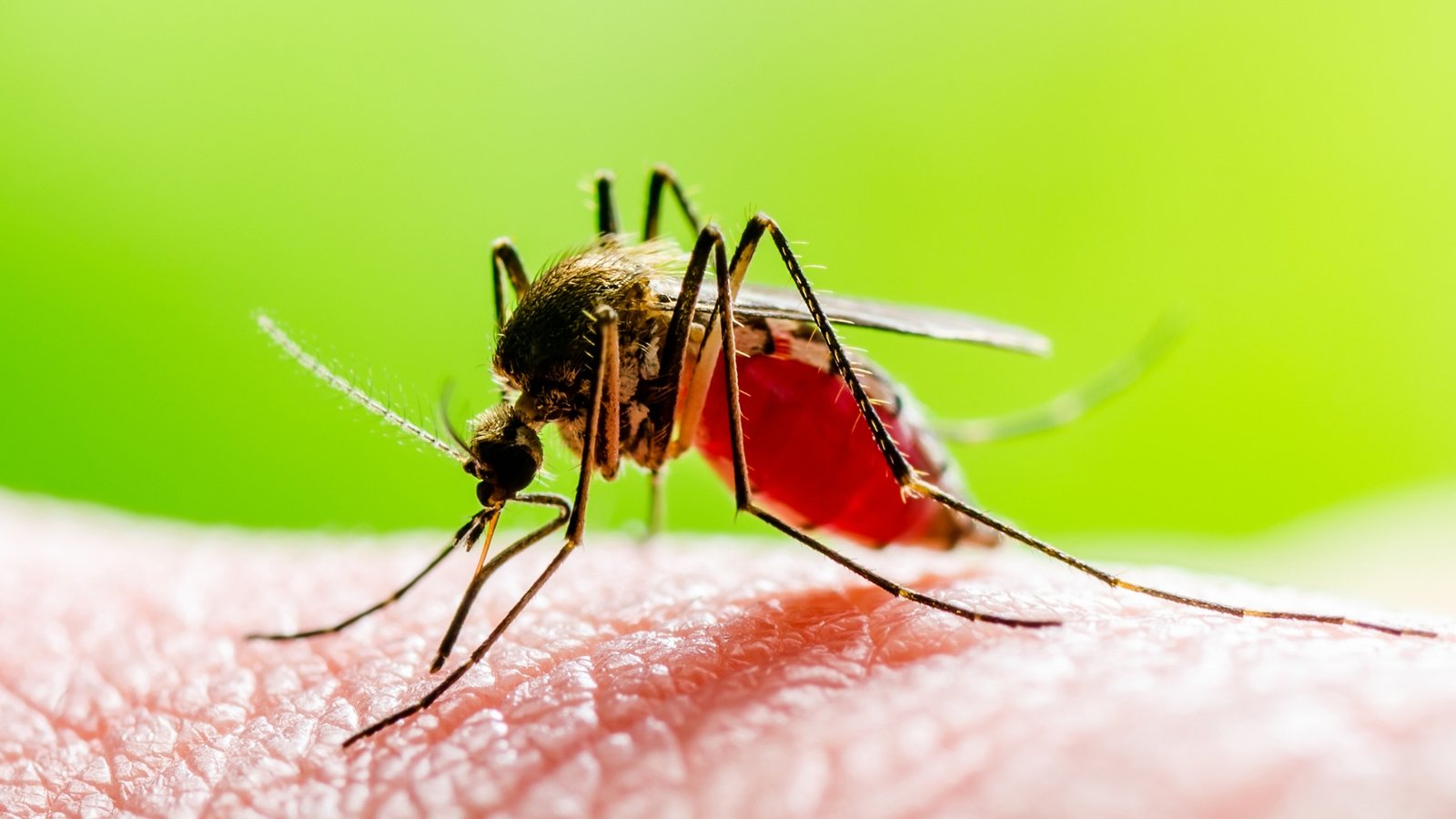
A mosquito is not born carrying disease. It becomes infectious only after two things happen in order. First, a female mosquito bites a host (a person, bird, or other animal) that already has a pathogen circulating in its blood. Second, that pathogen survives and multiplies inside the mosquito for a period of days before the mosquito can pass it on at a later bite.
Two facts drive everything that follows. Only female mosquitoes bite, because only females take blood. And a mosquito can only spread a germ it picked up earlier from an infected host. A mosquito that has never fed on an infected host cannot give you a disease, no matter how many times it bites.
Why only females bite
Male mosquitoes never bite. Both males and females feed on plant nectar and sap for their own energy. The blood meal is different. A female needs the protein and iron in blood to develop her eggs, so she seeks out a host only when she is preparing to reproduce. Because biting is tied to egg production, the entire disease-transmission story runs through the female mosquito and her search for blood.
This is also why blood feeding is repeated. A female may take several blood meals over her life as she produces successive batches of eggs, and each bite is another chance for her either to pick up a pathogen or to pass one on.
The step-by-step
Transmission is a sequence, not a single event.
-
The mosquito bites an infected host. A female feeds on a person or animal whose blood contains a virus or parasite. She draws that pathogen into her gut along with the blood.
-
The pathogen multiplies inside the mosquito. The germ has to survive the mosquito’s digestive environment, infect the cells lining her midgut, spread out through her body, and finally reach her salivary glands. Only once the pathogen has reached the salivary glands can it be injected into the next host.
-
The extrinsic incubation period passes. This internal journey takes time, usually somewhere between about a week and two weeks depending on the pathogen and the temperature. Entomologists call this waiting time the extrinsic incubation period. For dengue virus the interval is roughly 8 to 12 days at typical warm temperatures. For the malaria parasite, development inside the mosquito takes about 9 to 18 days. Warmer conditions generally speed this up; the mosquito also has to live long enough for the process to finish.
-
The mosquito injects saliva at the next bite. When the now-infectious female bites again, she first injects a little saliva into the skin. Mosquito saliva contains compounds that keep blood flowing while she feeds, and for an infected mosquito that saliva also carries the pathogen. The germ is delivered through the saliva, not through the blood the mosquito removes.
That last point is worth restating. Disease is passed in on the way in, through saliva, at the start of a bite, which is why the pathogen the mosquito picked up days earlier is what matters.
The transmission cycles
Different diseases move through different loops between animals and mosquitoes.
Bird to mosquito to bird. West Nile virus and the encephalitis viruses are maintained in nature by a cycle between mosquitoes and birds. For West Nile virus, Culex mosquitoes bite infected birds, and after about a week those mosquitoes can pass the virus to more birds. Eastern equine encephalitis virus is kept going in a similar loop between the mosquito Culiseta melanura and birds in freshwater swamps. Birds are the reservoir that keeps the virus circulating.
Human to mosquito to human. Dengue, Zika, chikungunya, and malaria run through people. Here humans are the reservoir. A mosquito (Aedes aegypti or Aedes albopictus for the viruses, Anopheles for malaria) bites an infected person while the pathogen is in that person’s blood, then passes it to the next person days later. Because Aedes aegypti lives near homes and prefers to feed on people, it is an especially efficient link in this chain. For dengue, a person can be infectious to mosquitoes from about 2 days before symptoms start until about 2 days after fever resolves.
Dead-end hosts. Some animals can be infected but cannot pass the germ onward. For West Nile and eastern equine encephalitis, people and horses are dead-end hosts. They can get sick, sometimes severely, but they do not build up enough virus in their blood to infect a mosquito that bites them. So they catch these viruses but never re-seed the cycle. Reaching people and horses usually requires a bridge mosquito species that feeds on both birds and mammals.
Why not every mosquito or bite transmits disease
Most mosquitoes carry nothing, and most bites transmit nothing. Several things have to line up.
- The mosquito has to have fed on an infected host first. A bite from an uninfected mosquito cannot give you a disease.
- Species matters. Of the thousands of mosquito species, only a limited set can carry any given pathogen. Whether a species can transmit a particular germ is called its vector competence.
- The pathogen has to clear internal barriers. Inside the mosquito the germ faces a series of tissue barriers: it must infect the midgut, escape the midgut, then infect and escape the salivary glands. If a mosquito’s biology blocks the germ at any of these steps, that mosquito cannot pass it on even after biting an infected host.
- Timing has to work out. The extrinsic incubation period must finish, and the mosquito has to survive that long and then bite again.
Because all of these have to align, the presence of mosquitoes in an area is not the same as the presence of disease.
What this means for prevention
The mechanism points straight at the defenses that work. Since transmission depends on being bitten, preventing bites prevents infection.
- Use an EPA-registered insect repellent and follow the label.
- Wear loose, long-sleeved clothing when mosquitoes are active.
- Use window and door screens to keep mosquitoes out of living spaces.
- Empty and scrub, cover, or throw out containers that hold standing water at least once a week, because that is where mosquitoes lay eggs. Fewer breeding sites means fewer mosquitoes.
None of these require knowing whether a given mosquito is infected. They lower the number of bites and the number of mosquitoes, which is what breaks the transmission chain.
Sources
- CDC, “Mosquito-borne Transmission” (Dengue clinician training), https://www.cdc.gov/dengue/training/cme/ccm/page45915.html. Accessed 20 July 2026. Supports: pathogen replicates in the mosquito midgut then disseminates to the salivary glands, and the extrinsic incubation period.
- CDC, “How Dengue Spreads,” https://www.cdc.gov/dengue/transmission/index.html. Accessed 20 July 2026. Supports: humans as the source of virus for mosquitoes, dengue extrinsic incubation period of about 8 to 12 days, and infectious window of about 2 days before symptoms to 2 days after fever resolves.
- CDC, “How Malaria Spreads,” https://www.cdc.gov/malaria/causes/index.html. Accessed 20 July 2026. Supports: only female Anopheles mosquitoes transmit malaria, blood meal needed for eggs, about a week before the mosquito is infective, parasite development of about 9 to 18 days, and injection of parasites via saliva.
- CDC, “Transmission of West Nile Virus,” https://www.cdc.gov/west-nile-virus/php/transmission/index.html. Accessed 20 July 2026. Supports: bird-mosquito-bird cycle with Culex species, about a week before an infected mosquito can transmit, and humans and horses as dead-end hosts.
- CDC, “Transmission of Eastern Equine Encephalitis Virus,” https://www.cdc.gov/eastern-equine-encephalitis/php/transmission/index.html. Accessed 20 July 2026. Supports: Culiseta melanura and birds in freshwater swamps, bridge mosquito species to reach mammals, and humans and horses as dead-end hosts.
- CDC, “How Zika Spreads,” https://www.cdc.gov/zika/causes/index.html. Accessed 20 July 2026. Supports: Zika spread by Aedes aegypti and Aedes albopictus, human infectious to mosquitoes mainly through the first week of infection.
- CDC, “Transmission of Chikungunya Virus,” https://www.cdc.gov/chikungunya/php/transmission/index.html. Accessed 20 July 2026. Supports: chikungunya spread mainly by Aedes aegypti and Aedes albopictus.
- CDC, “Life Cycle of Anopheles Mosquitoes,” https://www.cdc.gov/mosquitoes/about/life-cycle-of-anopheles-mosquitoes.html. Accessed 20 July 2026. Supports: female mosquitoes take blood meals for egg production; males and females otherwise feed on plant sugars.
- “The making of a dangerous vector: factors shaping the vector competence of Aedes mosquitoes,” PMC, https://pmc.ncbi.nlm.nih.gov/articles/PMC12623374/. Accessed 20 July 2026. Supports: vector competence defined by how efficiently a virus overcomes midgut and salivary gland barriers, and that most species do not serve as vectors.
- “Tissue Barriers to Arbovirus Infection in Mosquitoes,” PMC, https://pmc.ncbi.nlm.nih.gov/articles/PMC4517124/. Accessed 20 July 2026. Supports: the midgut infection barrier, midgut escape barrier, salivary gland infection barrier, and salivary gland escape barrier a pathogen must cross.
- CDC, “Preventing Mosquito Bites,” https://www.cdc.gov/mosquitoes/prevention/index.html. Accessed 20 July 2026. Supports: EPA-registered repellent, long-sleeved clothing, window and door screens, and removing standing water weekly.
- EPA, “Using Repellent Products to Protect against Mosquito-Borne Illnesses,” https://www.epa.gov/insect-repellents/using-repellent-products-protect-against-mosquito-borne-illnesses. Accessed 20 July 2026. Supports: EPA-registered repellents used as directed are proven safe and effective.
Related
- What diseases do mosquitoes carry in the US? [placeholder]
- West Nile virus: symptoms, risk, and prevention [placeholder]
- Dengue in the US: where it spreads and how to avoid it [placeholder]
- Which mosquito species are disease vectors? [placeholder]
- How to prevent mosquito bites [placeholder]
- Do all mosquitoes carry disease? [placeholder]
This page is an independent, non-commercial reference and is for general education only. It is not medical advice. For diagnosis, treatment, or guidance about your health, consult a qualified healthcare professional or your local health department.
Last reviewed 20 July 2026.