The short answer
Methoprene is an insect growth regulator (IGR) that stops mosquito larvae from becoming biting adults. It is a larvicide, which means it is added to the standing water where young mosquitoes live rather than sprayed at flying adults. Instead of poisoning the larvae outright, methoprene interferes with the hormones that control their development, so the immature mosquitoes never complete the change into adults and die before they can bite or breed (NPIC 1; CDC 3).
Mosquito control programs use methoprene widely, often alongside or as an alternative to Bti (Bacillus thuringiensis subspecies israelensis), a bacterial larvicide. The two products attack the same stage of the mosquito’s life in different ways, so they are frequently discussed together.
How it works
Every mosquito passes through egg, larva, pupa, and adult stages. Juvenile hormone is the natural signal that keeps an insect in its immature form; when the hormone level falls at the right moment, the insect molts and matures. Methoprene mimics that juvenile hormone. Because it keeps the hormone signal artificially switched on, the larva cannot make the normal transition to the adult stage (NPIC 1).
In practice this means the treated mosquitoes typically die in the pupal stage and never emerge as adults. As the CDC describes it, methoprene “mimics an insect hormone to prevent immature insects from shedding its exoskeleton and emerging into adults,” so that “unable to develop into adults, the mosquitoes die in the pupal stage” (CDC 3). The EPA classifies methoprene as an insect growth regulator that “interferes with insect growth and development” and can prevent normal molting and development from the immature phase to the adult phase (NPIC 1; EPA 2).
This is the key difference from a contact or ingestion killer. Bti works by producing proteins that a feeding larva eats, which then damage its gut and kill it fairly quickly. Methoprene does not kill on contact the same way. It works slowly and only becomes apparent when the pupae fail to emerge, which is why a treated pool can still contain living larvae for a while before the effect shows.
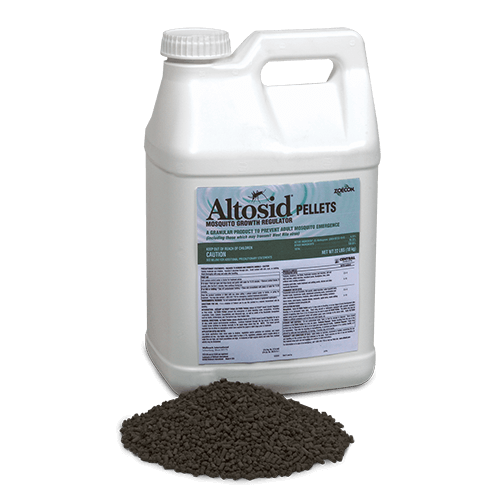
Methoprene larvicide granules, one of several slow-release formulations used to treat standing water.
Does it work
Methoprene is an effective larvicide for standing water and is a standard tool for organized mosquito control. Slow-release formulations are designed to keep releasing the active ingredient over weeks rather than acting all at once. NPIC notes that in briquette form, full breakdown of methoprene has been reported to take up to about 18 months, which is why briquets are marketed for long-lasting sites (NPIC 1).
Field evaluations bear out the multi-week performance. In a study of methoprene formulations used in roadside catch basins, control was measured across different products, with pellets reapplied on a roughly four-week cycle providing significantly more effective control than the longer-interval formulations in that setting (Catch basin evaluation 4). The same work notes the scale of routine use: one abatement district applied larvicides to roughly 40,000 catch basins each year from June through September to suppress the Culex mosquitoes tied to West Nile virus (Catch basin evaluation 4). Both the EPA and CDC emphasize controlling mosquitoes at the larval, water-based stage, before they emerge as flying, biting adults (CDC 3).
One practical caveat: because methoprene targets development rather than killing on contact, timing and coverage matter. It needs to be present in the water while larvae are still developing, so re-treatment schedules follow the label and the local breeding cycle.
How it is used
Methoprene is sold in several slow-release solid forms so it can be matched to the water body being treated (NPIC 1; EPA 2):
- Pellets and granules that are broadcast or dropped into water and release the active ingredient over roughly a month.
- Briquets (sometimes called dunks or tablets) designed for longer-term sites, releasing over many weeks to months.
Typical treatment sites include storm drains and roadside catch basins, ornamental ponds and fountains, and smaller standing water such as rain barrels and containers that hold water. It is used especially where high concentrations of larvae collect, such as storm drains, neglected swimming pools, and some flooded irrigation (CDC 3; Catch basin evaluation 4). The correct dose depends on the surface area or volume of water and is set by the product label.
Safety
Methoprene is registered by the EPA for these uses, and its reregistration review supported continued registration as a larvicide (EPA 2). At label rates it has low toxicity to people and other mammals. NPIC reports that methoprene is broken down and eliminated quickly in the body and that it is low in acute toxicity; the CDC states that, when used according to product label instructions, larvicides “do not harm people, pets, or the environment” (NPIC 1; CDC 3).
The main environmental caution is for aquatic life. Laboratory testing shows methoprene can be moderately toxic to some fish and, importantly, “very highly toxic to freshwater invertebrates” (NPIC 1). Because larvicide is applied directly into water, this matters for ponds and other habitats that support non-target aquatic insects and crustaceans. The practical takeaway is the same one printed on the container: follow the label, use only the labeled dose for the site, and do not treat water bodies the label excludes.
Methoprene vs Bti
Both methoprene and Bti are larvicides that stop mosquitoes at the immature stage, and both are widely used, but they act differently. Bti is a naturally occurring soil bacterium whose proteins kill larvae that eat them, usually within a day or two. Methoprene is a juvenile hormone mimic that prevents larvae from ever maturing, so the effect shows up later, at the pupal stage. Programs sometimes rotate or combine the two, in part to manage the risk of resistance. For a full side-by-side, see the comparison page.
Sources
- National Pesticide Information Center (NPIC), “Methoprene General Fact Sheet.” Mechanism as an insect growth regulator and juvenile hormone mimic, formulations and briquette persistence, and toxicity to humans and to freshwater invertebrates. https://npic.orst.edu/factsheets/methogen.html (accessed 2026-07-20).
- U.S. Environmental Protection Agency, “Methoprene R.E.D. (Reregistration Eligibility Decision) Fact Sheet,” June 2001 update. Registration status, insect growth regulator mode of action, and solid larvicide formulations. https://www3.epa.gov/pesticides/chem_search/reg_actions/reregistration/fs_PC-105401_1-Jun-01.pdf (accessed 2026-07-20).
- Centers for Disease Control and Prevention (CDC), “Larvicides.” How methoprene mimics an insect hormone so larvae die in the pupal stage, application sites for standing water, and the label-safety statement. https://www.cdc.gov/mosquitoes/mosquito-control/larvicides.html (accessed 2026-07-20; page returned HTTP 403 on direct fetch, quoted text from search-result excerpt of the same URL).
- “An Operational Evaluation of 3 Methoprene Larvicide Formulations for Use Against Mosquitoes in Catch Basins,” PubMed Central. Multi-week efficacy of pellet, granule, and briquet formulations and the scale of routine catch-basin larviciding. https://pmc.ncbi.nlm.nih.gov/articles/PMC5824906/ (accessed 2026-07-20).
Related
- Larval source control overview [placeholder]
- Bti (Bacillus thuringiensis israelensis) [placeholder]
- Methoprene vs Bti comparison [placeholder]
- Standing water and mosquito breeding sites [placeholder]
Educational note: This page is a general reference and is not pesticide-use guidance. Always read and follow the product label, and consult your local mosquito control or health authority for treatment decisions in your area.
Last reviewed 20 July 2026.