The short answer
BTI and methoprene are two of the most widely used mosquito larvicides, and they do the same job in very different ways. Both are applied to standing water to stop mosquitoes before they become biting, disease-carrying adults (3). Neither one touches the adults already flying in your yard.
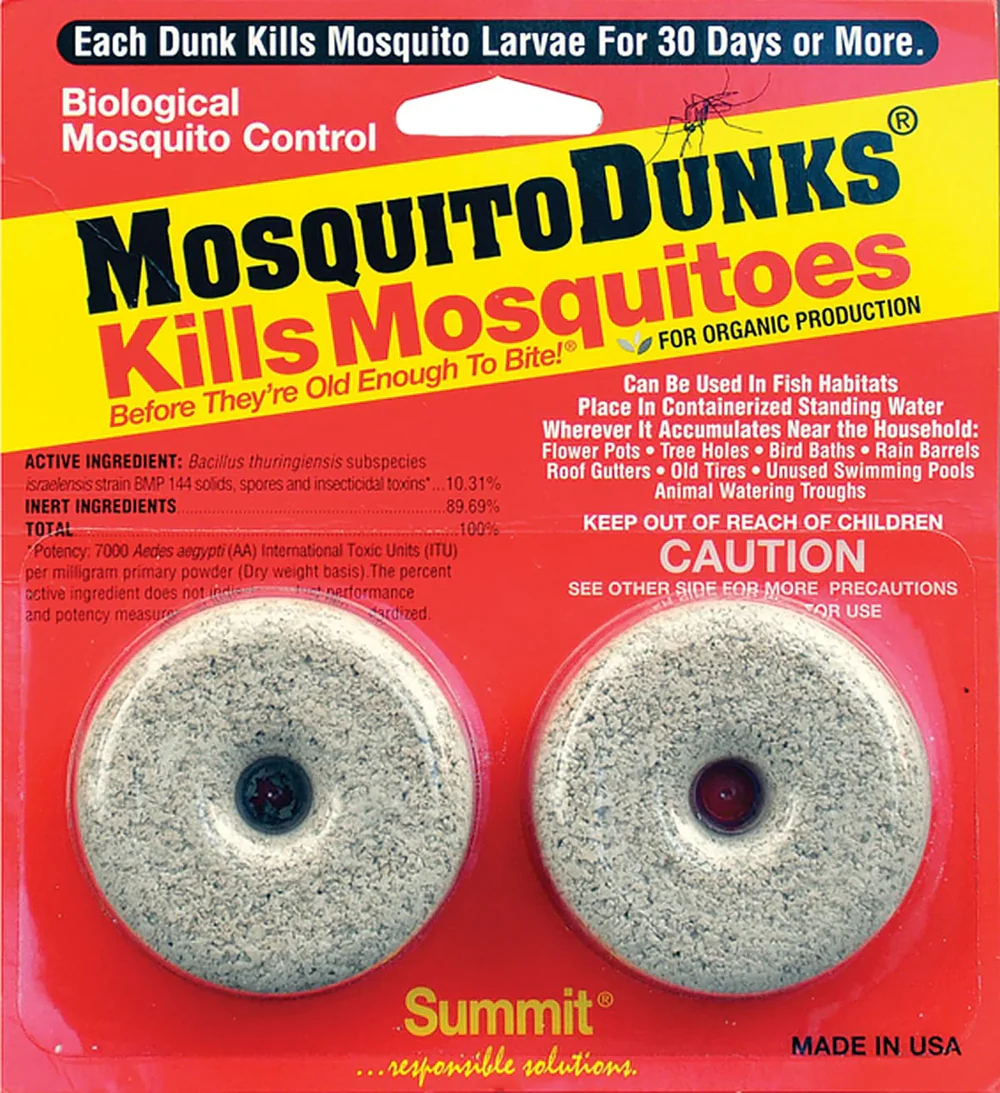
BTI (Bacillus thuringiensis subspecies israelensis) is a naturally occurring soil bacterium. Larvae eat it, a toxin acts on their gut, and they stop feeding and die, often within a short time of ingestion (1, 3, 5). Methoprene is a synthetic insect growth regulator that mimics a natural insect hormone. It does not poison larvae outright. Instead it disrupts their development so that they never molt into functioning adults (2, 3).
The short version: BTI is a fast-acting bacterial toxin that kills young, actively feeding larvae. Methoprene is a slower-acting growth regulator that lets larvae keep developing but prevents them from emerging as adults. BTI usually works over days; extended-release methoprene formulations can hold for weeks to months. Each has a place, and mosquito programs often rotate the two to slow resistance.
How each works
BTI works as a stomach toxin, not a contact poison, so it has to be eaten to work (1). A BTI product carries protein crystals produced by the bacterium. When a larva ingests them, the crystals dissolve in the alkaline environment of the larval midgut and are activated by gut enzymes. The activated Cry and Cyt toxins bind to receptors on the cells lining the midgut, punch pores in those cells, and destroy the gut wall, which kills the larva (4). State health agencies describe the practical result plainly: the toxins are released into the gut, the larvae stop eating, and they die (5). Because the toxins are specific to receptors found in a narrow group of flies, BTI affects the larvae of mosquitoes, black flies, and fungus gnats and little else (1).
Methoprene works on the insect’s own control system rather than its gut. It is a juvenile hormone analog: it imitates the hormone that keeps an insect in its immature form. By flooding the larva with that false signal at the wrong time, methoprene interferes with normal molting and prevents development from the immature stage to the adult stage (2, 3). It does not kill the larva on contact. A treated larva can look and behave normally for a while, then simply fail to complete the transition to a flying adult (2). The manufacturer of one common methoprene product states the effect directly: it prevents the emergence of adult mosquitoes but does not affect mosquitoes that have already reached the pupal or adult stage (6).
Speed and timing
Speed is the clearest difference between the two.
BTI acts fast, but only on the right target. It is most effective against young, actively feeding larvae, and it works quickly once ingested (3, 5). The tradeoff is a narrow window. Late-stage larvae feed less and are harder to kill, and once larvae stop feeding to become pupae, BTI no longer reaches them because pupae do not eat (3, 5). BTI also breaks down quickly in the environment, so its control is short-lived and often has to be reapplied. Depending on the formulation and site conditions, a BTI treatment may stay effective anywhere from about a day to more than a month, with granular and briquette forms lasting longer than sprays (5).
Methoprene acts more slowly but across a wider slice of development. Because it works on the molt into adulthood rather than on active feeding, it can still act on later-stage larvae that BTI tends to miss, and its endpoint is the failure of the adult to emerge (2, 6). Its residual life depends heavily on formulation. Standard methoprene briquettes are labeled for up to 30 days of control in standing water, and extended-release briquettes for up to 150 days from a single application (6). Those are label maximums under favorable conditions; field studies of larvicide residual have found that real-world control from a single application can be considerably shorter than laboratory or label figures for both BTI and methoprene (8).
Safety and non-target effects
Both products are registered by the EPA and are considered low-risk to people when used as directed, but they differ in how they touch other water life.
BTI has one of the most favorable non-target profiles of any larvicide. The EPA states that BTI has no toxicity to people and is approved for use in organic farming, and that its toxins do not affect other types of insects, including honey bees (1). Its activity is essentially limited to the larvae of mosquitoes, black flies, and a few related flies such as midges (1, 5).
Methoprene is also low in toxicity to people, with acute exposure causing at most mild skin, eye, or lung irritation, and it is not expected to contribute to cancer; it is relatively non-toxic to birds (2). The important caveat is aquatic life. According to the National Pesticide Information Center, methoprene is very highly toxic to some freshwater invertebrates, slightly toxic to crustaceans such as shrimp and crayfish, and moderately toxic to some fish, and it can accumulate in fish tissue (2). Because methoprene mimics a developmental hormone shared across many arthropods, non-target crustaceans and aquatic insects are a more realistic concern for methoprene than for BTI. Both products should be applied only where mosquitoes are actually breeding, and the product label is the legal instruction for where and how much to use.
Comparison table
| BTI | Methoprene | |
|---|---|---|
| Type | Naturally occurring soil bacterium (1) | Synthetic insect growth regulator / juvenile hormone mimic (2, 3) |
| Mode of action | Stomach toxin: eaten by larvae, destroys the midgut wall (1, 4, 5) | Hormonal disruptor: blocks development into an adult (2, 3) |
| Speed | Fast once ingested (3, 5) | Slow; larva fails to emerge as an adult later (2, 6) |
| Target stages | Young, actively feeding larvae; not pupae or adults (3, 5) | Larvae, preventing adult emergence; not existing pupae or adults (6) |
| Residual life | About 1 day to over a month, by formulation (5) | Up to 30 days (standard) or up to 150 days (extended-release briquettes) on the label (6) |
| Non-target effects | Very narrow: mosquito, black fly, fungus gnat larvae; not honey bees (1) | Toxic to some aquatic invertebrates, crustaceans, and fish; can accumulate in fish (2) |
| Best use | Quick knockdown of a young larval population in water you check often (3, 5) | Longer-term prevention in standing water you cannot revisit frequently (6) |
Which to choose, or rotate
For most homeowners the choice comes down to how often you can revisit the water. If you can check and re-treat a container every week or two, BTI is a strong, low-impact choice that acts fast on young larvae. If the water is somewhere you will not get back to, such as a catch basin, an out-of-the-way pool, or a large ornamental feature, an extended-release methoprene formulation can prevent adult emergence for far longer from a single application. In sensitive aquatic settings with fish or crustaceans, BTI’s narrow non-target profile is a point in its favor.
For mosquito control programs, the more important question is not which one but how to use both without breeding resistance. Because BTI and methoprene have entirely different modes of action, they are well suited to rotation: guidance for professional programs recommends alternating larvicides with distinct molecular targets, and lists BTI and S-methoprene among the products that are ideal to rotate for exactly this reason (7). One caution worth knowing: methoprene should not be alternated with another juvenile hormone analog such as pyriproxyfen, because they share a mode of action and resistance to one can carry over to the other (7). If a population starts to show resistance to methoprene, switching to BTI for several generations is a common way to restore susceptibility (7).
If you want the details on each product on its own, see the method pages for BTI mosquito dunks and methoprene as an insect growth regulator.
Sources
- US EPA, “Bti for Mosquito Control” (BTI is a naturally occurring soil bacterium; spores produce toxins that specifically target and only affect the larvae of the mosquito, black fly, and fungus gnat; not a contact poison and must be eaten to work; no toxicity to people and approved for organic farming; toxins do not affect other insects including honey bees; EPA has registered five strains of BTI in dozens of products). https://www.epa.gov/mosquitocontrol/bti-mosquito-control (accessed 2026-07-20).
- National Pesticide Information Center, “Methoprene General Fact Sheet” (methoprene acts like an insect hormone and interferes with insect growth and development; prevents normal molting and development from the immature to the adult phase; does not kill directly; very highly toxic to some freshwater invertebrates; slightly toxic to crustaceans such as shrimp and crayfish; moderately toxic to some fish and can accumulate in fish tissue; relatively non-toxic to birds; acute human exposure causes at most mild irritation; not expected to contribute to cancer; first registered in 1975). https://npic.orst.edu/factsheets/methogen.html (accessed 2026-07-20).
- CDC, “Larvicides” (larvicides reduce populations of mosquito larvae before they become biting adults; BTI is eaten by the mosquito larva and becomes highly toxic to it, killing within a short time after ingestion; BTI is effective against the early stages of larvae and does not affect eggs, mature larvae, pupae, or adults; methoprene is a synthetic juvenile growth hormone mimic that, applied to water, prevents mosquito larvae from metamorphosing into adults). https://www.cdc.gov/mosquitoes/mosquito-control/larvicides.html (accessed 2026-07-20).
- Silva-Filha, Romao, Nielsen-LeRoux, et al., “Bacterial Toxins Active against Mosquitoes: Mode of Action and Resistance,” Toxins 13(8):523, 2021 (BTI crystal protoxins are solubilized in the alkaline larval midgut and activated by proteases; Cry and Cyt toxins bind receptors on midgut cells, form pores, and destroy the midgut epithelium; the multi-toxin mode of action carries a low risk of resistance). https://www.mdpi.com/2072-6651/13/8/523 (accessed 2026-07-20).
- Washington State Department of Health, “Mosquito Larvicide – Bti” (spores eaten by larvae release toxins into the gut so larvae stop eating and die; effective only against actively feeding larvae and does not affect pupae or adults; available in liquid, briquette, and granular forms; may remain effective from about 24 hours to over one month depending on formulation; breaks down quickly and may need reapplication; nontoxic to mammals, birds, and fish). https://doh.wa.gov/community-and-environment/pests/mosquitoes/bti (accessed 2026-07-20).
- Central Life Sciences / Zoecon, “Altosid Mosquito Larvicide” product information for (S)-methoprene (Altosid Briquets provide up to 30 days of residual control in standing water; Altosid XR Extended Residual Briquets release (S)-methoprene for up to 150 days from a single application; the product prevents the emergence of adult mosquitoes but does not affect mosquitoes that have reached the pupal or adult stage). https://www.centralmosquitocontrol.com/all-products/altosid (accessed 2026-07-20).
- Rutgers / New Jersey Department of Environmental Protection, “Insecticides Recommended for Mosquito Control in New Jersey” (the major recommended larvicides, including S-methoprene and BTI, are ideal for rotation because each has low environmental stability, a separate molecular mode of action, and different detoxification mechanisms; S-methoprene and pyriproxyfen should not be alternated because they share a juvenile hormone mode of action and show cross-resistance). https://dep.nj.gov/wp-content/uploads/njfw/insecticides-recommended-for-mosquito-control-rutgers.pdf (accessed 2026-07-20).
- Su, Thieme, Cheng, et al., “Residual efficacy of selected larvicides against Culex pipiens pipiens under laboratory and semi-field conditions,” Environmental Science and Pollution Research, 2023 (residual control from a single application of larvicides including S-methoprene and BTI can be substantially shorter under semi-field conditions than under laboratory conditions). https://link.springer.com/article/10.1007/s11356-022-24654-6 (accessed 2026-07-20).
Related
- BTI mosquito dunks
- Methoprene as an insect growth regulator
- [Larvicides versus adulticides in mosquito control] (placeholder)
- [Removing standing water around the home] (placeholder)
- [Integrated mosquito management for homeowners] (placeholder)
Educational note: This page is for general reference and is not pest-control advice for a specific situation. Pesticide product labels are the legal instructions for use, so always read and follow the label for the specific BTI or methoprene product you buy, including the amount, the water sources it is approved for, and how often to reapply. For persistent mosquito problems or disease concerns, contact your local mosquito control district or public health department. Last reviewed 20 July 2026.