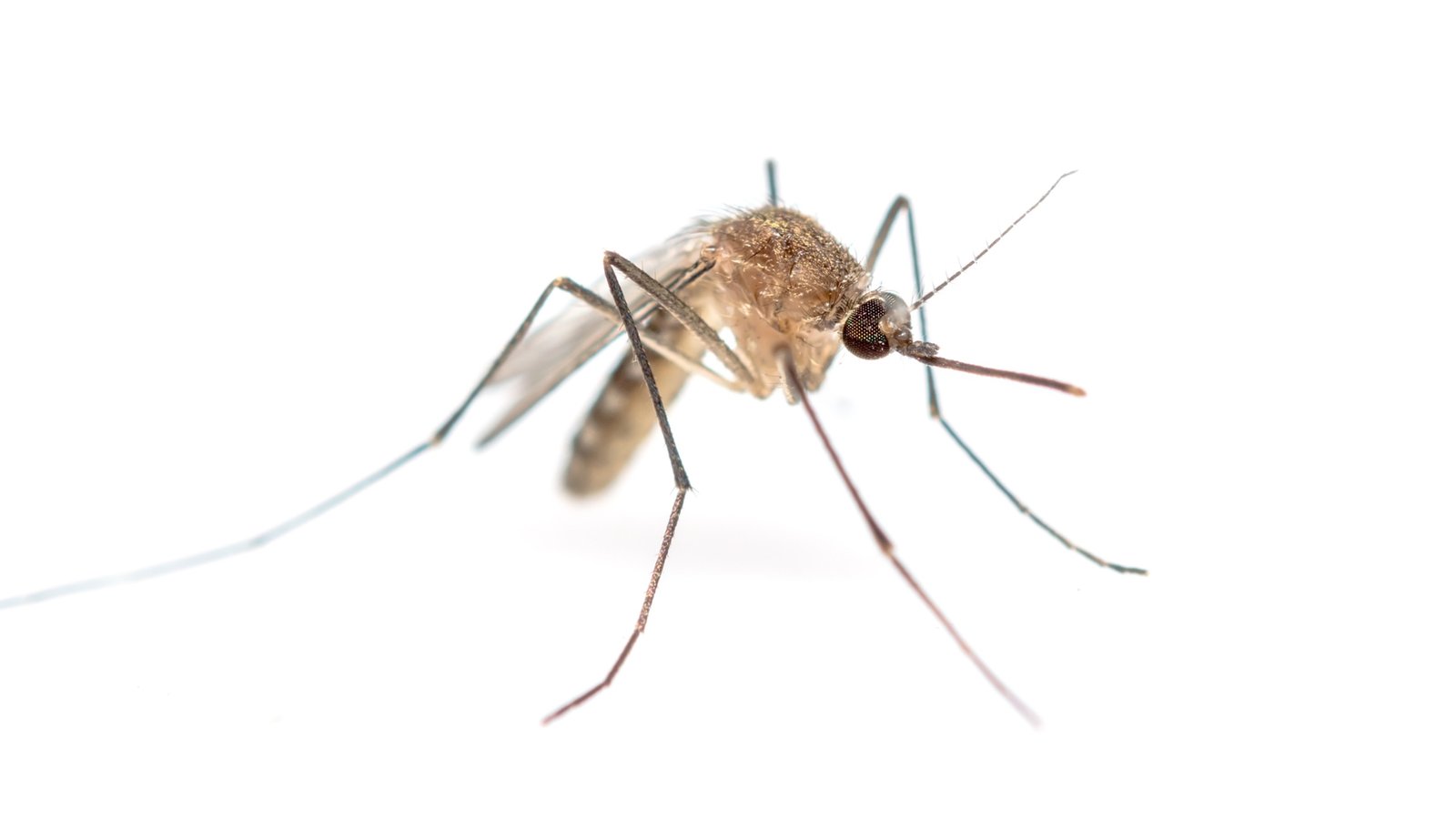
The short answer
There are more than 200 mosquito species living across the states and territories, but you do not need to know all of them. Only a small share, a few dozen at most, commonly bite people, and an even smaller set actually spreads disease. Most of the rest feed on birds, frogs, or other animals, or bite people rarely enough that you will probably never notice them.
So the practical question is not “which of 200 species is this,” it is “which handful is likely near me, and does it matter.” You can narrow it down fast with a few clues: the time of day it bit you, where it was resting, whether it had bold markings, and where it is likely breeding. Those clues almost always point to one of five groups, called genera. Start with the genus. That is usually enough to know whether you are dealing with a daytime backyard biter, a dusk-to-dark house mosquito, or a rare nuisance from a flooded field.
This page is the map to those groups. Each genus and key species has its own page with the detail.
The main groups (genera) to know
Five genera cover almost everything that will bite you or that matters for health here. One line each on how they look and behave:
| Genus | Look | When and where it bites | Why it matters |
|---|---|---|---|
| Aedes | Small and dark with bold white or silver markings on the legs and body | Bites during the day, especially early morning and before dusk; breeds in small containers of water | The daytime backyard biters. Includes the yellow fever mosquito (Aedes aegypti) and Asian tiger mosquito (Aedes albopictus), the main dengue, Zika, and chikungunya carriers |
| Culex | Medium, dull brown to tan, without bold markings | Bites from dusk through the night; lays eggs in rafts on still, often stagnant water | The house mosquitoes. The main carriers of West Nile virus and St. Louis encephalitis here |
| Anopheles | Slender, often with dark wing spots; rests with the body tilted at a sharp angle | Mostly bites at dusk and night | The only malaria carriers. Anopheles quadrimaculatus in the East and Anopheles freeborni in the West are the historic US vectors |
| Psorophora | Very large; some are among the biggest mosquitoes here, with shaggy, banded legs | Aggressive day and evening biter after heavy rain | The floodwater nuisance. The giant “gallinipper” (Psorophora ciliata) delivers a painful bite but is not a major disease carrier |
| Culiseta | Dark and stout, cool-weather mosquitoes | Active in cooler parts of the season | Mostly bird feeders. Culiseta melanura keeps eastern equine encephalitis (EEE) circulating in birds |
If you remember only two, remember Aedes and Culex. A bite in broad daylight in your yard is most often Aedes. A bite at dusk or after dark, indoors or just outside, is most often Culex.
How to identify a mosquito
You rarely get a clear look before you swat, so identification is usually about circumstances plus a few visible features. Work through these:
When did it bite? Time of day is the single most useful clue. Aedes mosquitoes bite during the day, with peaks in the early morning and the hours before dusk. Culex and Anopheles are dusk-to-night biters. A daytime bite in the backyard strongly suggests Aedes.
What did it look like? Bold black-and-white or silver banding on the legs points to Aedes; the Asian tiger mosquito has a single bright white stripe down the center of its back, and the yellow fever mosquito has a curved, lyre-shaped pattern on its thorax. A plain brown or tan mosquito with no striking markings is more likely Culex. Dark wing spots and a slender build suggest Anopheles. A mosquito noticeably larger than the rest, with fuzzy banded legs, may be a Psorophora.
How was it resting? This is the classic tell for Anopheles. An Anopheles at rest tilts its body and abdomen up at a sharp angle to the surface, roughly 45 degrees, so it looks like it is standing on its head. Culex and Aedes hold their bodies roughly parallel to the surface. On a female Anopheles, the pair of sensory palps beside the proboscis are about as long as the proboscis itself; on Culex and Aedes females they are much shorter.
Where is it breeding? Aedes are container breeders, laying eggs in small pockets of water, a bottle cap, a plant saucer, a clogged gutter, and their eggs can survive drying out for months. Culex prefer still, often stagnant water and lay floating egg rafts. Anopheles favor cleaner standing water. Psorophora are floodwater mosquitoes that lay eggs in low ground that later floods after heavy rain, which is why their numbers surge after storms.
None of these clues is foolproof on its own, but together they usually settle the genus, which is what matters for judging risk.
Which mosquitoes actually spread disease
Here is the calibration that keeps this in perspective. Of the 200-plus species here, only a handful are meaningful disease carriers, and most bites you get are from nuisance mosquitoes that carry nothing.
- Aedes (mainly Aedes aegypti and Aedes albopictus) can carry dengue, Zika, chikungunya, and yellow fever. In most of the country these are largely travel-associated diseases, with limited local spread in a few warm states.
- Culex are the main West Nile virus carriers, and West Nile is the most common mosquito-borne disease reported here. Culex also spread St. Louis encephalitis.
- Anopheles are the only mosquitoes that transmit human malaria. Nearly all US malaria is travel-related, with rare local cases.
- Culiseta melanura rarely bites people. It matters because it keeps EEE virus cycling among birds; other “bridge” mosquitoes occasionally carry it to people and horses.
- Psorophora and most other genera are nuisance biters. A gallinipper bite hurts, but it is not a notable disease risk.
The takeaway: a painful or itchy bite is not the same as a dangerous one. For what these diseases are and how worried to be, see the diseases hub.
Larvae matter too
If you find wrigglers in standing water, you can often identify the genus before it ever grows wings, which is useful if you are trying to figure out what is breeding on your property. The tell is how the larva hangs at the water surface.
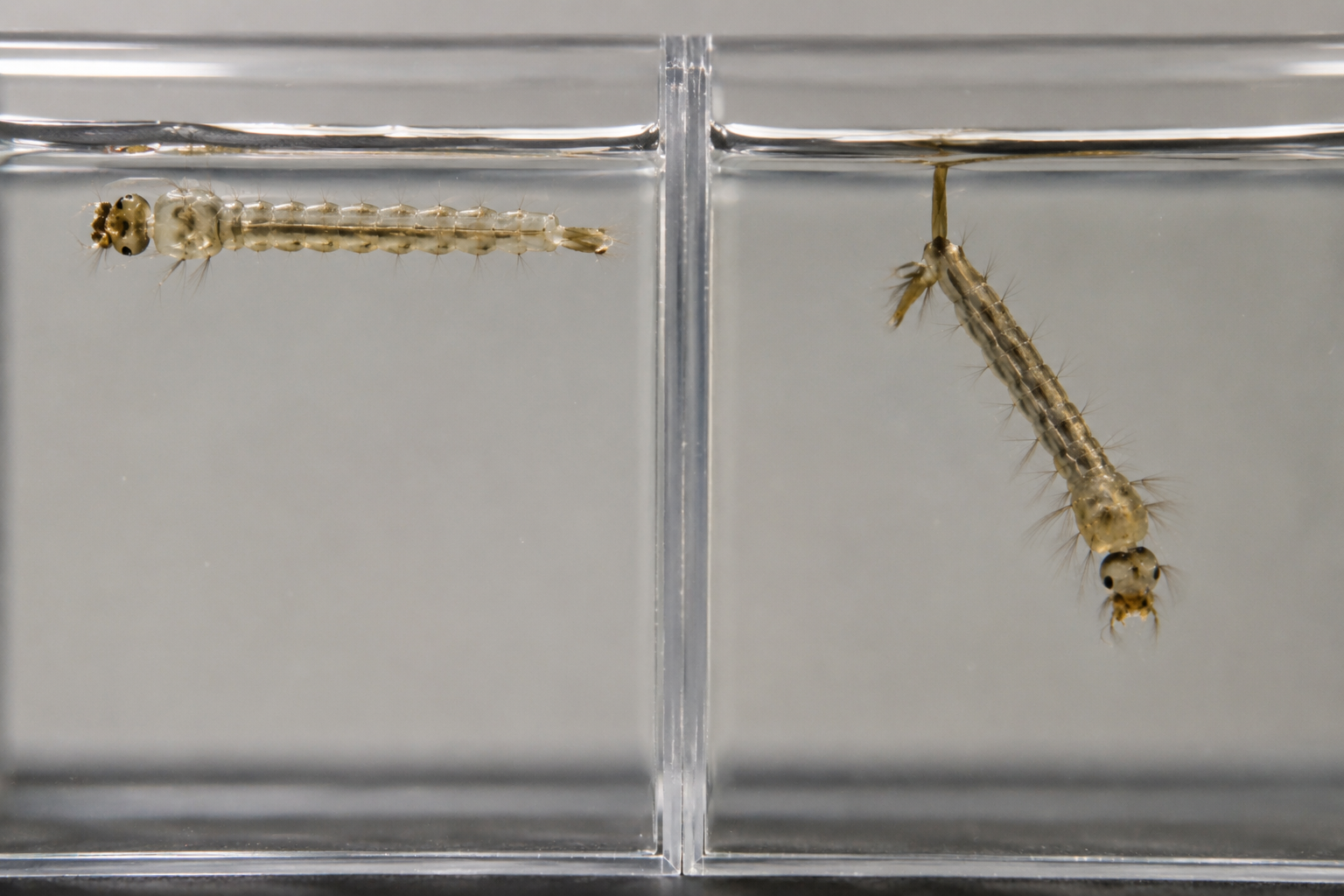
Illustration. Most mosquito larvae must come to the surface to breathe air. Culex and Aedes larvae breathe through a tube called a siphon at the tail end, so they hang down from the surface at an angle, tail-up. Anopheles larvae have no siphon and instead breathe through openings along the body, so they lie flat, parallel to the surface, right against it. In short: flat along the top means Anopheles; hanging at an angle means Culex or Aedes. Among the two anglers, Culex tend to have a longer, more slender siphon than Aedes.
How to get help identifying one
If you want a confident answer, your local mosquito control or abatement district is the best resource, and often a free one. Many districts will identify a specimen, tell you which species are active in your area right now, and point out likely breeding sources on your property. County health departments and university extension entomology offices (such as land-grant university extension programs) also field identification questions and often publish local species lists.
To submit a specimen, catch it without crushing it if you can, keep it dry, and note the date, the time of day it was active, and where you found it. Those notes are often as helpful to an entomologist as the mosquito itself.
Sources
- CDC, “About Mosquitoes in the United States” (more than 200 types of mosquitoes live in the US; most are nuisance mosquitoes and only some spread germs; Aedes, Culex, and Anopheles are the most common types that can spread disease; list of diseases including dengue, Zika, chikungunya, West Nile, and yellow fever). https://www.cdc.gov/mosquitoes/about/about-mosquitoes-in-the-united-states.html Accessed 2026-07-20.
- CDC, “About Culex Mosquitoes” (Culex bite from dusk through the night; carry West Nile virus and St. Louis encephalitis). https://www.cdc.gov/mosquitoes/about/culex-mosquitoes.html Accessed 2026-07-20.
- American Mosquito Control Association, “Mosquito Biology” (four life-cycle stages; larvae of almost all species come to the surface to breathe air through a siphon). https://www.mosquito.org/mosquito-biology/ Accessed 2026-07-20.
- Vector Disease Control International, “Meet the Dengue Mosquito: What You Need to Know About This Daytime Biter” (Aedes aegypti and albopictus are day-biting container breeders with white markings; eggs survive drying; carry dengue, Zika, chikungunya, yellow fever). https://www.vdci.net/blog/meet-the-dengue-mosquito-what-you-need-to-know-about-this-daytime-biter/ Accessed 2026-07-20.
- University of Florida IFAS Featured Creatures, EENY-540, “A Mosquito Psorophora ciliata (Fabricius)” (large floodwater mosquito known as the gallinipper; aggressive, painful bite; females lay eggs in soil at the edges of water bodies that flood after heavy rain). https://edis.ifas.ufl.edu/publication/IN967 Accessed 2026-07-20.
- University of Florida IFAS, EENY-536, “Dark-Tailed Mosquito Culiseta melanura (Coquillett)” (cool-water mosquito that feeds almost exclusively on birds and maintains eastern equine encephalitis virus in bird populations). https://ask.ifas.ufl.edu/publication/IN950 Accessed 2026-07-20.
- Rutgers Center for Vector Biology, “Culiseta melanura” species page (strictly a bird-feeding mosquito; primary enzootic vector of EEE; larvae develop in cool, shaded water). https://vectorbio.rutgers.edu/outreach/species/sp25.htm Accessed 2026-07-20.
- University of Florida IFAS, EENY-491, “Common Malaria Mosquito Anopheles quadrimaculatus Say” (most important vector of human malaria in the eastern US). https://ask.ifas.ufl.edu/publication/IN791 Accessed 2026-07-20.
- American Mosquito Control Association. Vector-Borne Diseases. https://www.mosquito.org/vector-borne-diseases/. Accessed 20 Jul 2026. (Anopheles freeborni is the principal malaria vector in the arid and semiarid western regions, historically transmitting Plasmodium vivax, especially in California; Anopheles quadrimaculatus is the eastern vector.)
- “The Resting Position of Anopheles” (Anopheles rest with the body angled sharply to the surface, distinct from the parallel posture of Culex and Aedes), PMC. https://www.ncbi.nlm.nih.gov/pmc/articles/PMC5195374/ Accessed 2026-07-20.
- Georgia Mosquito Control Association, “Field Identification of Adult and Larval Mosquitoes” (Anopheles larvae lack a siphon and lie parallel to the surface; Culex and Aedes larvae hang at an angle from a siphon; Culex siphons longer and more slender than Aedes; female Anopheles palps about as long as the proboscis). http://www.gamosquito.org/resources/fguideid.pdf Accessed 2026-07-20.
Explore the species
- Aedes mosquitoes (the daytime biters)
- Yellow fever mosquito (Aedes aegypti)
- Asian tiger mosquito (Aedes albopictus)
- Inland floodwater mosquito (Aedes vexans)
- Culex mosquitoes (the house mosquitoes)
- Northern house mosquito (Culex pipiens)
- Western encephalitis mosquito (Culex tarsalis)
- Anopheles mosquitoes (the malaria carriers)
- Psorophora and the gallinipper (Psorophora ciliata)
- Culiseta and the dark-tailed mosquito (Culiseta melanura)
- How to identify mosquito larvae
This page is a general educational reference, not pest-control advice. For treatment of a mosquito problem on your property, or to identify a specimen, contact your local mosquito control district or a licensed professional. Last reviewed 20 July 2026.