The short answer
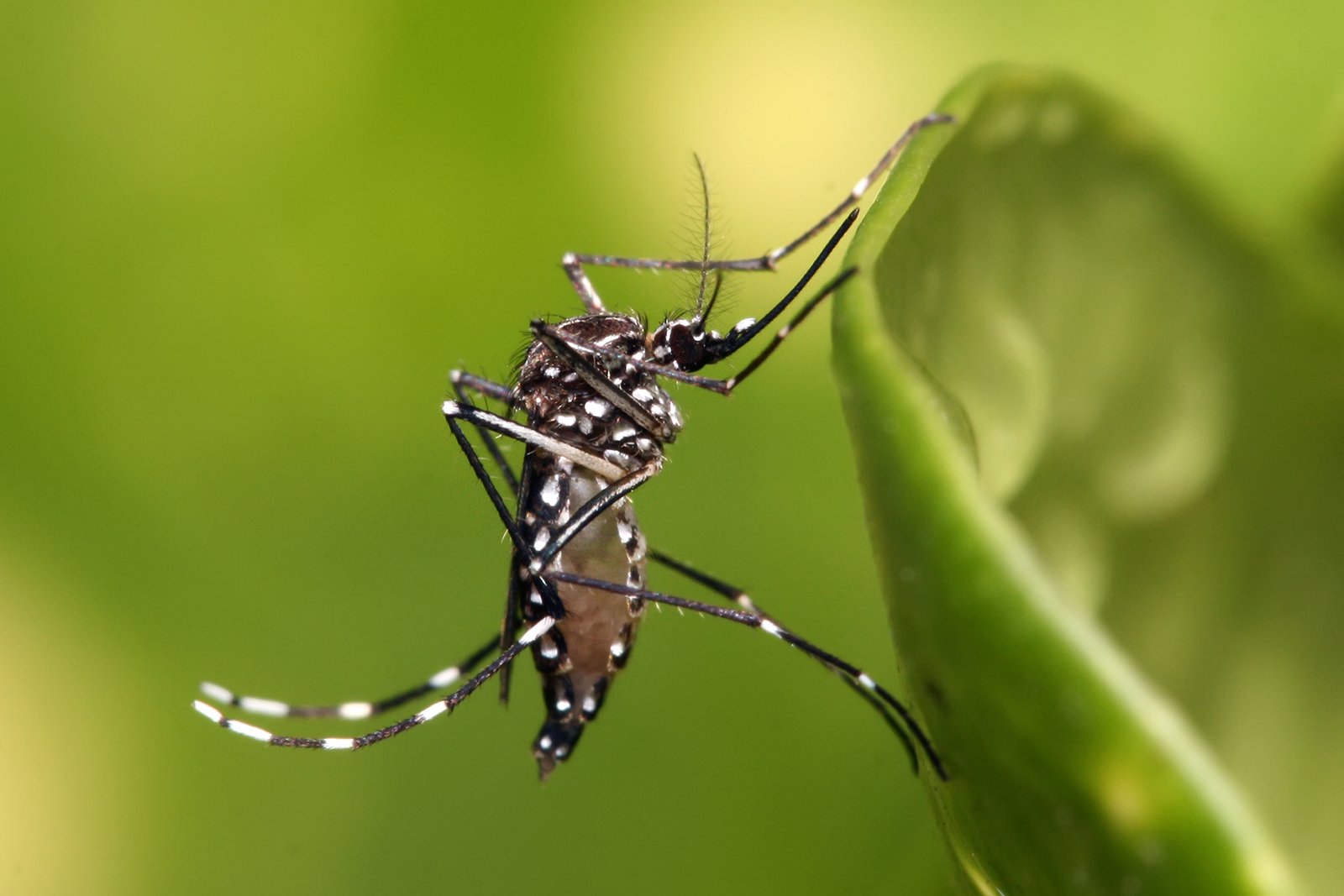
Aedes aegypti is the yellow fever mosquito, a small dark mosquito that lives close to people and breeds in the little pockets of water we leave lying around the yard. The quick field mark is a pair of silver-white lines flanked by curved lines on the top of the thorax, a pattern that looks like a violin or a lyre, plus white bands on the legs [1].
It matters because it is one of the most important disease-carrying mosquitoes in the world. Aedes aegypti is the primary mosquito that spreads dengue, and it can also carry Zika, chikungunya, and yellow fever viruses [2][6]. It is not a swamp or woodland mosquito. It is a mosquito of porches, patios, flowerpots, and old tires, which is exactly why it comes into so much contact with humans.
How to identify it
Aedes aegypti is small and dark, with adults running roughly 4 to 7 mm long [1]. Against the dark body, look for three things:
- The thorax pattern. White scales on top of the thorax form the shape of a violin or lyre, two straight center lines with a curved line on each side [1]. This is the single most reliable mark.
- Banded legs. Each segment of the hind legs carries white bands at its base, so the legs look striped [1].
- A boldly speckled body. The thorax and abdomen are patterned with white scales against the dark background [1].
Telling it apart from the Asian tiger mosquito (Aedes albopictus). The two look alike at a glance and share the same container-breeding, daytime-biting habits, but the back of the thorax gives it away. Aedes aegypti shows the curved lyre pattern, while Aedes albopictus shows a single bold white stripe running straight down the center of the thorax [1]. If you see one central line, you are likely looking at the tiger mosquito, not the yellow fever mosquito. See our Aedes albopictus profile for a full comparison.
Where it lives
In the US, Aedes aegypti is a mosquito of the warmer, more southern regions. It has been detected across the southern tier of the country, with the heaviest presence in Florida, Texas, Arizona, and southern California [2]. Surveillance has recorded it in hundreds of counties across more than two dozen states, though it is most firmly established where winters are mild [2].
What defines this species is not a wild habitat but a human one. Aedes aegypti is a container mosquito that lives in close association with people, breeding in artificial containers rather than natural wetlands. Typical sites include unused flowerpots and saucers, spare tires, buckets, untreated pools, and drainage catches, anywhere a small amount of water collects near a home [1]. Its eggs are laid just above the waterline and resist drying out, surviving for months until rain or watering refloods the container and triggers hatching [7]. That trait lets it ride out dry spells and makes it hard to clear once it settles into a neighborhood.
In Florida, its numbers dropped sharply after the Asian tiger mosquito arrived in 1985, because tiger mosquito larvae out-compete it for food and grow faster, but Aedes aegypti still thrives in urban South Florida [1].
Behavior
Aedes aegypti is an aggressive daytime biter. While many mosquitoes feed at dusk, dawn, or night, this one readily bites during the day, and it bites indoors as well as outdoors [1]. Females feed primarily on humans to produce their eggs, so they show a strong preference for people over other animals [1].
It is also a homebody. Aedes aegypti tends to stay close to where it emerged, with typical flight ranges on the order of a couple hundred meters or less, shorter than many other mosquitoes [3]. Because hosts, mates, and egg-laying sites are all available inside and around human dwellings, the females rarely need to travel far [3]. In practice this means the mosquito biting you often developed in a container within your own yard or your neighbor’s.
Diseases it can carry
Aedes aegypti is a competent vector for several viruses that affect people. It can transmit:
- Dengue [2][6]
- Zika [2][6]
- Chikungunya [2][6]
- Yellow fever, the disease that gives the mosquito its common name [1][6]
It is regarded as the most important vector of dengue, and local dengue transmission has been reported in Florida, Texas, Hawaii, Arizona, and California [2]. Being bitten does not mean infection, since the mosquito must first pick up a virus from an infected person, but the presence of established Aedes aegypti is what makes local outbreaks possible in the first place.
How to control it
Because this mosquito breeds in small artificial containers, the most effective thing you can do is take away the water. This is more useful against Aedes aegypti than fogging or spraying, since the immature stages are concentrated in containers you can find and empty.
- Tip and toss weekly. At least once a week, empty, scrub, turn over, cover, or throw out anything that holds water: flowerpot saucers, buckets, toys, tarps, birdbaths, trash-can lids, and old tires [4]. Emptying a container once a week interrupts development before larvae can become biting adults [4].
- Scrub, do not just dump. The eggs cling to container walls above the waterline and survive drying, so scrubbing the sides removes eggs that pouring the water out will miss [4][7].
- Check the tiny stuff. These mosquitoes can develop in very small volumes of water, down to something as small as a bottle cap, so nothing that holds water is too small to matter [4].
- Close the gaps. Cover or screen water-storage containers and rain barrels, and keep gutters clear so they do not pool [4].
- Reduce indoor biting. Because Aedes aegypti bites and rests indoors, window and door screens and, during outbreaks, professional mosquito-control support all help [1][4].
The through-line is simple. Deny the container, and you deny the mosquito.
Sources
- University of Florida IFAS, Featured Creatures, “Yellow Fever Mosquito, Aedes aegypti” (EENY-434 / IN792). Accessed 2026-07-20. https://ask.ifas.ufl.edu/publication/IN792. Supports: adult size 4 to 7 mm; lyre/violin thorax pattern; white-banded hind legs; distinction from Aedes albopictus (single central stripe); container breeding sites; daytime and indoor biting; preference for feeding on humans; decline in Florida after Aedes albopictus arrived in 1985; vector of yellow fever, dengue, chikungunya, and Zika.
- CDC Dengue, “CDC’s Most (un)Wanted Mosquitoes.” Accessed 2026-07-20. https://www.cdc.gov/dengue/stories/unwanted-mosquitoes.html. Supports: Aedes aegypti as primary vector of dengue plus Zika, chikungunya, and yellow fever; US distribution concentrated in Florida, Texas, Arizona, and southern California, detected across the southern tier and hundreds of counties in more than two dozen states; local dengue transmission reported in Florida, Texas, Hawaii, Arizona, and California.
- Journal of Medical Entomology, “Estimating Aedes aegypti (Diptera: Culicidae) Flight Distance: Meta-Data Analysis.” Accessed 2026-07-20. https://academic.oup.com/jme/article/59/4/1164/6596097. Supports: short flight range (typically within a couple hundred meters), and that hosts, mates, and oviposition sites in human dwellings make long-distance flight unnecessary.
- CDC Mosquitoes, “Mosquito Control at Home.” Accessed 2026-07-20. https://www.cdc.gov/mosquitoes/mosquito-control/mosquito-control-at-home.html. Supports: empty, scrub, cover, or throw out water-holding containers at least weekly; weekly emptying interrupts development; mosquitoes can breed in very small containers; cover water storage and use screens.
- ECDC, “Aedes aegypti factsheet for experts.” Accessed 2026-07-20. https://www.ecdc.europa.eu/en/disease-vectors/facts/mosquito-factsheets/aedes-aegypti. Supports: silver lyre-shaped scales on the scutum and white-and-black banded legs as diagnostic characters.
- CDC Dengue, “Public Health Considerations for Dengue.” Accessed 2026-07-20. https://www.cdc.gov/dengue/php/public-health-considerations/index.html. Supports: Aedes aegypti as vector of dengue, Zika, chikungunya, and yellow fever viruses.
- PLOS Biology, “Eggs of the mosquito Aedes aegypti survive desiccation by rewiring their polyamine and lipid metabolism.” Accessed 2026-07-20. https://journals.plos.org/plosbiology/article?id=10.1371/journal.pbio.3002342. Supports: eggs are laid above the waterline and resist desiccation, surviving dry periods for months until reflooding triggers hatching.
Related
- Aedes albopictus (Asian tiger mosquito)
- Dengue: symptoms, spread, and risk
- Zika virus and mosquitoes
- Chikungunya in the US
- Yellow fever and its mosquito
- How to get rid of standing water around your home
This profile is educational reference material, not pest-control advice. For an infestation or a suspected mosquito-borne illness, contact your local mosquito-control district or a health professional.
Last reviewed 20 July 2026.