The short answer
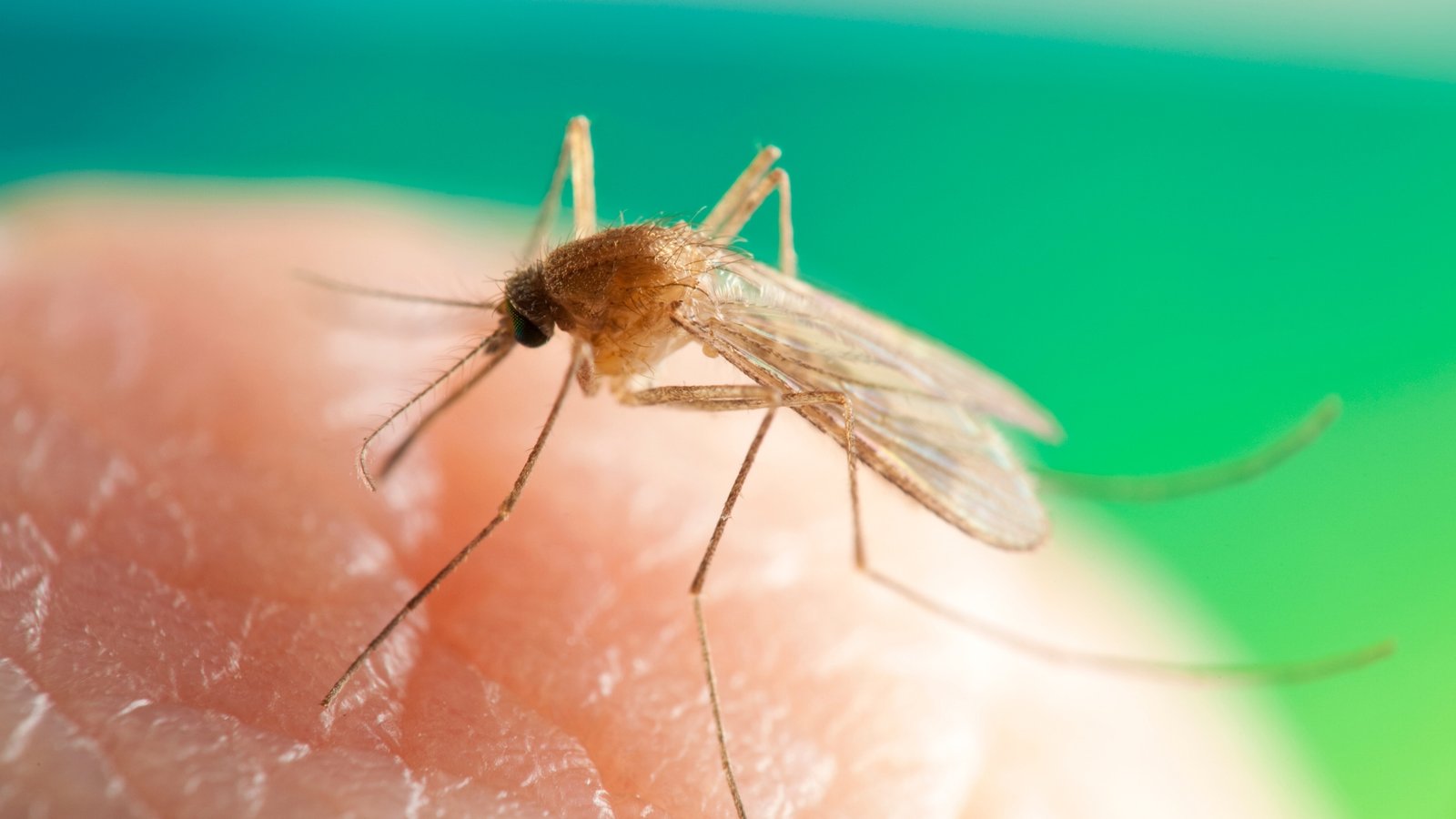
Aedes vexans, the inland floodwater mosquito, is one of the most common and widespread nuisance mosquitoes across most of the country. It is a floodwater breeder, which means its eggs sit dry on damp soil and hatch only after rain or overflow floods them. When conditions line up after heavy rain, large broods can emerge at once, and the females are aggressive evening and nighttime biters. It is chiefly a nuisance species, though it can play a limited secondary role in disease transmission.
How to identify it
Aedes vexans is a medium-sized mosquito, roughly 7 mm long, with a dark gray to brownish-black body. Two features help separate it from look-alikes:
- The abdomen carries narrow pale (whitish) bands at the base of the segments, and these bands are notched in the middle with a small v-shape at the rear edge. Viewed from the side, the pattern repeats down the abdomen in a way described as a “B” shape, which is considered diagnostic.
- The legs are banded, with a narrow white band at the base of the tarsal segments. The bands are narrow, less than one-third the length of the tarsal segment, and the proboscis is a uniform dark color with no pale band.
As with most mosquitoes, females have slender antennae and males have feathery (plumose) antennae.
Where it lives
Aedes vexans is one of the most widespread pest mosquitoes in the world. It is found throughout the continental United States and into southern Canada, and it is the dominant mosquito species across much of North America, thinning out at higher elevations in the Rockies and at higher latitudes.
It is a classic floodwater breeder. Females lay their eggs singly on moist soil above the waterline, in low spots that are subject to flooding by rain, overflow, seepage, or irrigation. Typical sites include temporary rain pools, roadside ditches, irrigated and flooded fields, detention basins, and river floodplains. The eggs are laid on damp ground rather than in standing water, and after a period of drying they must later be flooded to hatch. The eggs are highly resistant to drying and can stay viable for multiple seasons, waiting out drought until water rises again. Because a fresh brood can hatch every time an area floods, a single season can produce many overlapping generations.
Behavior
Females are aggressive, persistent biters that feed mainly in the evening and at night. Biting activity typically peaks within about half an hour to an hour after sunset. When rainfall and flooding favor larval development, they can appear in very large numbers over a short window.
Aedes vexans is also a strong flier and a notable disperser. It can travel well away from where it hatched in search of a blood meal, with documented flights of roughly 10 miles and reports of even greater distances. This dispersal is a big part of why the species is such a widespread nuisance: adults can turn up miles from any obvious water. Individual adults commonly live about three to six weeks, and sometimes longer.
Diseases
In practical terms, Aedes vexans is mainly a nuisance biter rather than a leading disease vector. Across its range it is usually the most abundant pest mosquito rather than the primary carrier of human disease. In the Northern Great Plains, for example, researchers describe Culex tarsalis as the primary West Nile virus vector while Aedes vexans is “generally the most predominant nuisance mosquito.”
That said, it can act as a secondary or supporting vector. It is a competent laboratory vector of the encephalitis viruses (eastern equine encephalitis, western equine encephalitis, and St. Louis encephalitis), and it has been implicated in West Nile virus transmission. It is also a recognized vector of dog heartworm (Dirofilaria immitis): in one feeding study, 68% of Ae. vexans that fed on an infected dog went on to develop infective-stage larvae. Its overall contribution to human disease is generally considered limited compared with its very large role as a biting nuisance, so its importance is best understood as species-, place-, and pathogen-specific rather than uniform.
How to control it
Because Aedes vexans is a floodwater breeder that disperses widely, control focuses on the water rather than the adults alone.
- Manage floodwater and standing water. Reduce or drain the low spots, ditches, clogged culverts, and poorly draining areas that repeatedly flood after rain. Around the home, empty and turn over anything that catches rain, and improve drainage so pools do not linger.
- Time larval treatment to flooding. Because eggs hatch as a flush after rain and larvae develop quickly, the window to treat larvae is short. Larvicides based on the bacterium Bacillus thuringiensis israelensis (Bti), sold in dunk and granule form, are commonly used to treat standing water and small pools.
- Protect yourself from bites. During peak evening and nighttime activity, wear long sleeves, long pants, and socks, and use an effective repellent such as one based on DEET or picaridin on exposed skin.
Because adults can fly miles from their breeding sites, meaningful area-wide reduction usually depends on organized mosquito control that treats many scattered flooded sites within the same short window after major rains.
Sources
- Rutgers Center for Vector Biology, “Aedes vexans (Meigen).” https://vectorbio.rutgers.edu/outreach/species/sp13.htm (accessed 2026-07-20). Supports: identification (narrow leg bands less than one-third of the tarsal segment, dark uniform proboscis, basal abdominal bands with a v-shaped notch), widespread distribution, egg laying on moist soil subject to flooding, flight range of five to fifteen miles, biting peak thirty to forty minutes after sunset, lab transmission of EEE/WEE/SLE, and 68% dog heartworm infective-larvae figure.
- Vector Disease Control International (VDCI), “Mosquito of the Month: Aedes vexans, the Inland Floodwater Mosquito.” https://www.vdci.net/blog/mosquito-of-the-month-aedes-vexans-the-inland-floodwater-mosquito/ (accessed 2026-07-20). Supports: dark scale color with “B”-shaped notched abdominal bands, banded legs, near-cosmopolitan distribution and dominance in North America, floodwater egg laying above the waterline and the drying-then-flooding hatch requirement, biting peak about an hour after sunset, strong flight up to 15 miles, adult lifespan of three to six weeks, and competent-vector status for West Nile virus and dog heartworm.
- LSU AgCenter, “Aedes vexans, Inland Floodwater Mosquito.” https://www.lsuagcenter.com/articles/page1757604977696 (accessed 2026-07-20). Supports: approximately 7 mm size, dark gray or black color, white band on each leg segment, diagnostic repeating “B” abdominal pattern, submerged-egg hatch requirement, rapid larval-to-pupal development, aggressive and persistent biting, documented travel up to 10 miles, vector notes (dog heartworm, potential West Nile and EEE), and control guidance (drainage, Bti dunks, long clothing, DEET/picaridin repellents).
- Whitehead et al., “Permethrin Susceptibility for the Vector Culex tarsalis and a Nuisance Mosquito Aedes vexans in an Area Endemic for West Nile Virus,” PMC6077664. https://pmc.ncbi.nlm.nih.gov/articles/PMC6077664/ (accessed 2026-07-20). Supports: framing of Ae. vexans as the predominant nuisance mosquito while Culex tarsalis is the primary West Nile virus vector in the Northern Great Plains.
- Wikipedia, “Aedes vexans.” https://en.wikipedia.org/wiki/Aedes_vexans (accessed 2026-07-20). Supports (background, corroborated by sources above): near-cosmopolitan distribution, floodwater breeding, desiccation-resistant eggs viable for multiple seasons, and overlapping summer generations after flooding.
Related
- Aedes sollicitans (eastern saltmarsh mosquito) [placeholder]
- Culex tarsalis (western encephalitis mosquito) [placeholder]
- Understanding floodwater mosquitoes [placeholder]
- Mosquito egg biology and drought survival [placeholder]
- How mosquito control districts respond after heavy rain [placeholder]
- Choosing and using mosquito repellents [placeholder]
Educational note: This page is an independent, non-commercial reference for general education. It is not medical, veterinary, or pest-control advice. For diagnosis, treatment, or a mosquito problem on your property, consult a qualified professional or your local mosquito control or health authority.
Last reviewed 20 July 2026.