Short answer
Mosquitoes go through four stages: egg, larva, pupa, and adult. The first three all happen in water. That single fact is the reason source reduction works. Take away the standing water and the cycle cannot finish, because the egg, the larva, and the pupa have nowhere to develop (Sources 1, 3, 4).
Egg
A female lays her eggs on or near water, on damp soil, or at the base of plants in low spots that may later fill with water (Source 3). How she lays them depends on the species. Culex mosquitoes stick their eggs together at the water surface to form a floating raft of roughly 100 to 300 eggs. Aedes and Ochlerotatus mosquitoes lay their eggs singly, usually on damp soil, and those eggs are more resistant to drying out (Source 5). Because some eggs can survive dry conditions for a matter of months, a container that has been empty for weeks can still start producing mosquitoes once rain refills it (Source 3).
For a closer look at what eggs and egg rafts look like, see mosquito eggs identification.
Larva
When water covers the egg, it hatches into a larva, commonly called a wriggler for the way it moves (Source 3). The larva lives entirely in the water, where it feeds on bacteria and other tiny organisms (Source 1). Almost all species must come to the surface at frequent intervals to obtain oxygen through a breathing tube called a siphon (Source 5). As it grows, the larva molts, meaning it sheds its skin, four times before it is ready to become a pupa (Source 5).
For how to tell wrigglers apart in the water, see mosquito larvae identification.
Pupa
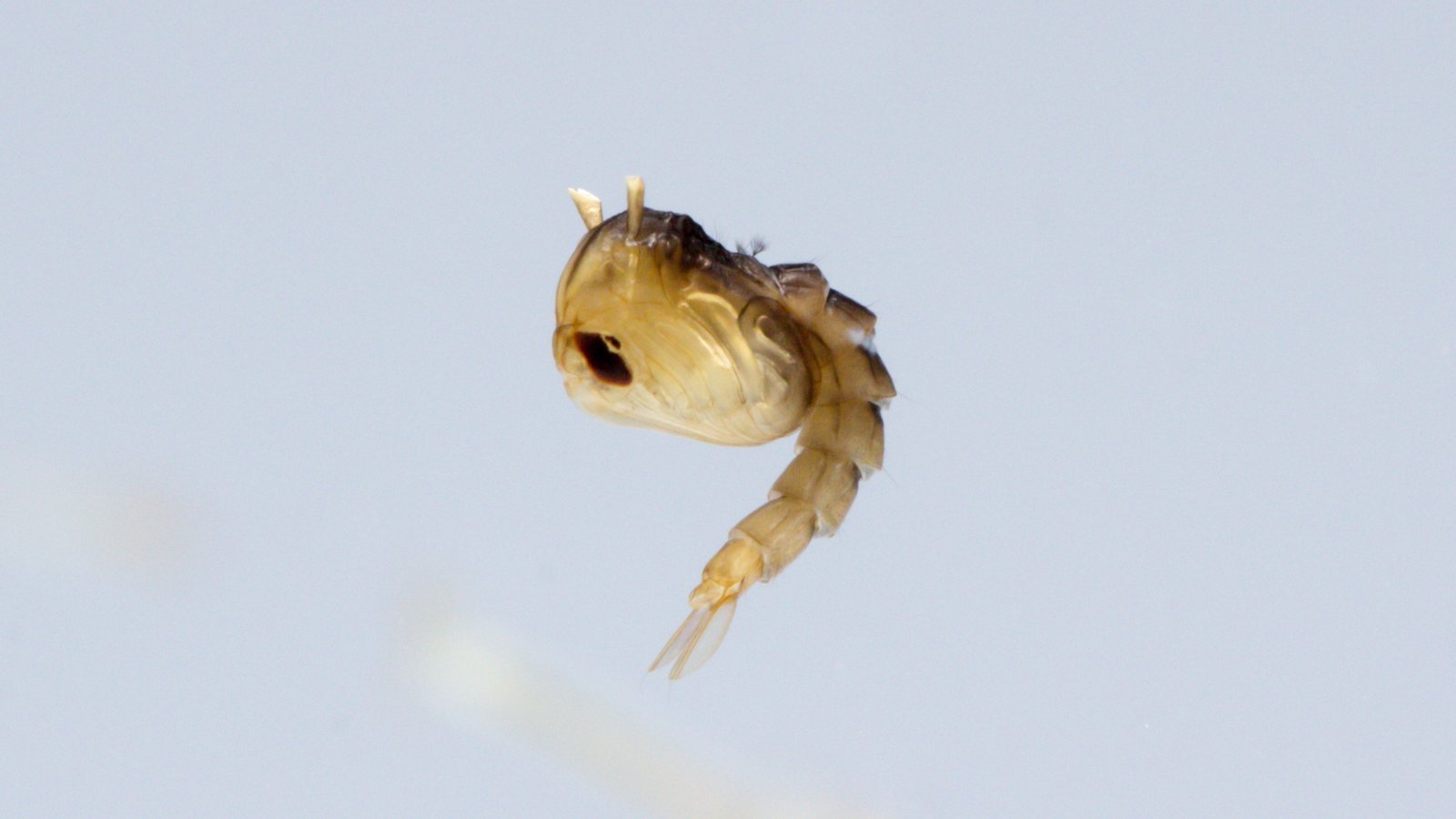
The larva develops into a pupa, commonly called a tumbler (Source 3). The pupa still lives in the water but no longer feeds (Source 3). It is a transition stage, not an inactive one. The tumbler can still swim and respond to light, but it takes in no food while the adult forms inside the pupal case (Sources 1, 5).
Adult
When development is complete, the adult mosquito splits the pupal case and emerges onto the surface of the water, where it rests until its body dries and hardens before it flies away (Sources 3, 5). Adults live a relatively short time, usually a few weeks (Source 1). Only the female bites. She feeds on the blood of humans or other animals because many species need a blood meal for their eggs to develop (Sources 1, 3, 5).
How long it takes and why it matters for control
The whole sequence is fast. The individual water stages run roughly 24 to 48 hours as an egg before hatching, 4 to 14 days as a larva, and 1 to 4 days as a pupa, with water temperature and species driving the pace (Sources 4, 5). Added together, egg to flying adult typically takes about two weeks, though it can range from as few as 4 days to as long as a month depending on conditions (Source 3). Warmer water speeds the cycle up.
The practical point is the same one from the short answer. Egg, larva, and pupa all need water, so any standing water on a property is a potential nursery, and it only needs to hold water for about a week or more for a new generation to reach adulthood. Emptying, draining, or removing that water breaks the cycle before adults ever emerge, which is why source reduction is the most effective first step in mosquito control.
Sources
- Centers for Disease Control and Prevention, Life Cycle of Aedes Mosquitoes (four stages, larvae as wrigglers feeding in water, pupae swim but do not eat, adults short lived, only females bite for egg development). https://www.cdc.gov/mosquitoes/about/life-cycle-of-aedes-mosquitoes.html (accessed 2026-07-20)
- Centers for Disease Control and Prevention, Life Cycle of Anopheles Mosquitoes (four stages, larvae breathe at the water surface, molt, and eat organisms in the water; pupae do not feed). https://www.cdc.gov/mosquitoes/about/life-cycle-of-anopheles-mosquitoes.html (accessed 2026-07-20; page returned HTTP 403, claims taken from the search result snippet)
- United States Environmental Protection Agency, Mosquito Life Cycle (eggs laid on or near water, eggs survive dry conditions for a few months, larva wriggler lives in water and surfaces to breathe, pupa tumbler does not feed, adult emerges onto the water surface, only females bite, typical two weeks ranging 4 days to a month). https://www.epa.gov/mosquitocontrol/mosquito-life-cycle (accessed 2026-07-20)
- American Mosquito Control Association, Life Cycle (per-stage durations: eggs 24 to 48 hours, larvae 4 to 14 days, pupae 1 to 4 days, depending on water temperature and species). https://www.mosquito.org/life-cycle/ (accessed 2026-07-20)
- American Mosquito Control Association, Mosquito Biology (Culex egg rafts of 100 to 300, Aedes eggs laid singly on damp soil and resistant to drying, larvae surface to breathe through a siphon and molt four times, pupae tumblers do not eat, adult splits the pupal case and emerges, females require a blood meal). https://www.mosquito.org/mosquito-biology/ (accessed 2026-07-20)
Related
- Mosquito eggs identification [placeholder]
- Mosquito larvae identification [placeholder]
- Source reduction [placeholder]
- Aedes vs Culex vs Anopheles [placeholder]
This page is educational reference material about mosquito biology. It is not pest control or medical advice.
Last reviewed 20 July 2026.