The short answer
Three mosquito genera do most of the biting and nearly all of the disease work that people worry about: Aedes, Culex, and Anopheles. If you can place a mosquito in one of these three groups, you already know most of what matters about when it bites you and what it might carry.
The three quickest tells:
- Look at the resting angle. Anopheles rest with the body tilted up, abdomen pointed away from the surface, often at roughly 45 degrees. Aedes and Culex rest nearly parallel to the surface, hunched flat (CDC DPDx Malaria; Target Malaria).
- Look at the markings. Aedes usually show a crisp black-and-white pattern, including white scale patches on the legs. Culex are plainer, brownish, with no bold pattern. Anopheles have blocks of black and white scales on the wings and palps as long as the proboscis (Target Malaria; CDC DPDx Malaria).
- Note the time. Aedes tend to bite by day (early morning and late afternoon). Culex and Anopheles bite mostly from dusk through the night (CDC Dengue; CDC About Malaria; Target Malaria).
A side-by-side comparison
The table below summarizes the features entomologists and mosquito control programs use to separate the three genera. Each row is drawn from the sources listed at the end.
| Feature | Aedes | Culex | Anopheles |
|---|---|---|---|
| Look / markings | Black-and-white pattern, white scale patches on the legs | Plain brownish body, no bold pattern | Blocks of black and white scales on the wings; palps as long as the proboscis |
| Resting posture | Body nearly parallel to the surface, hunched | Body nearly parallel to the surface, hunched | Body tilted up at an angle (roughly 45 degrees), abdomen away from the surface |
| When they bite | Mostly daytime, peaking early morning and late afternoon | Mostly night, dusk to dawn | Mostly night, dusk to dawn (crepuscular to nocturnal) |
| Host preference | Bites people readily, indoors or outdoors near dwellings | Feeds heavily on birds; some species bridge to people | Feeds on people and other mammals (the malaria link) |
| Eggs | Laid singly, above the water line on damp surfaces that later flood | Laid stuck together in floating rafts of about 100 to 300 eggs | Laid singly on the water surface, each with a pair of floats |
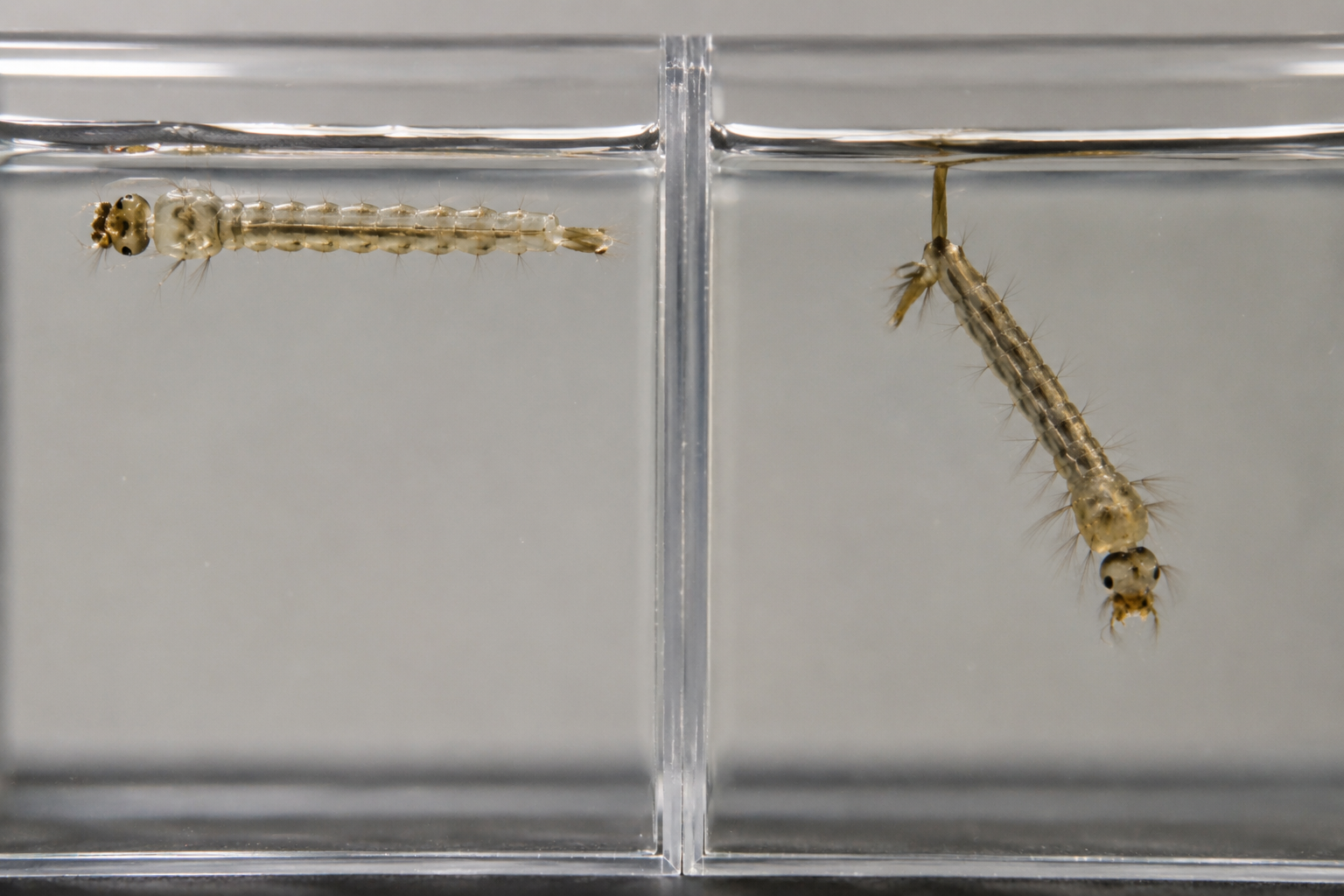
| Larvae posture | Hang at an angle from the surface, breathing through a siphon | Hang at an angle from the surface, breathing through a siphon | No siphon; lie parallel to the water surface |
| Main diseases | Dengue, Zika, chikungunya, yellow fever | West Nile virus (and related encephalitis viruses) | Malaria |
(Illustration.)
Aedes in a sentence
Aedes are the day-biting, boldly black-and-white mosquitoes that breed in small containers of water around homes, lay their eggs singly just above the waterline, and are the main US concern for dengue, Zika, and chikungunya (CDC Dengue; Target Malaria; AMCA Life Cycle).
Culex in a sentence
Culex are the plain brown, night-biting mosquitoes that lay floating egg rafts in standing or polluted water, feed heavily on birds, and are the primary vector of West Nile virus in the US (CDC West Nile Transmission; AMCA Life Cycle; Target Malaria).
Anopheles in a sentence
Anopheles are the tilt-resting mosquitoes with long palps and spotted wings whose larvae lie flat against the water because they lack a siphon, and they are the only US genus that transmits malaria, a disease that is not currently endemic here (CDC About Malaria; CDC DPDx Malaria; Alameda County Mosquito Abatement District).
Why the differences matter (disease and control)
The genus tells you the risk profile. An Aedes population near a home points to daytime, container-breeding mosquitoes and to the dengue and Zika group of viruses, so control focuses on dumping standing water from buckets, flowerpots, and tires. A Culex population points to nighttime biters that amplify West Nile virus in birds before spilling over to people, so control leans on catch basins, storm drains, and other stagnant water plus evening bite protection. Anopheles matter because they are the malaria vector; malaria is not currently endemic in the US, but Anopheles are present, so identifying them is what makes local transmission after an imported case even possible to track (CDC Dengue; CDC West Nile Transmission; CDC About Malaria).
The larvae differences are practical too. Because Anopheles larvae lie flat and lack a siphon while Aedes and Culex larvae hang from one, a control technician can often sort a dip sample by genus at the water’s edge, before any adult is ever caught (Alameda County Mosquito Abatement District; AMCA Life Cycle).
Sources
- CDC, “How Dengue Spreads” (Aedes aegypti and Ae. albopictus as dengue vectors, daytime biting, container egg-laying, biting near dwellings). https://www.cdc.gov/dengue/transmission/index.html (accessed 2026-07-20).
- CDC, “Transmission of West Nile Virus” (Culex species as primary WNV vectors; enzootic cycle between Culex mosquitoes and birds). https://www.cdc.gov/west-nile-virus/php/transmission/index.html (accessed 2026-07-20).
- CDC, “About Malaria” (Anopheles as malaria vectors; dusk-to-dawn, crepuscular to nocturnal biting; malaria not endemic in the US). https://www.cdc.gov/malaria/about/index.html (accessed 2026-07-20).
- CDC DPDx, “Malaria” (Anopheles identification: palps as long as the proboscis, blocks of black and white scales on the wings, resting at roughly 45 degrees with the abdomen up). https://www.cdc.gov/dpdx/malaria/index.html (accessed 2026-07-20).
- American Mosquito Control Association, “Life Cycle” (Culex egg rafts of about 100 to 300 eggs; Anopheles single eggs on the water surface; Aedes single eggs on damp soil; larval breathing through a siphon). https://www.mosquito.org/life-cycle/ (accessed 2026-07-20).
- Alameda County Mosquito Abatement District, “Life Cycle” (Anopheles larvae lack a siphon and lie parallel to the surface; other larvae have siphon tubes; Aedes lay on damp substrate that later floods; Culex lay rafts). https://www.mosquitoes.org/life-cycle (accessed 2026-07-20).
- Target Malaria, “Anopheles, Aedes or Culex: how to tell mosquito species apart?” (adult markings, leg pattern in Aedes, plain Culex body, Anopheles resting posture and palps, biting times, diseases per genus). https://targetmalaria.org/latest/blog/anopheles-aedes-or-culex-how-to-tell-mosquito-species-apart/ (accessed 2026-07-20).
Related
- Aedes mosquitoes (genus page) [placeholder]
- Culex mosquitoes (genus page) [placeholder]
- Anopheles mosquitoes (genus page) [placeholder]
Educational note: This page is for general reference and identification. It is not medical advice or a diagnosis. For disease risk in your area or for symptoms after a bite, contact your local mosquito control program or a healthcare provider.
Last reviewed 20 July 2026.