The short answer
Mosquitoes lay eggs in two main ways, and the way tells you a lot about the type. Some species glue their eggs together into a small floating raft that sits on standing water. Others lay eggs one at a time, either directly on the water surface or on a damp surface just above the waterline where the eggs wait for a flood.
If you find a tiny dark patch floating on water in a bucket or birdbath, you are almost certainly looking at an egg raft (typically a Culex or Culiseta mosquito). If instead the water yields no visible raft but larvae appear after rain, the eggs were probably laid singly, either on the water (Anopheles) or on a damp surface above it (Aedes and Psorophora) (American Mosquito Control Association, “Life Cycle”; Penn State Extension, “Mosquito Biology and Control”).
The individual eggs are small, roughly a millimeter long, and hard to identify to species with the naked eye. What is practical to identify at home is the laying strategy: raft versus single, and on the water versus above it.
Egg rafts
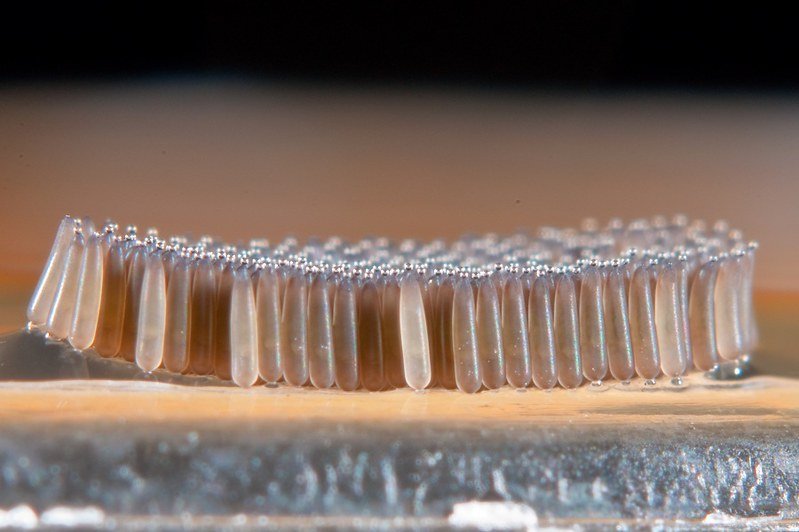
Culex and Culiseta mosquitoes lay dozens to hundreds of eggs stuck together as a single floating raft on the water surface. Culex females usually lay their eggs at night, sticking them together to form a raft of from 100 to 300 eggs (American Mosquito Control Association, “Life Cycle”).
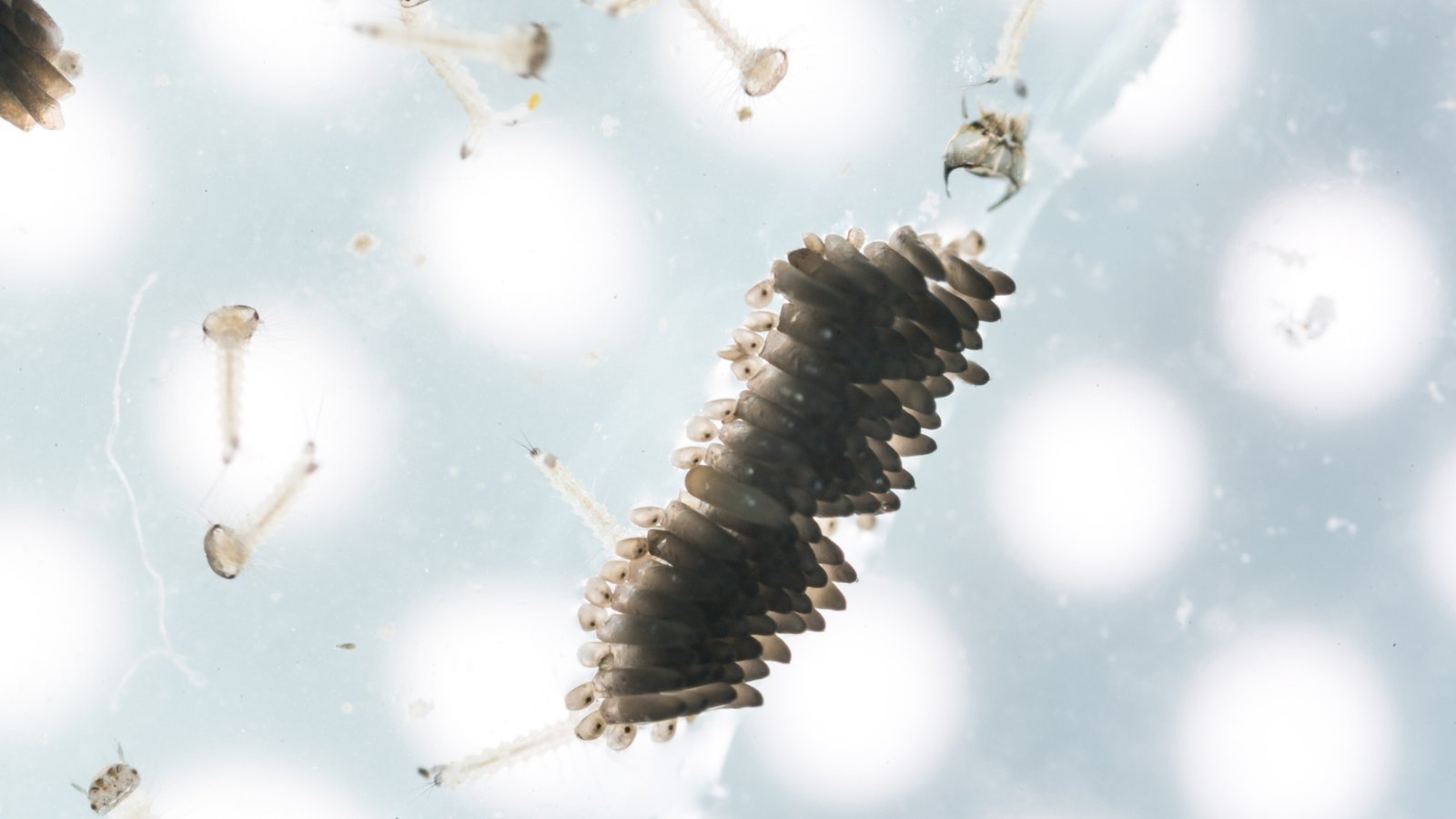
A raft of eggs looks like a speck of soot floating on the water and is about a quarter inch long and an eighth inch wide (Salt Lake City Mosquito Abatement District, “Mosquito Biology”). Each raft is made of many individual eggs standing on end and packed together, which is why the whole structure floats as one piece. A single female may lay a raft every third night during her life span (American Mosquito Control Association, “Life Cycle”).
Rafts need standing water to form, so they turn up in the same places these mosquitoes breed: buckets, old tires holding rainwater, clogged gutters, birdbaths, storm drains, and other quiet water that sits for several days. These eggs are not built to survive drying out. Culex eggs are susceptible to drying out during extended droughts, so a raft that is stranded on a dry surface generally does not survive (American Mosquito Control Association, “Life Cycle”). Most eggs hatch into larvae within about 48 hours of contact with water (Salt Lake City Mosquito Abatement District, “Mosquito Biology”).
Single eggs on water
Anopheles mosquitoes lay their eggs singly on the water surface, and each egg carries little floats. Anopheles and many other mosquitoes lay their eggs one at a time directly on standing water rather than gluing them into a raft (American Mosquito Control Association, “Life Cycle”; Penn State Extension, “Mosquito Biology and Control”).
The distinguishing feature is on the egg itself. Anopheles eggs have paired float structures on their sides that keep each egg riding on the surface film. Under magnification the eggs often appear arranged in loose patterns on the water rather than clumped together. Like Culex eggs, Anopheles eggs are susceptible to drying out during droughts, so they depend on the water staying put (American Mosquito Control Association, “Life Cycle”).
Anopheles is the group that includes the malaria vectors, so its breeding water matters for disease surveillance. In practice the floats and the single-egg pattern are visible only under a hand lens or microscope, not to the naked eye.
Single eggs above the waterline
Aedes and Psorophora mosquitoes lay eggs singly on damp surfaces just above the water, not on the water itself. Adult females lay eggs one at a time on the inside wall of a container, at or above the waterline, or on damp soil that will later be flooded (Penn State Extension, “Mosquito Biology and Control”; American Mosquito Control Association, “Life Cycle”).
These eggs are drought-resistant. They can remain dormant and viable on a container wall or in soil for a long time, then hatch after the area is flooded and the eggs become submerged (Penn State Extension, “Mosquito Biology and Control”). Some require a period of complete drying before they will hatch at all (American Mosquito Control Association, “Life Cycle”). Laboratory work on Aedes aegypti has documented eggs surviving many months of dry storage, with a large fraction still viable after roughly eight months at cooler temperatures (Farnesi et al., PLOS Biology, 2023). This is why containers and floodplains matter so much: an egg laid this year on the dry inside of a flowerpot or in a low spot of a field can wait through a dry spell and hatch the next time water rises.
Two overlapping groups use this strategy. Container Aedes such as the yellow fever mosquito (Aedes aegypti) and the Asian tiger mosquito (Aedes albopictus) lay on the walls of artificial containers just above the water line and overwinter in the egg stage. Floodwater species, including most Psorophora and floodwater Aedes such as Aedes vexans, lay desiccation-resistant eggs in moist depressions above the water line that hatch in large numbers when rain or a river inundates the ground (Rutgers Center for Vector Biology, “Life Cycle Types”; Penn State Extension, “Mosquito Biology and Control”).
Why egg strategy makes some species hard to control
The above-the-waterline egg is the reason certain mosquitoes are stubborn. When eggs sit on water as a raft or float, draining or treating the water removes the next generation directly. When eggs are glued to a dry surface, they are out of the water and out of reach of larvicides that only work once larvae are swimming.
A drought-resistant egg also breaks the link between a single rain event and a single hatch. Because some of these eggs hatch only after drying and then flooding, and because a batch does not always hatch all at once, one clutch can produce mosquitoes across several separate flooding events (American Mosquito Control Association, “Life Cycle”; Penn State Extension, “Mosquito Biology and Control”). Floodwater species compound this by hatching in large numbers at the same time after inundation, with adults appearing as early as about seven days after flooding (Penn State Extension, “Mosquito Biology and Control”).
The practical control lesson follows from the biology. For raft and float layers, the target is standing water: dump it, drain it, or treat it. For above-the-waterline layers, the target is the surface itself. Scrubbing the inside walls of containers, and emptying and drying them, removes eggs that draining alone leaves behind.
What you might actually see at home
The two most common finds are a raft and a container clutch.
A raft in a bucket looks like a small dark fleck, gray to brown, floating flat on water that has stood undisturbed for several days. It is roughly the size of a grain of rice, holds together when the water is nudged, and is usually a Culex or Culiseta raft. Standing water that has sat long enough to grow a raft is prime breeding water, so tipping it out is the direct response.
Eggs in a container are harder to spot. Aedes eggs are laid one at a time on the damp inside wall just above the water, so they show up as tiny dark specks stuck to the plastic or ceramic rather than as a floating mass. They are difficult to see and may already be dry. Because they can survive drying, emptying the container is not enough on its own. Scrubbing the inner walls removes eggs that pouring out the water leaves in place (Penn State Extension, “Mosquito Biology and Control”; Centers for Disease Control and Prevention, “Life Cycle of Aedes Mosquitoes”).
If you are seeing repeated waves of mosquitoes from the same low spot in a yard or field after each heavy rain, that pattern points to floodwater eggs in the soil rather than to any single body of standing water.
Sources
- American Mosquito Control Association, “Life Cycle.” https://www.mosquito.org/life-cycle/ (accessed 2026-07-20). Culex egg rafts of 100 to 300 eggs, raft resembling a speck of soot about 1/4 inch by 1/8 inch, a raft laid every third night, Anopheles single eggs on water, Aedes and Ochlerotatus eggs laid singly on damp soil, drought resistance and hatching only when flooded.
- Salt Lake City Mosquito Abatement District, “Mosquito Biology.” https://www.slcmadutah.gov/biology.html (accessed 2026-07-20). Raft dimensions and soot appearance, Anopheles and Aedes not making rafts, most eggs hatching within 48 hours of contact with water.
- Penn State Extension, “Mosquito Biology and Control.” https://extension.psu.edu/mosquito-biology-and-control (accessed 2026-07-20). Culex rafts, Anopheles single eggs, Aedes eggs laid singly on container walls at or above the waterline, eggs remaining dormant on soil until flooded, hatching after desiccation, large simultaneous floodwater hatches with adults in about seven days, overwintering in the egg stage.
- Centers for Disease Control and Prevention, “Life Cycle of Aedes Mosquitoes.” https://www.cdc.gov/mosquitoes/about/life-cycle-of-aedes-mosquitoes.html (accessed 2026-07-20; page returned HTTP 403 on direct fetch, content confirmed via search result snippet). Aedes females lay eggs singly on container walls above the waterline, eggs can survive drying for months, and eggs hatch when covered with water.
- Rutgers Center for Vector Biology, “A Classification System for Mosquito Life Cycles.” https://vectorbio.rutgers.edu/outreach/mosclassSOVE.php (accessed 2026-07-20). Floodwater life cycle type, desiccation-resistant eggs laid in depressions inundated by floodwater, genera including Aedes, Ochlerotatus, and Psorophora.
- Farnesi, L. C., et al., “Eggs of the mosquito Aedes aegypti survive desiccation by rewiring their polyamine and lipid metabolism,” PLOS Biology, 2023. https://journals.plos.org/plosbiology/article?id=10.1371/journal.pbio.3002342 (accessed 2026-07-20). Aedes aegypti eggs surviving many months of desiccation.
Related
- [Placeholder: Culex mosquito identification]
- [Placeholder: Aedes aegypti and Asian tiger mosquito identification]
- [Placeholder: Anopheles mosquito identification]
- [Placeholder: Mosquito larvae identification]
- [Placeholder: How to find and remove mosquito breeding sites]
Educational note: This guide is a non-commercial reference for general identification and biology. It is not pest control advice or a species-level diagnostic. For control decisions or disease concerns in your area, contact your local mosquito control district or public health department.
Last reviewed 20 July 2026.