The short answer
Psorophora are floodwater mosquitoes. Many are large, and several are among the most aggressive daytime and evening biters you will meet in the eastern and southern US. Their populations swell in the days after heavy rain, when temporary pools flood the low ground where their eggs were waiting. For most people, the practical concern is nuisance and a painful bite rather than disease. A few species carry arboviruses, but their role as vectors of human illness is limited and is stated honestly below.
The genus includes the famous “gallinipper,” Psorophora ciliata, one of the largest mosquitoes in the region.
Shared identification traits
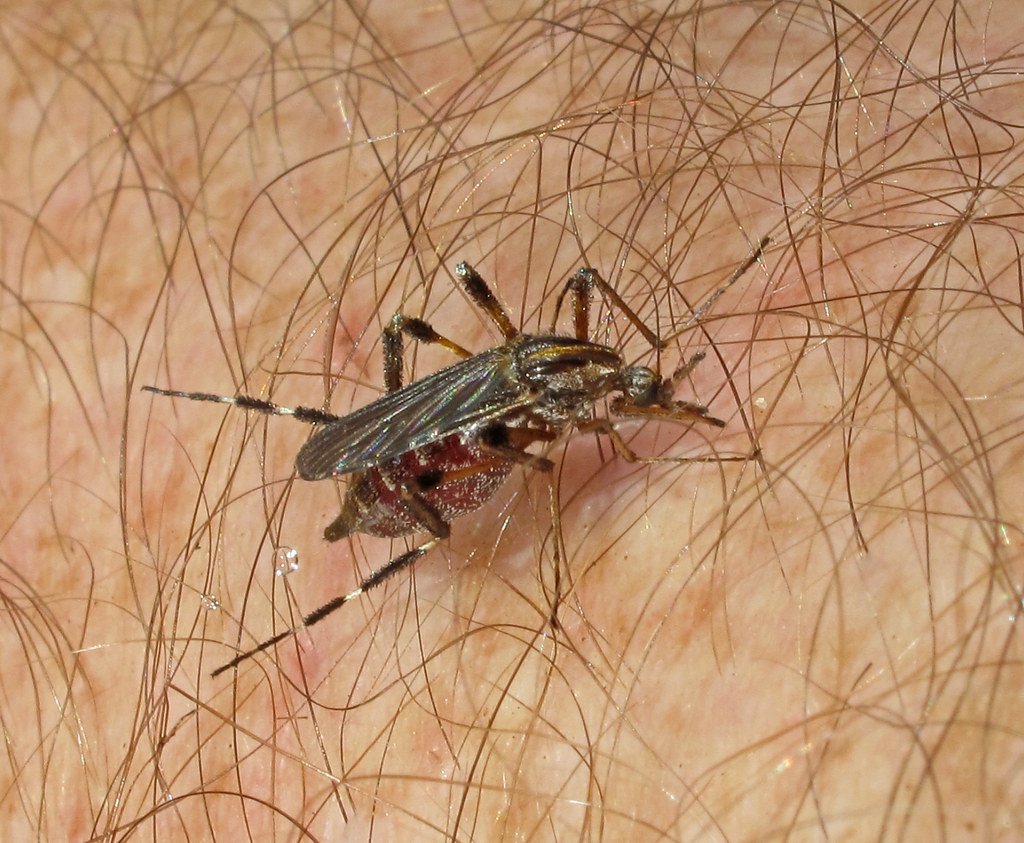
Psorophora tend to run large for a mosquito, and the biggest members are unmistakable. The gallinipper has a body about half an inch long with a black-and-white pattern that looks like a super-sized version of the Asian tiger mosquito, and it carries banded, “shaggy” legs that are a signature of the group. Reported wingspan for P. ciliata is roughly 7 to 9 mm, large compared with most other mosquitoes.
Not every Psorophora is a giant. The dark rice field mosquito, Psorophora columbiae, is only medium-sized, with a wing length around 4.0 to 4.5 mm. It is dark brown to dull black with numerous patches of pale scales, a broad band of pale scales on the proboscis, and pale golden scale patches toward the tips of the abdominal segments. So while “large with shaggy or banded legs” describes the headline species, careful identification of the smaller members rests on scale patterns rather than size alone.
Breeding
Psorophora are true floodwater mosquitoes, and their breeding cycle is tied to the rise and fall of temporary water. Females lay eggs on moist or damp soil in open, sunny, low-lying ground that is subject to flooding, rather than on standing water. Those eggs can sit dormant on dry or damp land for long periods, in some cases months or years, and they hatch only when floods, rain, or irrigation cover them with water.
The larvae then develop fast in the shallow temporary pools, puddles, flooded ruts, roadside ditches, grassy swales, and rice fields that appear after inundation. In warm conditions, P. columbiae can go from first instar to pupa in as few as 3.5 days.
One trait sets part of this genus apart from typical mosquitoes. Some Psorophora larvae are predacious: instead of grazing on decaying plant matter, they eat the larvae of other mosquitoes sharing the same temporary pool, and the gallinipper’s larvae have been described as devouring other mosquito larvae and even tadpoles.
Behavior
The behavior that earns Psorophora its reputation is the bite. Females of P. ciliata are vicious biters that prefer mammals, will feed during both day and night, and are able to bite through heavy clothing. The bite is genuinely painful. A University of Florida entomologist who studies the species put it plainly: “The bite really hurts, I can attest to that.” Females of P. columbiae are likewise described as furious biters by day or night.
Because their eggs hatch on cue with flooding, Psorophora emerge in large numbers after heavy rain. That timing is why they can seem to appear suddenly and in force, and why the usual advice to empty birdbaths and gutters does little to control them: they breed in flooded fields and floodplains, not in backyard containers. Only females take blood; males feed on flower nectar.
Key US Psorophora species
-
Psorophora ciliata, the gallinipper. The large, aggressive standout of the genus, native to the eastern half of the region and ranging roughly from South Dakota south toward Central America and east to Quebec and Florida. Known for its size, shaggy banded legs, painful bite, and predatory larvae. See the species page: Psorophora ciliata.
-
Psorophora columbiae, the dark rice field mosquito. A medium-sized, dark, pale-flecked floodwater species strongly associated with rice-growing regions and other flooded farmland across the Gulf Coast and Atlantic seaboard, with scattered populations elsewhere. A relentless biter and a significant pest of livestock. See the species page: Psorophora columbiae.
Disease relevance
Chiefly, Psorophora are nuisance biters, and that is the honest headline. The gallinipper in particular is not considered a significant vector of mosquito-borne illness affecting people or animals; the case against it is the pain and annoyance of the bite, not disease.
The dark rice field mosquito is the more medically and agriculturally notable member. It is regarded as a competent vector of epidemic strains of Venezuelan equine encephalitis virus, it can transmit canine heartworm (Dirofilaria immitis), and it has frequently tested positive for West Nile virus, though it has never been implicated as a major epidemic vector of West Nile. In heavy years, large P. columbiae populations are a serious veterinary problem: they cause extreme annoyance to livestock, transmit anaplasmosis in cattle, and swarms have been reported to reduce weight gain and milk production and, at extremes, to kill animals.
The balanced picture: enjoy no illusions about the bite, but keep the disease risk in proportion. For the genus as a whole in this region, the dominant story is aggressive nuisance biting, with a limited and species-specific vector role.
Sources
-
UF/IFAS EDIS, “Dark Rice Field Mosquito (suggested common name) Psorophora columbiae (Dyar & Knab)” (publication IN1265), https://ask.ifas.ufl.edu/publication/IN1265 (accessed 2026-07-20). Size and identification (wing length 4.0 to 4.5 mm, dark coloration, pale scale patches, proboscis band); eggs deposited on damp soil of sunny sites subject to flooding; floodwater biology and rice-field association; feeds on mammalian hosts including humans; vector of Venezuelan equine encephalitis and canine heartworm; frequent West Nile positives but not a major epidemic vector.
-
Rutgers Center for Vector Biology, species profile “Psorophora columbiae (Dyar and Knab),” https://vectorbio.rutgers.edu/outreach/species/sp4.htm (accessed 2026-07-20). Eggs deposited on moist soil subject to flooding by rainfall or irrigation; larvae in temporary vegetated pools, rice fields, ditches, swales; larval development to pupa in as few as 3.5 days; “furious biters in day or night”; distribution from Florida to New York and westward to California; nuisance and vector of Venezuelan equine encephalitis and anaplasmosis; livestock impacts.
-
Iowa State University Extension, Yard and Garden, “Giant Mosquitoes Invade Iowa” (2010), https://yardandgarden.extension.iastate.edu/article/2010/8-25/psorophora.html (accessed 2026-07-20). Females lay eggs on moist soil that hatch when covered by floodwater or temporary pools; some Psorophora larvae are predacious and eat other mosquito larvae; P. ciliata females are vicious biters, feed by day and night, and bite through heavy clothing; container-source control is ineffective.
-
University of Florida news release, “Huge, aggressive mosquito may be abundant in Florida this summer, UF/IFAS expert warns” (2013), archived at https://archive.news.ufl.edu/articles/2013/03/huge-aggressive-mosquito-may-be-abundant-in-florida-this-summer-ufifas-exper.html (accessed 2026-07-20). Gallinipper body about half an inch long with black-and-white pattern; entomologist Phil Kaufman on the painful bite (“The bite really hurts, I can attest to that”); eggs laid in soil at water edges remain dormant until high water triggers hatch; larvae omnivorous, devouring other mosquito larvae and tadpoles; not considered a significant vector of illness affecting people or animals.
-
Wikipedia, “Psorophora ciliata,” https://en.wikipedia.org/wiki/Psorophora_ciliata (accessed 2026-07-20). Wingspan 7 to 9 mm and relatively large within the genus; banded “shaggy” legs; range from South Dakota south to Central America and east to Quebec and Florida, east of the Continental Divide; eggs laid singly on moist soil, dormant then hatching; larvae prey on other mosquito larvae and tadpoles; aggressive females active day or night; origin of the name “gallinipper.” (Used for corroborating size, range, and predatory-larvae details also supported by sources 3 and 4.)
Related
- Psorophora ciliata (the gallinipper) [placeholder]
- Psorophora columbiae (dark rice field mosquito) [placeholder]
- Floodwater mosquitoes explained [placeholder]
- Aedes vexans, the inland floodwater mosquito [placeholder]
Educational note: This page is an independent, non-commercial reference summary drawn from public entomology and public-health sources. It is for general education and is not medical, veterinary, or pest-control advice. For a bite reaction that concerns you, consult a clinician; for persistent local mosquito problems, contact your county or regional mosquito control program.
Last reviewed 20 July 2026.