The short answer
Psorophora ciliata, commonly called the gallinipper, is one of the largest mosquitoes on the continent and an aggressive, persistent biter. Its bite is genuinely painful, and adults can appear in large numbers after heavy rain or flooding. That reputation is earned, but it should be kept in proportion. This is a nuisance mosquito, not a major disease threat. Available evidence points to a limited vector role rather than a public-health emergency, and much of what circulates online about the gallinipper is exaggeration. The plain reality is a big mosquito with a sharp bite that shows up in wet, flood-prone areas and then fades as the water recedes.
How to identify it
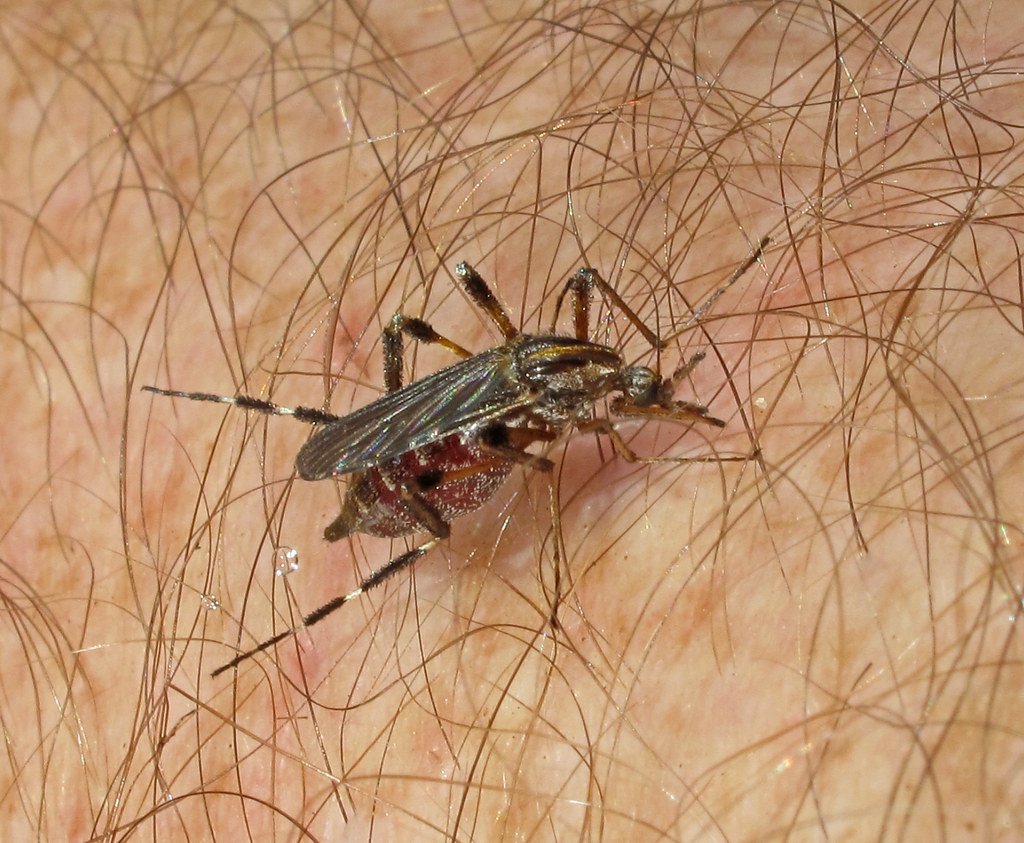
Size is the first clue. Psorophora ciliata is described by the Walter Reed Biosystematics Unit as the largest mosquito in North America, and local mosquito control programs note that a female is roughly the size of a quarter (Sources 2, 5). University of Florida entomologists have put it at around 20 times larger than the common mosquitoes most people are used to swatting (Source 6).
The legs are the second clue and the reason for one of its common names. Jacksonville mosquito control describes a very large mosquito with noticeably yellow and black banded legs, which is why it is sometimes called the feather-legged or shaggy-legged gallinipper (Sources 2, 4). The overall look is dark and mottled with those conspicuous banded, shaggy-looking hind legs. If you see a mosquito that looks oversized, dark, and hairy-legged after a flood, the gallinipper is a strong candidate.
Where it lives
The gallinipper is a floodwater mosquito of the eastern and southeastern regions, and it is recorded broadly across the continental part of the country (Sources 1, 2). Rather than laying eggs directly on water like some mosquitoes, the female deposits eggs in small depressions or cracks in damp soil in low-lying, flood-prone ground (Sources 4, 5). Those eggs are drought-hardy. Jacksonville mosquito control notes that gallinipper eggs can hatch several years after they are laid, and Brunswick County mosquito control reports that eggs deposited in soil cracks probably do not hatch until after a winter in hibernation (Sources 4, 5). Hatching is triggered when rain or flooding inundates the site.
Once flooded, the larvae develop in unshaded, temporary rain-filled pools, usually in about 4 to 6 days, with the pupal stage complete in roughly 2 days (Source 5). One of the more striking facts about this species lives in that larval stage. Gallinipper larvae are predatory, feeding on other mosquito larvae that share their pools, including species such as Psorophora columbiae (Sources 1, 5). A peer-reviewed study of prey capture found that Psorophora ciliata is an obligate predator that strikes with robust, sharply toothed mandibles and a rapid, accordion-like propulsion of the head toward prey (Source 3). Because of this appetite, the species has been floated as a natural control on pest mosquitoes, but University of Florida researchers note the larvae do not occur in large enough numbers to meaningfully control overall mosquito populations (Source 1).
Behavior
Female gallinippers are persistent biters that will attack at any time of day when their habitat is disturbed, and they inflict what mosquito control literature plainly calls a painful injury (Sources 2, 5). They are not shy dawn-and-dusk feeders. If you walk into a field where they are resting, they will come for you in daylight. Host studies in Florida show the species is primarily mammal-feeding, with recorded hosts including humans, cattle and other ruminants, rabbits, armadillos, and raccoons (Source 2).
The other defining behavior is timing. Because eggs sit dormant in soil and hatch on flooding, adults tend to emerge in pulses. Large numbers can appear after heavy rain, and it is not uncommon to see them in force following a hurricane or major flood event (Sources 1, 5). This boom-and-fade pattern is why the gallinipper feels sudden and overwhelming, then largely disappears.
Disease role
This is the part most worth keeping calm about. The gallinipper is chiefly a painful nuisance rather than an important disease vector. University of Florida entomologists note that Psorophora ciliata has not had enough research to support labeling it a vector of significant medical or veterinary importance (Source 1). The Walter Reed Biosystematics Unit does list it among species noted in connection with St. Louis encephalitis virus, so a minor or occasional role cannot be dismissed outright (Source 2).
Laboratory work supports a cautious, honest reading. In an experimental study of Rift Valley fever virus, Psorophora ciliata could become infected after feeding on viremic hosts, yet showed negligible ability to actually transmit the virus, which is the step that matters for spreading disease (Source 7). In short, the science available today describes a big, painful biter with, at most, a limited vector role. Claims that frame the gallinipper as a serious disease menace go beyond what the evidence shows.
How to control it
Because the gallinipper breeds in temporary floodwater, control focuses on water and habitat rather than on chasing adults. Organized mosquito control programs monitor known wetlands and flood-prone sites and treat them when they are wet and larvae are found, which targets the species during its vulnerable aquatic stage (Source 4). For homeowners, this mosquito is genuinely hard to manage by source reduction alone, since the breeding sites are often large flooded fields and ditches rather than backyard containers (Source 4). Practical steps are the standard floodwater-mosquito playbook. Reduce standing water where you can, keep low areas draining after storms, use personal protection such as repellent and long sleeves during outbreak periods, and report large breeding sites to your local mosquito control district so professionals can treat the water. Broad adult spraying tends to be a short-term measure, and given the larvae’s own predation on other mosquitoes, sound programs weigh source-based management over blanket insecticide use.
Sources
- University of Florida IFAS Featured Creatures, “A Mosquito Psorophora ciliata (Fabricius)” (EENY-540/IN967), Ragasa and Kaufman. https://edis.ifas.ufl.edu/publication/IN967 (accessed 2026-07-20 via search snippet text; page returned 410/redirect on direct fetch). Claims: floodwater biology, egg laying in soil, larval predation on other mosquito larvae, larvae too few for effective biocontrol, roughly 20x larger framing context, limited/unproven vector status, outbreaks after heavy rain.
- Walter Reed Biosystematics Unit (WRBU), “Psorophora ciliata (Fabricius, 1794).” https://wrbu.si.edu/vectorspecies/mosquitoes/ciliata (accessed 2026-07-20 via search snippet text; direct fetch failed on DNS). Claims: largest mosquito in North America, painful persistent day-biting, eggs laid in flood-prone soil cracks and depressions, mammal-feeding hosts, association with St. Louis encephalitis virus, continental distribution.
- Annals of the Entomological Society of America / PMC, “Mosquitoes Eating Mosquitoes: How Toxorhynchites amboinensis, Psorophora ciliata, and Sabethes cyaneus Capture Prey.” https://pmc.ncbi.nlm.nih.gov/articles/PMC9661258/ (accessed 2026-07-20). Claims: obligate predatory larvae, toothed mandibles, accordion-like head-propulsion strike mechanism.
- City of Jacksonville Mosquito Control, “Psorophora ciliata.” https://www.jacksonville.gov/departments/neighborhoods/mosquito-control/psorophora-ciliata.aspx (accessed 2026-07-20). Claims: very large mosquito with yellow and black banded legs, feather-legged gallinipper name, vicious mammal-preferring biter, breeds in flooded fields, eggs can hatch several years later, difficult for homeowners to control, monitoring-and-treatment approach.
- Brunswick County (NC) Mosquito Control, “Psorophora ciliata Biology,” Hickman and Brown. https://www.brunswickcountync.gov/DocumentCenter/View/1396/Psorophora-Ciliata-Biology-PDF (accessed 2026-07-20). Claims: eggs in soil depressions hatching after winter hibernation, larvae in temporary rain-filled pools developing in 4 to 6 days, pupa in 2 days, larvae predacious on other mosquito larvae including Ps. columbiae, persistent painful daytime biters, size of a quarter, large numbers in post-hurricane situations.
- Live Science, “Meet the Gallinippers: Huge Mosquitoes Spotted in Florida” (quoting University of Florida entomologist). https://www.livescience.com/37383-gallinippers-huge-mosquitoes-florida.html (accessed 2026-07-20). Claims: about 20 times larger than common mosquitoes, floodwater breeding tied to heavy rain.
- “Potential for Psorophora columbiae and Psorophora ciliata Mosquitoes (Diptera: Culicidae) to Transmit Rift Valley Fever Virus.” https://www.researchgate.net/publication/281541458_Potential_for_Psorophora_columbiae_and_Psorophora_ciliata_Mosquitoes_Diptera_Culicidae_to_Transmit_Rift_Valley_Fever_Virus (accessed 2026-07-20 via search snippet text; direct fetch returned 403). Claim: Ps. ciliata became infected with Rift Valley fever virus in the laboratory but showed negligible transmission.
Related
- Psorophora columbiae (dark rice field mosquito)
- Psorophora ferox
- Aedes vexans (inland floodwater mosquito)
- Floodwater mosquitoes: what they are and why they surge after storms
- Mosquito bite pain and reactions: what to expect
- How mosquito control districts manage floodwater breeding sites
Educational note: This profile is provided for general education and reference. It is not medical, pest-control, or public-health advice. For bite reactions that concern you, consult a clinician, and for large or persistent mosquito breeding problems, contact your local mosquito control district or health department.
Last reviewed 20 July 2026.