Short answer
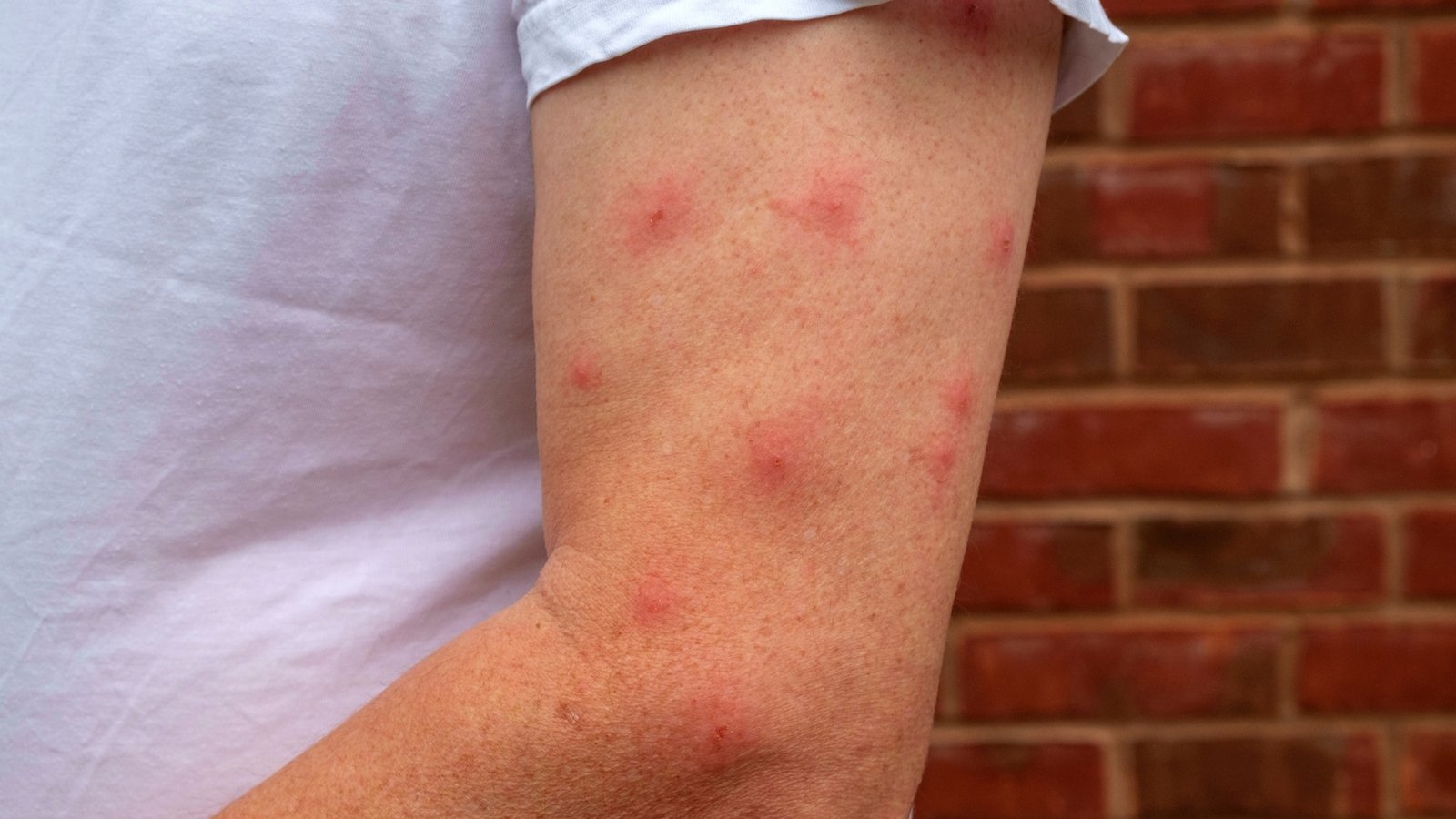
Waking up or coming indoors covered in bites usually means one of two things. Either one or more mosquitoes fed on you repeatedly, or you spent time in a spot where a lot of mosquitoes were active. A single mosquito can leave more than one welt, and several mosquitoes in a mosquito-heavy area can add up quickly.
There is one important exception. A tight line or a small cluster of bites on skin that was covered by bedding overnight can point to bedbugs rather than mosquitoes. The pattern and the location on your body are the main clues (Cleveland Clinic).
Why one mosquito can leave several bites
A cluster of welts does not always mean a swarm attacked you. A few things explain it.
Interrupted feeding. A mosquito probes the skin before it settles into a blood vessel. If it is disturbed before it finishes, by a swat, a brush of the hand, or you simply shifting, it may relocate a short distance and bite again. Several close-together welts can be the record of one determined mosquito trying to finish a meal.
More than one mosquito. Individual mosquitoes also feed on more than one person, and bite more than once, within a single reproductive cycle. In one field study of the dengue mosquito, researchers estimated that roughly 43 to 46 percent of blood-fed mosquitoes had bitten more than one person in a single feeding cycle (Scott and colleagues, PLoS Neglected Tropical Diseases). In a spot with a lot of mosquitoes, several of them biting is enough to leave a group of welts.
Being more attractive to mosquitoes. Some people simply get bitten more. Mosquitoes track the carbon dioxide you exhale, which they can sense from a distance, then home in on body heat and on the lactic acid and other compounds in sweat (Houston Methodist). Skin bacteria and body odor play a role too. Blood type may matter, with some studies pointing to type O, though the overall picture is best treated as one factor among several rather than a settled rule (Smithsonian Magazine). For the full breakdown, see why some people get bitten more.
Where clusters happen
Mosquito bites tend to show up on skin that is not covered by clothing, such as the arms, hands, legs, feet, and neck (Cleveland Clinic; American Academy of Dermatology). That is why bites often group on ankles and forearms, the areas most people leave exposed.
Two situations make a cluster more likely.
- Near breeding sites. Mosquitoes develop in shallow, stagnant water, including birdbaths, buckets, old tires, clogged gutters, ponds, and children’s pools. Standing close to one of these means standing close to where mosquitoes emerge (Cleveland Clinic).
- At dusk and dawn. Many mosquitoes are most active in the low light around sunset and sunrise, so time spent outdoors then raises your odds of collecting several bites at once (Cleveland Clinic).
When a cluster suggests bedbugs, not mosquitoes
If the bites appeared overnight and sit in a straight line, a row, or a zigzag, bedbugs are worth considering. Bedbug bites often line up in a series and turn up on skin that touches bedding, including the arms, legs, back, face, and neck. Bedbugs are typically active at night while you are lying still (Cleveland Clinic).
Mosquito bites, by contrast, tend to be more scattered and random, sit on exposed skin, and follow time spent outdoors rather than time in bed (Cleveland Clinic; American Academy of Dermatology). No single feature is proof on its own, but the combination of an overnight appearance, a linear pattern, and bites on normally covered skin leans toward bedbugs. For a fuller comparison, see mosquito bite versus bedbug bite.
What to do
Treat the itch. Most mosquito bites settle and heal on their own within a few days. To ease the itch in the meantime, apply a cold pack or ice, or use an over-the-counter hydrocortisone or other anti-itch cream. Calamine lotion or an oral antihistamine can help with stronger reactions. Try not to scratch, since broken skin can become infected (Mayo Clinic; American Academy of Dermatology).
Prevent more bites. Use an insect repellent on exposed skin and clothing; dermatologists suggest a product with 20 to 30 percent DEET. When the weather allows, cover up with a hat, long sleeves, and long pants, and empty standing water around your home so mosquitoes have fewer places to breed (American Academy of Dermatology; Cleveland Clinic).
Check for bedbugs if the pattern fits. If the bites keep appearing overnight in lines on covered skin, inspect the mattress seams, headboard, and bedding for signs of bedbugs, and read mosquito bite versus bedbug bite before assuming the cause.
If you develop a spreading rash, a fever, or body aches after being bitten, contact a clinician, since some mosquito-borne illnesses begin that way (American Academy of Dermatology).
Sources
- Cleveland Clinic, “What Do Bed Bug Bites Look Like? What To Know” (bedbug bite patterns: lines, rows, zigzag, overnight, covered skin; comparison with mosquito bites). https://health.clevelandclinic.org/need-know-bed-bugs (accessed 20 July 2026).
- Cleveland Clinic, “Mosquito Bites” (bites on exposed skin, dusk and dawn activity, standing-water breeding sites, treatment and prevention). https://my.clevelandclinic.org/health/diseases/17695-mosquito-bites (accessed 20 July 2026).
- Mayo Clinic, “Mosquito bites: Diagnosis and treatment” (cold compress, hydrocortisone, calamine, antihistamine, avoid scratching, most bites heal in days; repellent and covering up). https://www.mayoclinic.org/diseases-conditions/mosquito-bites/diagnosis-treatment/drc-20375314 (accessed 20 July 2026; page returned an access error, claims drawn from the Mayo Clinic search result summary of this URL).
- American Academy of Dermatology, “How to prevent and treat bug bites” (20 to 30 percent DEET on skin and clothing, ice pack, hydrocortisone anti-itch cream, when to see a doctor). https://www.aad.org/public/everyday-care/injured-skin/bites/prevent-treat-bug-bites (accessed 20 July 2026).
- Houston Methodist, “Why Are Mosquitoes Attracted to Some People More Than Others?” (carbon dioxide, body heat, lactic acid and sweat, skin bacteria and body odor). https://www.houstonmethodist.org/blog/articles/2022/jun/why-are-mosquitoes-attracted-to-some-people-more-than-others/ (accessed 20 July 2026).
- Smithsonian Magazine, “Why Do Mosquitoes Bite Some People More Than Others?” (blood type studies, type O; treated as one factor among several). https://www.smithsonianmag.com/science-nature/why-do-mosquitoes-bite-some-people-more-than-others-your-blood-type-sweat-contents-even-alcohol-consumption-may-make-you-more-attractive-pesky-insects-10255934/ (accessed 20 July 2026).
- Scott TW and colleagues, “Heterogeneous Feeding Patterns of the Dengue Vector, Aedes aegypti, on Individual Human Hosts in Rural Thailand,” PLoS Neglected Tropical Diseases, 2014 (estimate that roughly 43 to 46 percent of blood-fed mosquitoes bit more than one person per gonotrophic cycle). https://pmc.ncbi.nlm.nih.gov/articles/PMC4125296/ (accessed 20 July 2026).
Related
- Why do some people get bitten more than others? (placeholder)
- Mosquito bite versus bedbug bite: how to tell them apart (placeholder)
- How to stop a mosquito bite from itching (placeholder)
- How long do mosquito bites last? (placeholder)
Educational note: This page is for general information and is not medical advice. It does not replace evaluation by a qualified clinician. If you have a severe reaction, a spreading rash, a fever, or other symptoms after a bite, seek medical care.
Last reviewed 20 July 2026.