The short answer
CO2 mosquito traps lure and capture host-seeking mosquitoes by mimicking a breathing animal. A trap puts out a plume of carbon dioxide, often alongside a chemical lure and sometimes warmth, and a fan pulls the mosquitoes that respond into a net or onto an adhesive surface. These traps can reduce the local numbers of some species, but they are not a standalone solution, and results vary a great deal depending on the mosquito, the trap, and what surrounds your property. University and mosquito-control experts describe them as a supplement to getting rid of standing water, not a replacement for it (University of Florida/IFAS, 2005; American Mosquito Control Association).
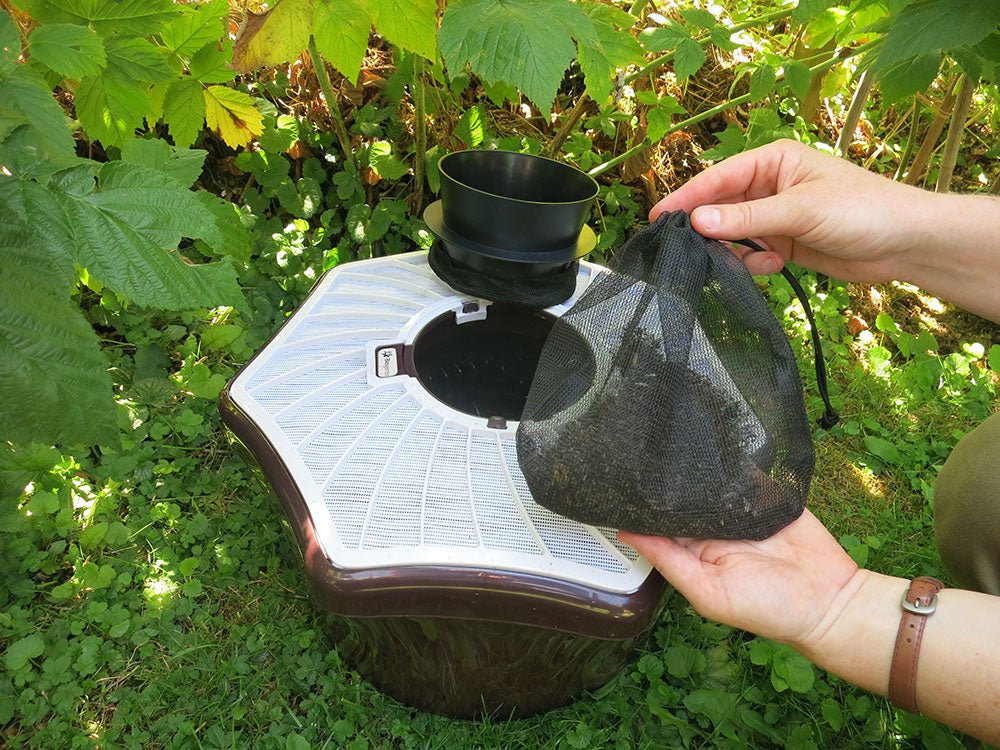
A CO2 mosquito trap running in a backyard. Units like this release carbon dioxide and use a fan to capture host-seeking females.
How they work
Female mosquitoes need a blood meal to produce eggs, and they find a host largely by smell. Carbon dioxide from breath is one of the strongest cues they follow, so a CO2 trap works by imitating that signal. The carbon dioxide is released at roughly 350 milliliters per minute from propane models and about 500 milliliters per minute from cylinder-and-regulator models (American Mosquito Control Association).
Many traps add a second lure to sharpen the imitation. The most common is 1-octen-3-ol (octenol), a compound found in breath and sweat, typically released at about 0.5 milligrams per hour; the American Mosquito Control Association notes it can raise attractiveness “by several orders of magnitude” for some species. Lactic acid is another human-scent lure used with carbon dioxide. Some traps also give off heat and moisture to seem more like a living animal.
Octenol is not equally useful for every species. It significantly increases catches of some mosquitoes that feed on mammals, yet it can actually reduce catches of others; for example, octenol has been shown to decrease collection of Aedes aegypti compared with carbon dioxide alone, while Aedes albopictus is drawn more strongly to carbon dioxide and carbon dioxide plus octenol than to octenol by itself (peer-reviewed trap-comparison studies summarized in extension and research literature). Once a female flies up the plume and reaches the device, a built-in fan draws her into a collection net, and she dries out, or she is held on an adhesive board or grid (University of Florida/IFAS, 2005).
Do they work
The honest answer is that the evidence is mixed. CO2 traps clearly catch mosquitoes, and under the right conditions they can lower populations of certain species over time. But whether that translates into fewer bites where you sit depends on the species, the placement, and the breeding sites around you.
Two things are worth holding side by side.
On the encouraging side, controlled field work shows real reductions when trapping is dense and sustained. A 2024 field trial in two villages in Ningbo, China, spaced carbon-dioxide “breathing” catchers 50 meters apart and reported larval density reductions of roughly 36 to 47 percent and adult reductions of roughly 38 to 66 percent for night-active Culex and 43 to 73 percent for day-active Aedes albopictus, compared with an untreated control village. The same study found the effective radius for control was less than 30 meters per trap (Wu et al., 2025). More broadly, a 2023 review in PLOS Neglected Tropical Diseases concluded that mass trapping of Aedes mosquitoes can reduce populations, but mainly when trap coverage is high; the authors found no significant reduction when coverage was between 0 and 20 percent of houses, with meaningful effects appearing only at much higher coverage and density (review in PLOS Neglected Tropical Diseases, 2023).
On the sobering side, consumer devices used one or two per yard have a weaker record. University of Florida entomologists called these traps “no magic bullet,” noting that they can work well only when the target mosquito does not fly far and breeds near your home, and that many pest species arrive from a considerable distance. Their research also found CO2 traps were significantly outperformed by traps baited with a live host (University of Florida/IFAS, 2005). The American Mosquito Control Association is blunter still, warning that “advertising claims for acre-wide control by these devices appear to be overstated” and that some studies could not demonstrate any meaningful reduction in biting pressure attributable to them (American Mosquito Control Association).
The takeaway: a trap catching mosquitoes is not the same as a trap protecting you. It can help most where the biting species is local, does not travel far, and you can run the trap steadily.
Types
Consumer CO2 traps fall into a few groups by how they make and power the carbon dioxide.
- Propane-powered traps burn propane to generate carbon dioxide, and the tank supplies both the gas and the power, which makes the unit portable and free of extension cords. These are the units most people picture when they hear “mosquito trap.” See our dedicated page on propane mosquito traps for details.
- CO2-cylinder traps feed compressed carbon dioxide from a gas cylinder through a regulator, releasing about 500 milliliters per minute. They avoid combustion but require refilling or swapping cylinders (American Mosquito Control Association).
- CO2-generating traps produce carbon dioxide by other means, such as catalytic conversion of propane or, in some designs, materials that capture and release carbon dioxide from the air; many of these are AC-powered and tethered to an outlet, which is cheaper but limits placement (American Mosquito Control Association; Wu et al., 2025).
Whatever the type, none is set-and-forget. Propane tanks need replacing, cylinders need refilling, capture nets need emptying, and adhesive boards or grids need cleaning or replacement (American Mosquito Control Association).
Getting the most from one
Placement matters more than most buyers expect. Mosquito researchers recommend keeping the trap out of the immediate area where people gather and setting it between the people and the source of the mosquitoes, so the plume intercepts females before they reach you rather than drawing more of them into your seating area (University of Florida/IFAS, 2005).
A few practical points follow from the research:
- Put it between breeding sites and gathering spots. Position the trap toward the likely mosquito source (shaded, damp, vegetated areas or standing water) and away from the patio or deck.
- Respect the short range. Field data suggest an effective radius under 30 meters per trap, so one unit covers a limited area and several spaced units do more than a single one (Wu et al., 2025).
- Run it continuously through the season. Traps work by steadily intercepting host-seeking females, so experts advise operating them continuously during warm months rather than switching them on only when you go outside (University of Florida/IFAS, 2005).
- Keep up the maintenance. Empty nets, refill gas, and clean surfaces on schedule, or the trap loses its pull (American Mosquito Control Association).
Reasonable expectations
Treat a CO2 trap as a supplement, not a cure. It does nothing about the breeding sites that produce mosquitoes in the first place, which is why every authoritative source pairs it with source reduction. The single most effective home step is still eliminating standing water where larvae develop, then adding barriers like screens and repellents. A trap can shave down local numbers of the right species in the right spot, and it may help most where your biting mosquitoes breed nearby and do not travel far. Where they fly in from a distance, expect modest results at best, and do not count on one device to clear a yard, let alone an acre (University of Florida/IFAS, 2005; American Mosquito Control Association).
Sources
- University of Florida/IFAS News, “Carbon dioxide mosquito traps no magic bullet, say UF experts” (2005). Expert commentary from entomologists Jonathan Day, Dan Kline, and Roxanne Rutledge, and Joe Conlon of the American Mosquito Control Association, on how CO2 traps work, species-specific limits, placement, and continuous operation. https://archive.news.ufl.edu/articles/2005/05/carbon-dioxide-mosquito-traps-no-magic-bullet-say-uf-experts.html (accessed 2026-07-20)
- American Mosquito Control Association, “Traps.” Technical detail on CO2 release rates, octenol as a lure, propane versus cylinder power, maintenance needs, and cautions that acre-wide control claims are overstated. https://www.mosquito.org/traps/ (accessed 2026-07-20)
- Wu et al., “Efficacy of CO2-baited mosquito catchers in controlling vector mosquitoes in residential areas of China,” Frontiers in Veterinary Science (2025). Field trial in Ningbo, China, reporting larval and adult density reductions and an effective radius under 30 meters. https://www.frontiersin.org/journals/veterinary-science/articles/10.3389/fvets.2025.1671416/full (accessed 2026-07-20)
- Review in PLOS Neglected Tropical Diseases (2023), “Current evidences of the efficacy of mosquito mass-trapping interventions to reduce Aedes aegypti and Aedes albopictus populations and Aedes-borne virus transmission.” Finds mass trapping can reduce populations mainly at high trap coverage and density, with no significant effect below about 20 percent coverage. https://journals.plos.org/plosntds/article?id=10.1371/journal.pntd.0011153 (accessed 2026-07-20)
Related
- Propane mosquito traps
- Source reduction: eliminating standing water (placeholder)
- Mosquito repellents that work (placeholder)
- Mosquito species that bite humans (placeholder)
Educational note: This page is an independent, non-commercial reference. It describes how CO2 mosquito traps work and what published research shows about their effectiveness. It does not endorse any brand or product, and it is not a substitute for guidance from your local mosquito control district. For a persistent or disease-related mosquito problem, contact your county or state mosquito control program.
Last reviewed 20 July 2026.