The short answer
A propane mosquito trap burns propane to make carbon dioxide, heat, and moisture, the same cues a breathing person or animal gives off. Host-seeking mosquitoes follow that plume toward the trap, and a fan pulls them into a net where they dry out and die. In other words, a propane trap is one kind of carbon dioxide trap, and it shares the same mixed, species-dependent track record as CO2 traps in general (American Mosquito Control Association).
These devices do catch mosquitoes. Whether they meaningfully reduce the bites in your yard depends heavily on which species is bothering you and where that species breeds. They are a supporting tool, not a standalone fix.
How they work
The core idea is imitation of a host. A small propane flame passes over a catalyst, and the combustion produces carbon dioxide along with some heat and water vapor. That mix is released steadily to mimic the breath and body warmth of a mammal (Mosquito Magnet, manufacturer description; American Mosquito Control Association).
Carbon dioxide is the long-range signal mosquitoes use to locate a blood meal, and CO2 traps typically emit it in the range of roughly 350 to 500 milliliters per minute (American Mosquito Control Association). Most propane traps also add a secondary chemical lure. The common one is 1-octen-3-ol, usually called octenol, a compound found in cattle breath and sweat that improves catches for several species. In one field evaluation, adding octenol to a Mosquito Magnet Pro trap produced roughly a 2.4-fold to 6-fold increase in Aedes albopictus catches across three trials, and the effect was statistically significant for several species (Qualls and Mullen 2007).
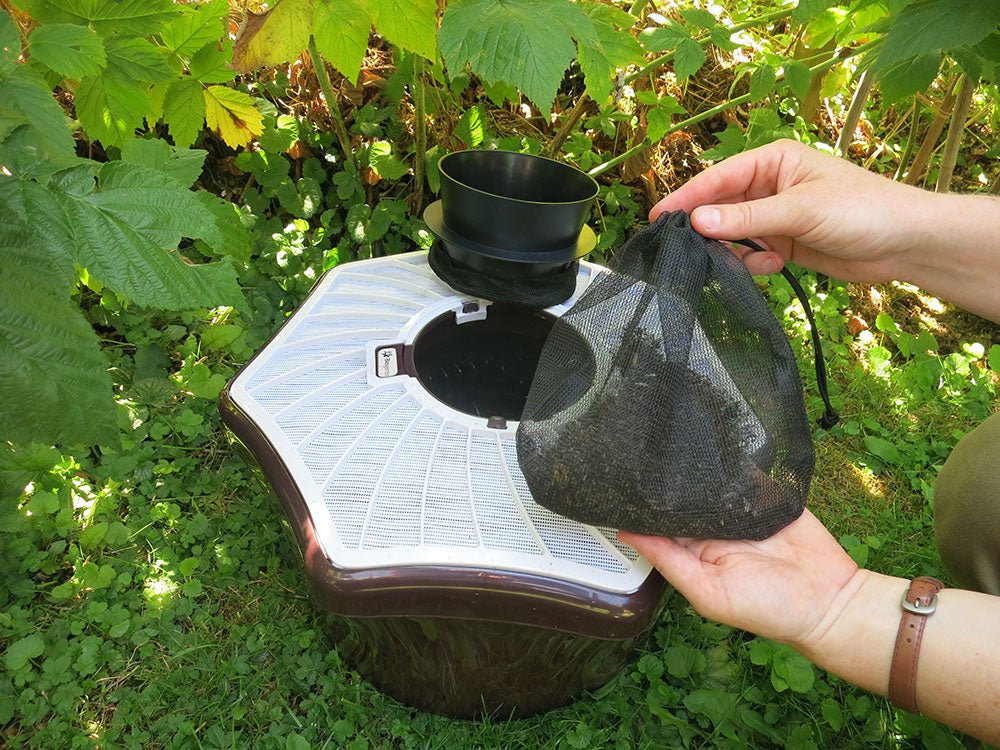
Once a mosquito arrives, a battery or line-powered vacuum fan draws it down into a mesh net. There is no zapper and no pesticide in a standard propane trap. The mosquitoes are simply captured and dehydrated.
Do they work
They work in the narrow sense that they capture large numbers of mosquitoes, and under the right conditions they can lower local numbers over a season. In a two-site study near Fort Langley, British Columbia, researchers ran Mosquito Magnet Liberty Plus traps and collected nearly 200,000 mosquitoes over the season, mostly Aedes sticticus and Aedes vexans. They measured a significant treatment effect, with an average decrease of about 32 percent in adult mosquitoes collected per day, and concluded the results “strongly suggest that Mosquito Magnets can reduce the abundance of nuisance mosquitoes” (Jackson et al. 2012).
The honest caveat is that the broader evidence is mixed, and reducing counts is not the same as stopping bites. The American Mosquito Control Association is direct about this: manufacturer claims of acre-wide protection “appear to be overstated,” and it points to two peer-reviewed studies (Collier et al. 2006; Henderson et al. 2006) that could not “demonstrate any meaningful reduction in biting pressure attributable to these devices.” The AMCA cautions against putting too much faith in traps “as your sole means of control” (American Mosquito Control Association).
Species and geography drive the outcome. University of Florida entomologist Jonathan Day put it plainly: a trap “can be very effective if the target insect is one that doesn’t fly very far or has its breeding site near your home,” but for the strong-flying species people usually complain about, using a trap “is like trying to capture all the grains of sand on the beach.” His lab also found that CO2 traps were significantly outperformed by traps baited with live hosts, because a real person or animal is a stronger draw than a machine (University of Florida, Day). His main advice comes first: know which species is causing your problem before you buy.
For the underlying attractant science shared by all of these devices, see the CO2 traps page.
Running costs and upkeep
A propane trap is a continuous-duty appliance, not a set-and-forget gadget, and the recurring costs reflect that.
- Propane. Most units run off a standard 20-pound refillable tank. Under continuous operation a tank commonly lasts on the order of three weeks, so plan on regular refills or exchanges through the season (Blue Rhino; SkeeterVac / manufacturer guidance).
- Attractant refills. If your trap uses an octenol lure, the cartridge is typically replaced roughly every three weeks for consistent performance (manufacturer guidance).
- Continuous operation. To draw down a local population the trap generally needs to run around the clock rather than only when you are outside, since mosquitoes emerge and seek hosts on their own schedule (manufacturer guidance).
- Cleaning and maintenance. The catch net needs periodic emptying and the unit needs cleaning so airflow and the catalyst stay effective. Some models add smart or adjustable output modes intended to stretch propane and attractant life, which trims but does not eliminate the running cost.
Add it up and a propane trap carries a real seasonal cost in fuel and consumables on top of the purchase price. That is worth weighing against lower-effort options such as source reduction.
Getting reasonable results
If you use a propane trap, a few practices give it the best chance.
- Place it between the mosquitoes’ likely breeding area and the space you want to protect, not next to where you sit. The trap should intercept mosquitoes on their way in, and you do not want to draw them across your patio to reach it. Put it in shade, out of the wind, near the damp or vegetated edges mosquitoes rest in.
- Run it all season, continuously. The British Columbia reduction was measured over months of steady operation, not a weekend (Jackson et al. 2012). Start it early, when temperatures are consistently warm enough for mosquito activity, and keep it going.
- Match it to the right species. A trap helps most against short-flying, locally-breeding species. If your biters are strong fliers arriving from a distant marsh or floodwater site, a yard trap will barely dent the pressure (University of Florida, Day).
- Pair it with source reduction. Removing standing water so fewer mosquitoes hatch in the first place attacks the problem at the source and does more, dollar for dollar, than any adult trap. Treat the trap as one layer in an integrated approach, which is exactly what mosquito control professionals recommend (American Mosquito Control Association).
Realistic expectations
A propane trap is a legitimate tool with a legitimate limit. Expect it to capture a lot of mosquitoes and, in the right setting with steady all-season use, to take some noticeable pressure off a defined area. Do not expect it to clear a yard on its own, protect an acre, or overcome a nearby breeding site that keeps producing new mosquitoes. The strongest, best-documented results come when a trap is one part of a plan that starts with eliminating standing water, and when it is aimed at a local, short-flying species rather than long-distance invaders (American Mosquito Control Association; University of Florida, Day; Jackson et al. 2012).
Sources
- American Mosquito Control Association, “Traps” (overview of CO2 and propane trap function, CO2 emission rates, octenol, overstated acre-wide claims, Collier et al. 2006 and Henderson et al. 2006 finding no meaningful reduction in biting pressure, and the caution against traps as a sole means of control). https://www.mosquito.org/traps/ (accessed 20 July 2026).
- University of Florida, “Carbon dioxide mosquito traps no magic bullet, say UF experts,” quoting entomologist Jonathan Day (how CO2 traps work, species-dependent effectiveness, “grains of sand on the beach,” CO2 traps outperformed by live-host traps, know your species first). https://archive.news.ufl.edu/articles/2005/05/carbon-dioxide-mosquito-traps-no-magic-bullet-say-uf-experts.html (accessed 20 July 2026).
- Jackson, M.J., et al. (2012), “An Evaluation of the Effectiveness of a Commercial Mechanical Trap to Reduce Abundance of Adult Nuisance Mosquito Populations,” Journal of the American Mosquito Control Association 28(4) (Mosquito Magnet Liberty Plus, Fort Langley, British Columbia; about 32 percent average decrease in adult mosquitoes per day; Aedes sticticus and Aedes vexans). https://complete.bioone.org/journals/journal-of-the-american-mosquito-control-association/volume-28/issue-4/12-6241R.1/An-Evaluation-of-the-Effectiveness-of-a-Commercial-Mechanical-Trap/10.2987/12-6241R.1.short (accessed 20 July 2026).
- Qualls, W.A., and Mullen, G.R. (2007), “Evaluation of the Mosquito Magnet Pro trap with and without 1-octen-3-ol for collecting Aedes albopictus and other urban mosquitoes,” Journal of the American Mosquito Control Association 23(2): 131-136 (octenol increased Aedes albopictus catches 2.4-fold to 6-fold; significant for several species). https://pubmed.ncbi.nlm.nih.gov/17847844/ (accessed 20 July 2026).
- Mosquito Magnet (Woodstream), “How Does Mosquito Magnet Work” (manufacturer description: propane converted to warm CO2 and moisture via catalytic converter to mimic a host). https://www.mosquitomagnet.com/advice/how-it-works (accessed 20 July 2026).
- Blue Rhino, “Mosquito Traps: Propane’s Solution for Backyard Bug Control” (operational context: 20-pound propane tank runtime under continuous use). https://bluerhino.com/about/rhino-feed/propane-powered-mosquito-traps (accessed 20 July 2026).
Related
- CO2 traps (co2-traps)
- Source reduction: eliminating standing water [placeholder]
- Choosing a mosquito control method [placeholder]
Educational note: This page is an independent, non-commercial reference. It describes how a category of device works and what the research shows. It is not a product endorsement and does not recommend a specific brand. For a control plan tailored to your property and local species, consult your regional mosquito control district or a university extension office.
Last reviewed 20 July 2026.