Short answer
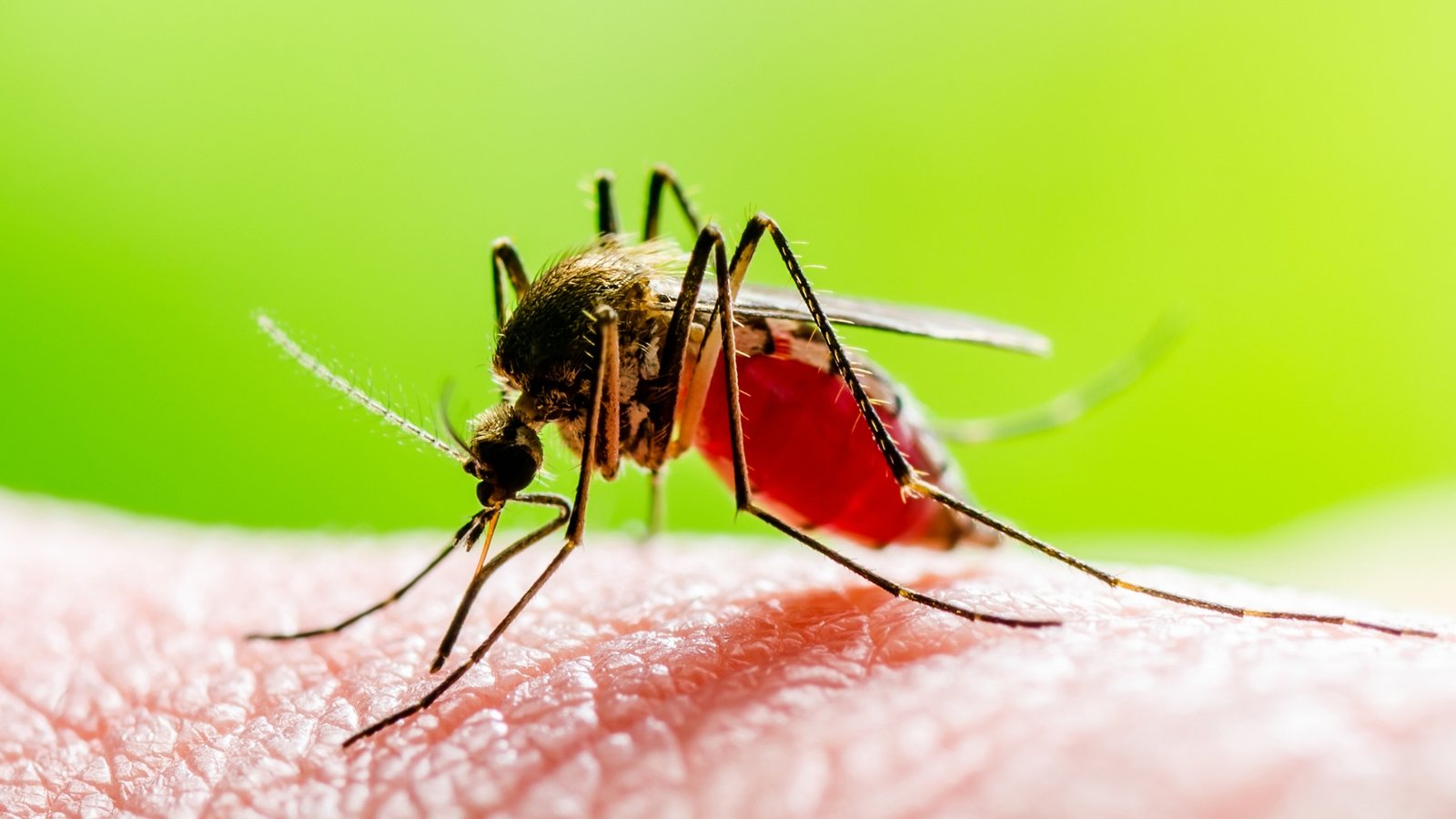
The everyday food of both male and female mosquitoes is flower nectar and plant sugars. That sugar is what fuels flight and keeps an adult mosquito alive. Only females take blood, and they do it for one reason: to get the protein needed to make eggs. A blood meal is not a mosquito’s meal in the ordinary sense. It is a reproductive step. Males never take blood at all (Sources 1, 4).
Nectar and plant sugars
For most of an adult mosquito’s life, its food is sugar. Both sexes drink floral nectar, plant sap, honeydew, and other sweet plant fluids, and this sugar is the main energy source for flight, mating, and day-to-day survival (Sources 1, 4). Males depend on it entirely, because they never feed on blood (Source 1).
Because mosquitoes visit flowers to drink nectar, they act as pollinators of some plants. The snowpool mosquito (Aedes communis) is a documented pollinator of the blunt-leaved bog orchid (Platanthera obtusata): as the mosquito drinks from the flower’s nectar spur, pollen sticks to its eye and is carried to the next flower (Sources 3, 7). Nectar feeding is easy to overlook because blood-feeding is what people notice, but sugar is the diet that keeps mosquitoes running (Source 4).
Blood is for eggs, not food
Only female mosquitoes bite, and a female needs the protein in a blood meal to develop a batch of eggs (Sources 1, 2, 3). After she feeds, she rests while the blood is digested and the eggs mature, then she lays them in or near water (Source 2). One blood meal supplies the protein for a clutch of eggs, and the cycle can repeat.
There is an exception worth knowing. Some mosquitoes are autogenous, meaning a female can produce her first batch of eggs without any blood at all, drawing instead on protein and energy she stored as a larva. In some species this happens only under certain conditions (facultative autogeny) and in others it is the normal pattern for the first batch (obligatory autogeny). Even these mosquitoes usually need blood for later batches (Source 6).
What larvae eat
Mosquitoes do not start life on nectar or blood. The larvae live in water and eat what is in that water: algae, plankton, fungi, bacteria, and other microorganisms, along with bits of organic matter. Most larvae are filter feeders, using brushes near the mouth to sweep small particles toward them as they hang below the surface (Source 1). A few kinds are predatory. Larvae of the genus Toxorhynchites, for example, feed on other mosquito larvae rather than filtering microorganisms (Source 4).
Why this matters
The distinction between sugar and blood is not a curiosity. Blood-feeding by females is the behavior that lets mosquitoes spread disease. A female picks up a pathogen when she bites an infected person or animal, and if that pathogen can survive and multiply inside her, she can pass it to the next host she bites (Source 5). Because males never take blood, they do not transmit these diseases (Source 1). Understanding what mosquitoes actually eat, and which meal is the risky one, is the starting point for understanding how mosquito-borne illness moves. For the health side of this story, see the disease-spread pages linked below.
Sources
- American Mosquito Control Association (AMCA), “Life Cycle.” https://www.mosquito.org/life-cycle/ (accessed 2026-07-20). States that larvae feed on algae, plankton, fungi, bacteria, and other microorganisms as filter feeders; that both sexes are primarily nectar feeders; that males feed on nectar and do not bite; and that a blood meal (protein) is essential for egg production.
- CDC, “Life Cycle of Aedes Mosquitoes.” https://www.cdc.gov/mosquitoes/about/life-cycle-of-aedes-mosquitoes.html (accessed 2026-07-20). States that female mosquitoes need blood to produce eggs, then rest while the blood digests and eggs develop before laying in water. (Page returned HTTP 403 on direct fetch; content confirmed via CDC search result snippet.)
- USDA Forest Service, “Aedes communis: The Pollinating Mosquito.” https://www.fs.usda.gov/wildflowers/pollinators/pollinator-of-the-month/aedes_communis.shtml (accessed 2026-07-20). States that adult mosquitoes feed on plant nectar to fuel flight, that only females take a blood meal (protein) for egg development, and that Aedes communis pollinates the orchid Platanthera obtusata.
- “Not Just from Blood: Mosquito Nutrient Acquisition from Nectar Sources.” Trends in Parasitology (2020). https://www.cell.com/trends/parasitology/fulltext/S1471-4922(20)30040-4 (accessed 2026-07-20). Reviews nectar and plant sugar as a primary energy resource for adult mosquitoes of both sexes, with males as obligate sugar feeders; notes predatory larvae in Toxorhynchites.
- CDC, “About Mosquitoes in the United States.” https://www.cdc.gov/mosquitoes/about/about-mosquitoes-in-the-united-states.html (accessed 2026-07-20). Describes how only female mosquitoes bite for a blood meal and how an infected female can pass a pathogen to the next host she bites.
- Kassim NFA, et al. “Is the expression of autogeny by Culex molestus (Diptera: Culicidae) influenced by larval nutrition or by adult mating, sugar feeding, or blood feeding?” Journal of Vector Ecology (2012). https://onlinelibrary.wiley.com/doi/10.1111/j.1948-7134.2012.00213.x (accessed 2026-07-20). Describes autogeny, in which a female produces a first egg batch without a blood meal using larval reserves, and distinguishes obligatory from facultative autogeny.
- “The olfactory basis of orchid pollination by mosquitoes.” Proceedings of the National Academy of Sciences (2020). https://www.pnas.org/doi/10.1073/pnas.1910589117 (accessed 2026-07-20). Documents mosquitoes pollinating Platanthera obtusata while nectar feeding.
Related
- Mosquito life cycle: egg, larva, pupa, adult (placeholder)
- Why only female mosquitoes bite (placeholder)
- How mosquitoes spread disease (placeholder)
- What attracts mosquitoes to people (placeholder)
Educational note: This page is provided for general reference and education. It is not medical, pest-control, or professional advice. For health concerns about mosquito-borne illness, consult a qualified professional or your local health department.
Last reviewed 20 July 2026.