The short answer
Around most yards and porches, two mosquitoes account for the majority of bites, and they are easy to tell apart once you know the two things to check: what the mosquito looks like, and what time of day it bites you.
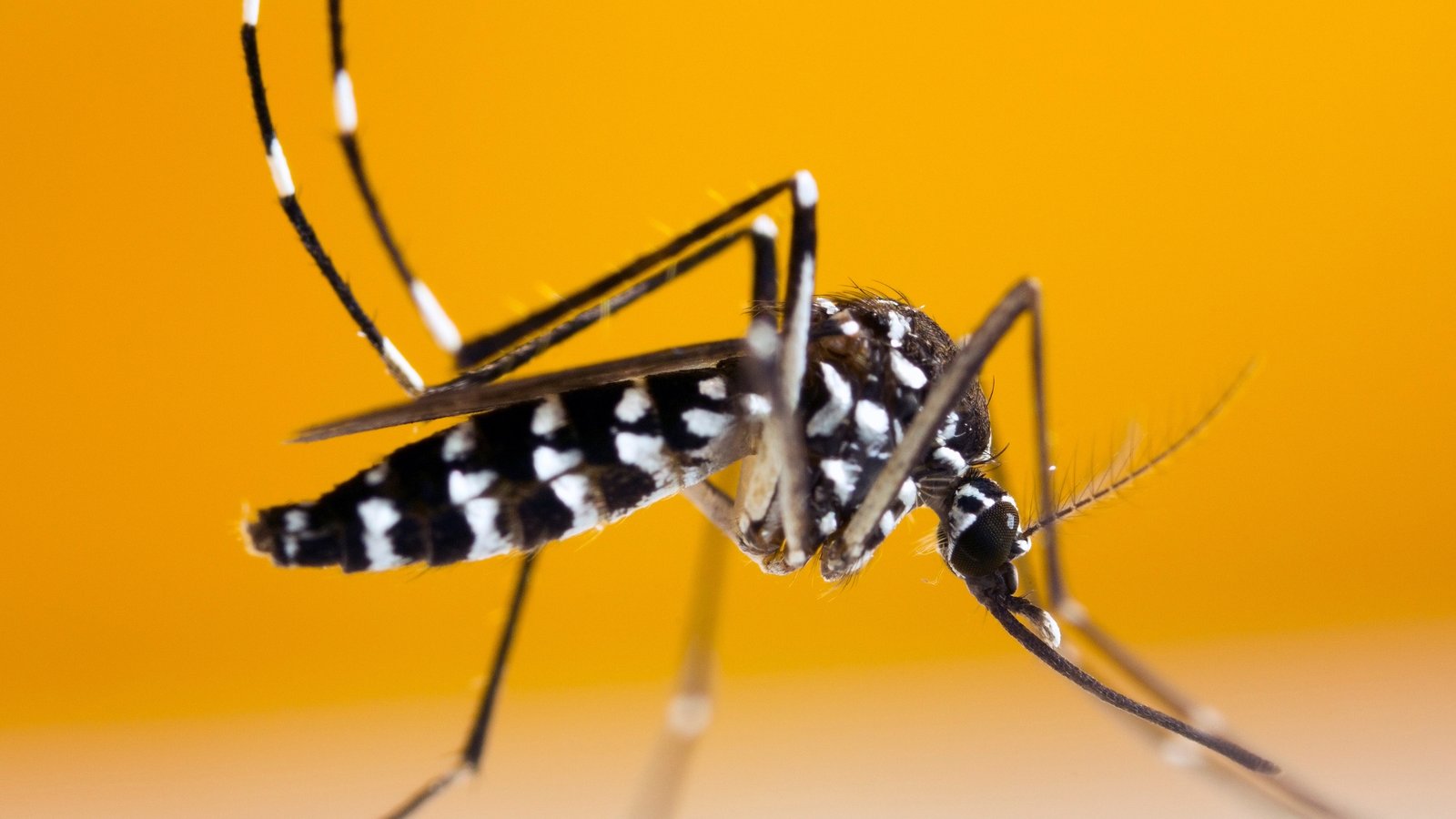
The first is the Asian tiger mosquito (Aedes albopictus). It is small, boldly black-and-white, and marked with a single bright white stripe running straight down the center of its back. It bites in the daytime, stays close to home, and breeds in small water-holding containers (UF IFAS Featured Creatures; ECDC).
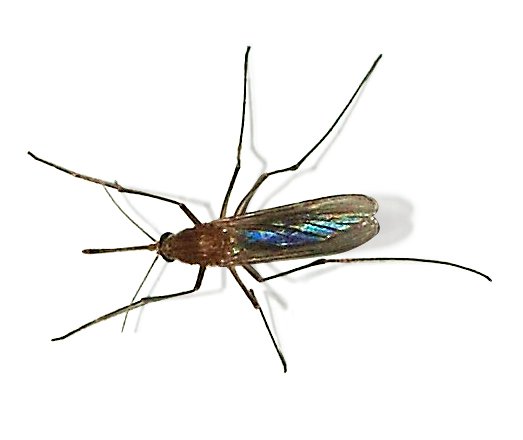
The second is the house mosquito (Culex pipiens in the north, or its close relative Culex quinquefasciatus in the south). It is a plain, drab brown mosquito with no showy markings. It bites mainly after dark, breeds in stagnant, dirty water, and is the main mosquito that spreads West Nile virus (UF IFAS Featured Creatures; CDC West Nile).
So the quick rule: a striped mosquito biting you in daylight is very likely the tiger mosquito, and a plain brown mosquito whining around you in the evening is very likely a house mosquito.
Side-by-side comparison
| Asian tiger mosquito (Aedes albopictus) | House mosquito (Culex pipiens / quinquefasciatus) | |
|---|---|---|
| Look | Small, shiny black with bright silver-white markings; one straight white stripe down the center of the thorax; legs banded with white (UF IFAS Featured Creatures) | Small to medium, dull light brown; no bold stripes; pale bands at the base of each abdominal segment; dark unbanded proboscis (UF IFAS Featured Creatures) |
| When they bite | Daytime, usually outdoors, with peaks in early morning and late afternoon (UF IFAS Featured Creatures; ECDC) | Mainly at night; becomes active around dusk and feeds through the evening and after dark (UF IFAS Featured Creatures) |
| Where they breed | Small containers of standing water: tires, buckets, planter saucers, birdbaths, clogged gutters, tree holes (ECDC; Rutgers Center for Vector Biology) | Stagnant water rich in organic matter: ditches, storm drains and catch basins, sewage seepage, rain barrels, cans (UF IFAS Featured Creatures) |
| Eggs | Laid singly on damp surfaces above the waterline (AMCA) | Laid stuck together in a floating raft of about 100 to 300 eggs, like a speck of soot on the water (AMCA; UF IFAS Featured Creatures) |
| Diseases | Competent vector of dengue and chikungunya, recognized vector of Zika (lower competence than Aedes aegypti); also dog heartworm (ECDC; CDC Aedes range) | Main vector of West Nile virus in northern regions; also St. Louis encephalitis virus (UF IFAS Featured Creatures; CDC West Nile) |
| Behavior and range | Aggressive daytime biter, wide host range, short flight range of about 200 meters, so it usually hatched nearby (ECDC) | Feeds on both birds and mammals including people, which is what links birds and humans in the West Nile cycle; overwinters as an adult female (UF IFAS Featured Creatures) |
The tiger mosquito in brief
The Asian tiger mosquito is the striped daytime biter. The single most useful field mark is that one straight white line running down the middle of its back, starting on the head and continuing along the thorax, which separates it from the similar-looking yellow fever mosquito (Aedes aegypti), whose back markings instead curve into a lyre or violin shape (UF IFAS Featured Creatures).
It is a container breeder. Females lay in small collections of standing water in and around yards, and the larvae need only a fraction of an inch of water to develop (Rutgers Center for Vector Biology). Because its flight range is only about 200 meters, when it is biting you it almost always came from a breeding site close by (ECDC). It is a competent vector of dengue and chikungunya and a recognized vector of Zika (ECDC; CDC Aedes range).
For the full profile, see Aedes albopictus (Asian tiger mosquito).
The house mosquito in brief
The house mosquito is the plain brown night biter. It is drab by comparison, light brown with modest pale bands rather than showy stripes, and it comes out around dusk and feeds through the night (UF IFAS Featured Creatures). Its larvae favor stagnant water loaded with organic matter, which is why storm drains and catch basins full of decaying debris are such productive breeding sites (UF IFAS Featured Creatures).
Its public-health importance comes from what it feeds on. Because it bites both birds and mammals, it can pick up West Nile virus from an infected bird and later pass it to a person, which makes it the main West Nile vector across northern regions (UF IFAS Featured Creatures; CDC West Nile). It also carries St. Louis encephalitis virus (UF IFAS Featured Creatures). In North America, Culex pipiens dominates roughly above 39 degrees north latitude, and the closely related southern house mosquito, Culex quinquefasciatus, takes over farther south (UF IFAS Featured Creatures).
For the full profile, see Culex pipiens (northern house mosquito).
Which one is biting you, and what it means for protection
Start with the clock and the coloring. If you are being bitten outdoors in daylight, especially in the morning or late afternoon, by a small striped mosquito, you are almost certainly dealing with the tiger mosquito. If the bites come in the evening or after dark from a plain brown mosquito, the house mosquito is the likely culprit (UF IFAS Featured Creatures; ECDC).
Knowing which one changes where you look for the source. The tiger mosquito breeds in the small containers right around your home and flies only a short distance, so the fix is to walk your own yard and empty anything that holds water: buckets, tires, planter saucers, birdbaths, tarps, toys, and clogged gutters, at least once a week (UF IFAS Featured Creatures; ECDC). Because it does not fly far, coordinating with immediate neighbors on the same cleanup clears most of the local population (ECDC).
The house mosquito breeds in stagnant, organically rich water, and some of its best breeding sites, like street catch basins, cannot simply be dumped. Those are typically handled by community mosquito control programs, often with larvicides such as Bti (CDC West Nile). At home, empty the standing water you can, keep window and door screens in good repair, and because this species bites at night, focus personal protection on the evening and nighttime hours (CDC West Nile).
For both mosquitoes, the shared steps are the same and they work: remove standing water, and use an EPA-registered repellent with long sleeves and pants during the hours the biting species is active (UF IFAS Featured Creatures; CDC West Nile).
Sources
- University of Florida IFAS Featured Creatures, “Asian tiger mosquito, Aedes albopictus (Skuse),” publication IN594. https://ask.ifas.ufl.edu/publication/IN594 (accessed 20 July 2026). Supports: single straight white stripe down the center of the thorax beginning at the head; banded legs; distinction from Aedes aegypti lyre/violin marking; small size; daytime feeder with early-morning and late-afternoon peaks; aggressive biter with wide host range; container breeder; source reduction as control.
- University of Florida IFAS Featured Creatures, “Northern House Mosquito, Culex pipiens Linnaeus” (EENY-765/IN1324). https://ask.ifas.ufl.edu/publication/IN1324 (accessed 20 July 2026). Supports: dull light-brown appearance, pale basal abdominal bands, dark unbanded proboscis; egg rafts; larval habitat in organically rich stagnant water including containers, ditches, and sewage seepage; night biting; feeds on birds and mammals including humans; overwinters as an adult female; distribution above 39 degrees north latitude with Culex quinquefasciatus to the south; vector of West Nile virus and St. Louis encephalitis virus.
- European Centre for Disease Prevention and Control (ECDC), “Aedes albopictus, Factsheet for experts.” https://www.ecdc.europa.eu/en/disease-vectors/facts/mosquito-factsheets/aedes-albopictus (accessed 20 July 2026). Supports: aggressive daytime outdoor biting; flight range about 200 meters with human-assisted container dispersal; breeds in tires, barrels, catch basins, tree holes, and rock pools; competent vector of dengue and chikungunya and recognized vector of Zika (lower competence than Aedes aegypti); dog heartworm (dirofilariasis).
- CDC, “Potential Range of Aedes Mosquitoes.” https://www.cdc.gov/mosquitoes/php/toolkit/potential-range-of-aedes.html (accessed 20 July 2026; page returned 403 on fetch, claim taken from CDC search-result snippet text). Supports: Aedes albopictus is a vector of dengue, chikungunya, and Zika; where Aedes aegypti is present it is generally the more efficient vector.
- CDC, “West Nile: Causes and How It Spreads.” https://www.cdc.gov/west-nile-virus/causes/index.html (accessed 20 July 2026). Supports: Culex species are the primary West Nile vector; virus cycles between mosquitoes and birds and people are infected when a mosquito bites an infected bird then a person; prevention depends on community mosquito control (including larvicides) and personal protection such as repellent and screens.
- Rutgers University Center for Vector Biology, “Aedes albopictus (Skuse).” https://vectorbio.rutgers.edu/outreach/species/albo.htm (accessed 20 July 2026). Supports: opportunistic container breeder using natural and artificial containers including tires, drums, buckets, and cans; larvae complete development in as little as about 1/4 inch of water.
- American Mosquito Control Association, “Life Cycle.” https://www.mosquito.org/life-cycle/ (accessed 20 July 2026). Supports: Culex lay eggs stuck together in a floating raft of about 100 to 300 eggs resembling a speck of soot; Aedes lay eggs singly on damp surfaces above the waterline.
Related
- Aedes albopictus (Asian tiger mosquito)
- Culex pipiens (northern house mosquito)
- Aedes aegypti (yellow fever mosquito) [placeholder]
- Culex quinquefasciatus (southern house mosquito) [placeholder]
- Aedes vs Culex: how to tell mosquito groups apart [placeholder]
- Container source reduction: a step-by-step guide [placeholder]
Educational note: This page is a general reference for identification and prevention. It is not medical advice. If you have symptoms of a mosquito-borne illness, contact a healthcare provider, and for local control questions contact your regional mosquito control district.
Last reviewed 20 July 2026.