The short answer
Texas spans several climates, from the humid Gulf Coast and subtropical Rio Grande Valley to the dry western plains, and it carries a heavy, long mosquito season across most of that range. About 55 mosquito species live in the state (Texas A&M AgriLife). The dominant public health concern is West Nile virus, which is now the most commonly reported mosquito-borne infection in Texas and turns up across the state most years (Texas DSHS). Along the southern border and the Gulf, there is also a standing, recurring risk of locally acquired dengue, carried by container-breeding mosquitoes that live close to homes (CDC, Emerging Infectious Diseases). The upshot: a long season, statewide West Nile, and a smaller but real border-and-coast dengue risk.
Mosquito season
Plan for a long season, and in the southern third of the state plan for something close to year-round. Texas winters are mild enough that mosquitoes rarely shut down completely, and the warm, humid stretch from late spring through fall is the demanding core of the year. West Nile activity typically builds through the summer and peaks in the warm months, with human cases most common from midsummer into early fall (Texas DSHS).
The southern house mosquito, the main West Nile carrier, does not enter a true winter dormancy in the warmer parts of the state. It slows during cold spells and becomes active again during warm periods, which is why South Texas and the Gulf Coast can see biting activity in nearly every month. Treat repellent and source reduction as close to year-round habits in the south, and as a long spring-through-fall routine farther north.
The mosquitoes you meet
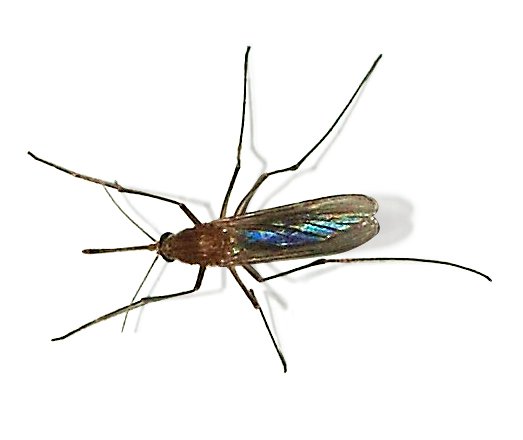
Texas hosts several distinct groups, and knowing which one is biting tells you what to expect.
The southern house mosquito (Culex quinquefasciatus) is the state’s key West Nile carrier. It is described as one of the carriers of West Nile virus found throughout Texas, breeds in standing and polluted water, and bites mainly around dusk and after dark, with peak activity roughly from 9 p.m. to 2 a.m. (Texas A&M). It is the mosquito that keeps West Nile circulating between birds and, occasionally, people.
Container mosquitoes are the disease-relevant daytime group in yards and neighborhoods. The yellow fever mosquito (Aedes aegypti), which has a thorax marked with two curved, lyre-shaped stripes, and the Asian tiger mosquito (Aedes albopictus), distinctly black with white markings and a single white stripe down the thorax, both breed in small artificial containers close to homes (Texas A&M AgriLife). These are the mosquitoes that can transmit dengue, and they are well established in South Texas and along the coast.
Saltmarsh and floodwater mosquitoes drive the big nuisance surges. On the coast, saltmarsh species lay eggs on moist soil at the marsh edge, where exceptional high tides or heavy rain flood them and trigger large broods of aggressive daytime biters. Inland and across pastureland, floodwater Aedes and Psorophora species lay eggs on moist soil or on plants at the water surface, then emerge in explosive numbers after heavy rain and tropical storms (Texas A&M AgriLife). Psorophora includes some of the largest and most aggressive biters in the state, but these floodwater species are mainly a nuisance rather than a major disease threat.
For identification details and biology, link to the individual species pages for Culex quinquefasciatus, Aedes aegypti, Aedes albopictus, and Psorophora.
Disease risk
West Nile virus is the leading mosquito-borne disease concern in Texas. Since it became established, it has been the most commonly reported arbovirus in people, birds, horses, and mosquitoes, and the state health department maps its occurrence in counties across Texas year after year (Texas DSHS). Most people who are infected have no symptoms, but a small share develop serious neuroinvasive illness, so the risk is worth taking seriously through the long season.
The scale of that risk was made clear in 2012, the state’s worst West Nile year on record. Texas reported 1,868 cases that year, including 844 neuroinvasive cases (45 percent) and 89 deaths, more than double the previous historic high of 735 cases in 2003 (CDC, Emerging Infectious Diseases). The outbreak was concentrated in the Dallas-Fort Worth area: Dallas County alone recorded 396 cases (21 percent of the state total), and four north Texas counties (Dallas, Tarrant, Collin, and Denton) together accounted for 902 cases, nearly half the statewide total (CDC, Emerging Infectious Diseases). The severity prompted aerial spraying over parts of the metroplex.
Local dengue is a smaller but persistent risk concentrated along the southern border and the Gulf. Dengue reemerged in southern Texas in 1980, with later outbreaks in 1999 and 2005, and again in 2013, when 53 laboratory-positive cases were identified in southern Texas. Of those, 26 (about half) were locally acquired without travel to Mexico, and roughly 70 percent of patients lived in Cameron County, in the Rio Grande Valley, where Aedes aegypti populations are well established (CDC, Emerging Infectious Diseases). The risk has not gone away: in late 2024, Texas DSHS reported another locally acquired dengue case in Cameron County (Texas DSHS via KSAT). This is why emptying small water-holding containers around the home matters most in South Texas.
For more on these illnesses, link to the West Nile virus and dengue disease pages.
Local control
Mosquito control in Texas is organized locally and coverage is uneven across the state. Some counties and cities run active programs that trap and test mosquitoes, track virus activity, and spray when thresholds are crossed. Others do far less. In Tarrant County, for example, each municipality is responsible for abatement within its own city limits, while county public health handles only the unincorporated areas (Tarrant County Public Health). Large urban counties on the Gulf Coast and in the metroplex tend to have the most capacity, while many rural counties have little or no organized program. If you have a persistent problem, find your city or county program, since it is the right contact for surveillance questions, spraying schedules, and reporting heavy activity.
Protect yourself
Your own steps matter, and source reduction is the core of it. At least weekly, empty, scrub, cover, or throw out anything that holds water: flowerpots, buckets, wheelbarrows, plant saucers, tarps, toys, clogged gutters, and tires, and keep unused pools drained or covered (Texas A&M). This targets the container species that carry dengue and the house mosquito that carries West Nile.
For biting protection, use an EPA-registered insect repellent. The CDC lists DEET, picaridin, IR3535, oil of lemon eucalyptus, para-menthane-diol, and 2-undecanone as effective registered active ingredients, and notes that products with oil of lemon eucalyptus or para-menthane-diol should not be used on children under three years old (CDC). Higher concentrations last longer. Wear light-colored long-sleeve shirts and long pants when you can, and be especially careful outdoors around dusk and after dark, when the West Nile carrier is most active (Texas A&M). After heavy rain or a tropical storm, expect a surge of nuisance mosquitoes and keep using repellent through the weeks that follow.
Sources
- Texas A&M AgriLife Extension, Field Guide to Common Texas Insects, “Mosquito.” About 55 mosquito species in Texas, Aedes aegypti and Aedes albopictus identification, and floodwater Aedes and Psorophora egg-laying behavior. https://texasinsects.tamu.edu/mosquito/ (accessed 20 July 2026).
- Texas Department of State Health Services, “Texas Maps of West Nile Virus Surveillance Data.” West Nile virus as the most commonly reported arbovirus in Texas and statewide county-level occurrence over multiple years. https://www.dshs.texas.gov/idps-home/notifiable-conditions/zoonosis-control/mosquito-borne-diseases/west-nile-virus/texas-maps-west-nile (accessed 20 July 2026).
- CDC, Emerging Infectious Diseases, “West Nile Virus, Texas, USA, 2012.” Statewide 1,868 cases, 844 neuroinvasive (45 percent), 89 deaths, more than double the 2003 high of 735; Dallas County 396 cases (21 percent) and four north Texas counties 902 cases (48 percent). https://wwwnc.cdc.gov/eid/article/19/11/13-0768_article (accessed 20 July 2026).
- CDC, Emerging Infectious Diseases, “Reemergence of Dengue in Southern Texas, 2013.” 53 laboratory-positive cases, 26 locally acquired, about 70 percent in Cameron County, Aedes aegypti established, and prior reemergence in 1980, 1999, and 2005. https://wwwnc.cdc.gov/eid/article/22/6/15-2000_article (accessed 20 July 2026).
- Texas Department of State Health Services, reported via KSAT, “First case of dengue virus found in Cameron County, Texas DSHS says” (November 2024). A locally acquired dengue case in Cameron County, showing continued border risk. https://www.ksat.com/news/local/2024/11/28/first-case-of-dengue-virus-found-in-cameron-county-texas-dshs-says/ (accessed via search summary 20 July 2026).
- Texas A&M University, Texas A&M Stories, “West Nile Virus Is Present In Texas. Here’s How To Protect Yourself” (August 2024). Culex quinquefasciatus as a West Nile carrier throughout Texas, peak biting roughly 9 p.m. to 2 a.m., dress and drain guidance, and EPA-registered repellents. https://stories.tamu.edu/news/2024/08/12/west-nile-virus-is-present-in-texas-heres-how-to-protect-yourself/ (accessed 20 July 2026).
- CDC, “Preventing Mosquito Bites.” EPA-registered repellent active ingredients (DEET, picaridin, IR3535, oil of lemon eucalyptus, para-menthane-diol, 2-undecanone) and the age-three restriction for oil of lemon eucalyptus and para-menthane-diol. https://www.cdc.gov/mosquitoes/prevention/index.html (accessed 20 July 2026).
- Tarrant County Public Health, “Ground Spraying for Mosquitoes in Tarrant County.” Municipalities are responsible for abatement within their city limits, while county public health covers unincorporated areas, illustrating uneven local coverage. https://www.tarrantcountytx.gov/en/public-health/health-protection-and-response/environmental-health-promotion/vector/ground-spraying-for-mosquitoes-in-tarrant-county.html (accessed via search summary 20 July 2026).
Related
- [Species: Culex quinquefasciatus (southern house mosquito)] (placeholder)
- [Species: Aedes aegypti (yellow fever mosquito)] (placeholder)
- [Species: Aedes albopictus (Asian tiger mosquito)] (placeholder)
- [Species: Psorophora (floodwater mosquitoes)] (placeholder)
- [Disease: West Nile virus] (placeholder)
- [Disease: Dengue] (placeholder)
- [Region: Gulf Coast regional guide] (placeholder)
- [Region: other US state and regional guides] (placeholder)
Educational note: This page is an independent, non-commercial reference for general education. It is not medical advice. For diagnosis, treatment, or travel guidance, consult a clinician or your state or local health department. For local mosquito problems, contact your city or county mosquito control program.
Last reviewed 20 July 2026.