The short answer
The Great Plains states punch above their weight for West Nile virus. In terms of cases per person, the northern Plains often lead the entire country. During the years 2009 through 2018, the highest average annual rates of West Nile neuroinvasive disease (the severe form that affects the brain and spinal cord) were in North Dakota (3.16 cases per 100,000 people), South Dakota (3.06), and Nebraska (1.95), well above the national average (Source 1).
The reason is one mosquito: Culex tarsalis, the western encephalitis mosquito. It is one of the most efficient carriers of West Nile virus known, it feeds on both birds and people, and it thrives in the irrigated cropland and prairie wetlands that define the region (Source 2, Source 4). If you live in the rural Plains, the practical takeaway is simple: the risk here is real, it peaks in summer, and it comes mostly at dusk and after dark.
Mosquito season here
Mosquito season on the Plains runs through the warm months, roughly June into September, and the disease risk is tightly concentrated inside that window. Most human West Nile cases across the country have their onset from July through September, with a pronounced peak in August (Source 1). On the Plains, July and August are almost always the worst weeks.
That timing tracks the life cycle of Culex tarsalis. Its numbers build through the summer heat, the virus amplifies in local bird populations, and by mid to late summer there are enough infected mosquitoes to spill the virus over to people. Cooler, wetter springs and hot summers both feed into how large a given year turns out to be, which is why case counts swing widely from one year to the next.
The mosquitoes you meet
Two species dominate what you feel on your skin in the Plains, and they play very different roles.
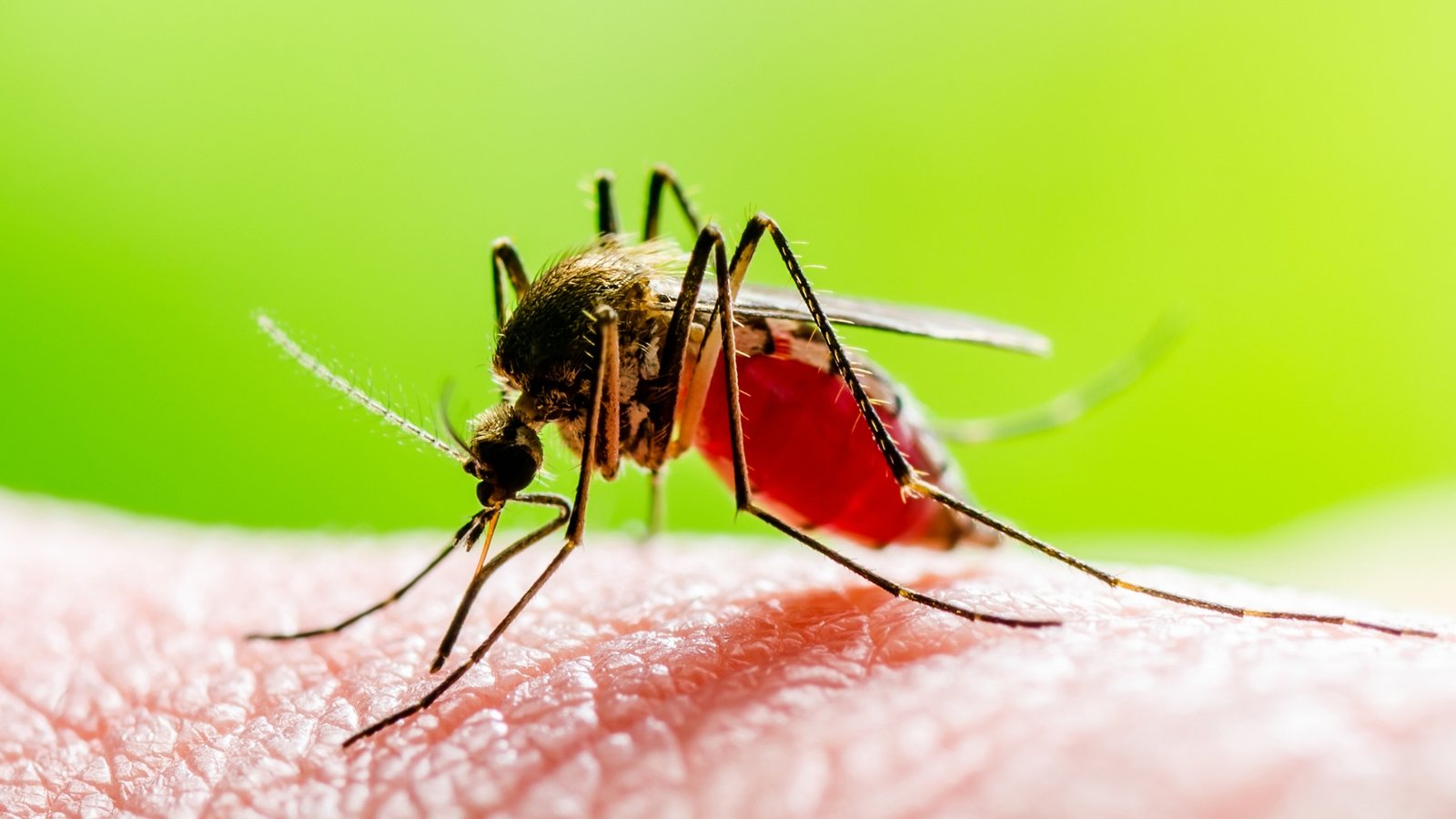
Culex tarsalis (the western encephalitis mosquito) is the one that matters for disease. It is a dark mosquito with a distinctive white band across the middle of its proboscis and pale bands on its legs. It feeds mainly on birds, which are the reservoir that keeps West Nile virus circulating, and it will also bite people, which makes it a bridge for the virus into humans. It is strictly a night feeder, with the greatest risk of bites between dusk and dawn (Source 4, Source 5). See the species page for Culex tarsalis.
Aedes vexans (the inland floodwater mosquito) is the one you are more likely to curse at a summer cookout. Its name comes from the Latin for “to annoy,” and it is the dominant biting nuisance across the northern Plains and Canada (Source 6). It hatches in floodwater after heavy rain, can fly many miles from where it bred, and bites people readily. It is a nuisance far more than a disease threat here, because it prefers to feed on mammals rather than birds and so rarely picks the virus up (Source 4). See the species page for Aedes vexans.
The short version: the mosquito that bothers you most is usually not the one that can make you sick, and the one that can make you sick bites quietly at night.
Disease risk
West Nile virus is the dominant mosquito-borne disease risk in the Great Plains, and by per-person measures this region carries some of the heaviest burden anywhere in the country (Source 1). Culex tarsalis also carries western equine encephalitis and St. Louis encephalitis viruses, but those cause far fewer human cases; West Nile is the one to plan around (Source 2).
Most infections are mild or silent. About 8 in 10 people infected with West Nile virus never develop symptoms at all. Roughly 1 in 5 develop a fever with headache, body aches, and sometimes a rash. About 1 in 150 infected people develop severe neuroinvasive disease, which can bring on meningitis, encephalitis, or paralysis, and roughly 1 in 10 of those severe cases is fatal (Source 3). Adults over 60 and people with weakened immune systems are at the highest risk of the severe form. There is no vaccine and no specific antiviral treatment for people, so prevention is the whole game. See the disease page for West Nile virus.
Local control and what to do
Two features of the Plains explain why control here looks different from a coastal suburb: irrigated agriculture and distance. Irrigation-heavy cropland and prairie wetlands create vast amounts of shallow standing water where Culex tarsalis breeds, and much of that habitat sits on rural land far from any organized mosquito abatement district (Source 2, Source 4). Rural exposure matters. Farm and ranch work, evening chores, and outdoor recreation put people outside exactly when Culex tarsalis is biting.
What actually reduces your risk:
- Use repellent. Health officials on the Plains recommend products containing DEET, picaridin, oil of lemon eucalyptus, or IR3535, applied per the label (Source 5).
- Respect the clock. Limit time outdoors, or cover up, from dusk through the middle of the night, when Culex mosquitoes are most active (Source 5).
- Cover up. Long sleeves and long pants when you are out in the evening in mosquito country (Source 5).
- Drain standing water. Empty buckets, tarps, troughs, and containers, change water in birdbaths and stock tanks every few days, and fill low spots that hold water. On rural property, water troughs, leaky sprinklers, and clogged gutters are common breeding sources (Source 5).
Personal protection carries more of the load here than area spraying does, precisely because so much of the risk is rural and spread out. The habits above, done consistently through July and August, are the most reliable defense.
Sources
- Centers for Disease Control and Prevention, “Surveillance for West Nile Virus Disease, United States, 2009 through 2018,” MMWR Surveillance Summaries, 2021. Reports highest average annual neuroinvasive disease incidence in North Dakota (3.16), South Dakota (3.06), and Nebraska (1.95) per 100,000, and July through September / August-peak seasonality. https://www.cdc.gov/mmwr/volumes/70/ss/ss7001a1.htm (accessed 2026-07-20)
- “Long-term surveillance defines spatial and temporal patterns implicating Culex tarsalis as the primary vector of West Nile virus,” Scientific Reports / PMC. Identifies Cx. tarsalis as a highly efficient West Nile vector and carrier of related encephalitis viruses in the Upper Midwest and northern Great Plains. https://pmc.ncbi.nlm.nih.gov/articles/PMC6488619/ (accessed 2026-07-20)
- Centers for Disease Control and Prevention, “Symptoms of West Nile Virus.” About 80% of infections are asymptomatic, roughly 1 in 5 develop febrile illness, about 1 in 150 develop severe neuroinvasive disease, and about 1 in 10 severe cases is fatal. https://www.cdc.gov/west-nile-virus/signs-symptoms/index.html (accessed 2026-07-20)
- South Dakota State University Extension, “Mosquitos to Watch for in South Dakota.” Describes Culex tarsalis (bird-feeding, higher West Nile risk, white proboscis band) and Aedes vexans (mammal-feeding nuisance), and small-water breeding habitat. https://extension.sdstate.edu/mosquitos-watch-south-dakota (accessed 2026-07-20)
- South Dakota Department of Health, “Mosquito Control and Protection.” Recommends DEET, picaridin, oil of lemon eucalyptus, or IR3535; limiting outdoor time from dusk to midnight when Culex are active; and eliminating standing water. https://doh.sd.gov/topics/diseases/infectious-diseases/vector-borne-diseases/mosquito-borne-diseases/west-nile-virus/mosquito-control-protection/ (accessed 2026-07-20)
- Vector Disease Control International, “Mosquito of the Month: Aedes vexans, the Inland Floodwater Mosquito.” Identifies Aedes vexans as the dominant biting nuisance in the northern Plains, hatching from floodwater and flying long distances. https://www.vdci.net/blog/mosquito-of-the-month-aedes-vexans-the-inland-floodwater-mosquito/ (accessed 2026-07-20)
Related
- Species: Culex tarsalis [placeholder]
- Species: Aedes vexans [placeholder]
- Disease: West Nile virus [placeholder]
- Region: Mosquitoes in the Mountain West [placeholder]
- Region: Mosquitoes in the Upper Midwest [placeholder]
Educational note: This page is for general information and prevention awareness only. It is not medical advice. If you develop a high fever, severe headache, stiff neck, confusion, or muscle weakness during mosquito season, contact a health care provider. For local risk levels and current-year case counts, consult your state or county health department.
Last reviewed 20 July 2026.