The short answer
Mosquitofish (genus Gambusia) eat mosquito larvae, and many local mosquito control districts hand them out free to stock ornamental ponds, unused swimming pools, animal troughs, and similar water features (Lake County Vector Control District). They can be a genuinely useful tool, but only in the right place. That place is contained, artificial water that never connects to a natural stream, lake, or wetland.
Outside of contained water they are a problem. Gambusia is a hardy, aggressive invader that preys on the eggs and young of native fish, eats amphibian eggs and tadpoles, and feeds on native aquatic invertebrates. Western mosquitofish (Gambusia affinis) sits on the IUCN list of 100 of the world’s worst invasive alien species, and in the wild it is generally considered no more effective at mosquito control than the native predators it displaces (IUCN Global Invasive Species Database). So the honest summary is: fine for your backyard pond if local rules allow, never for a creek, ditch that drains to open water, or any natural habitat.
What mosquitofish are
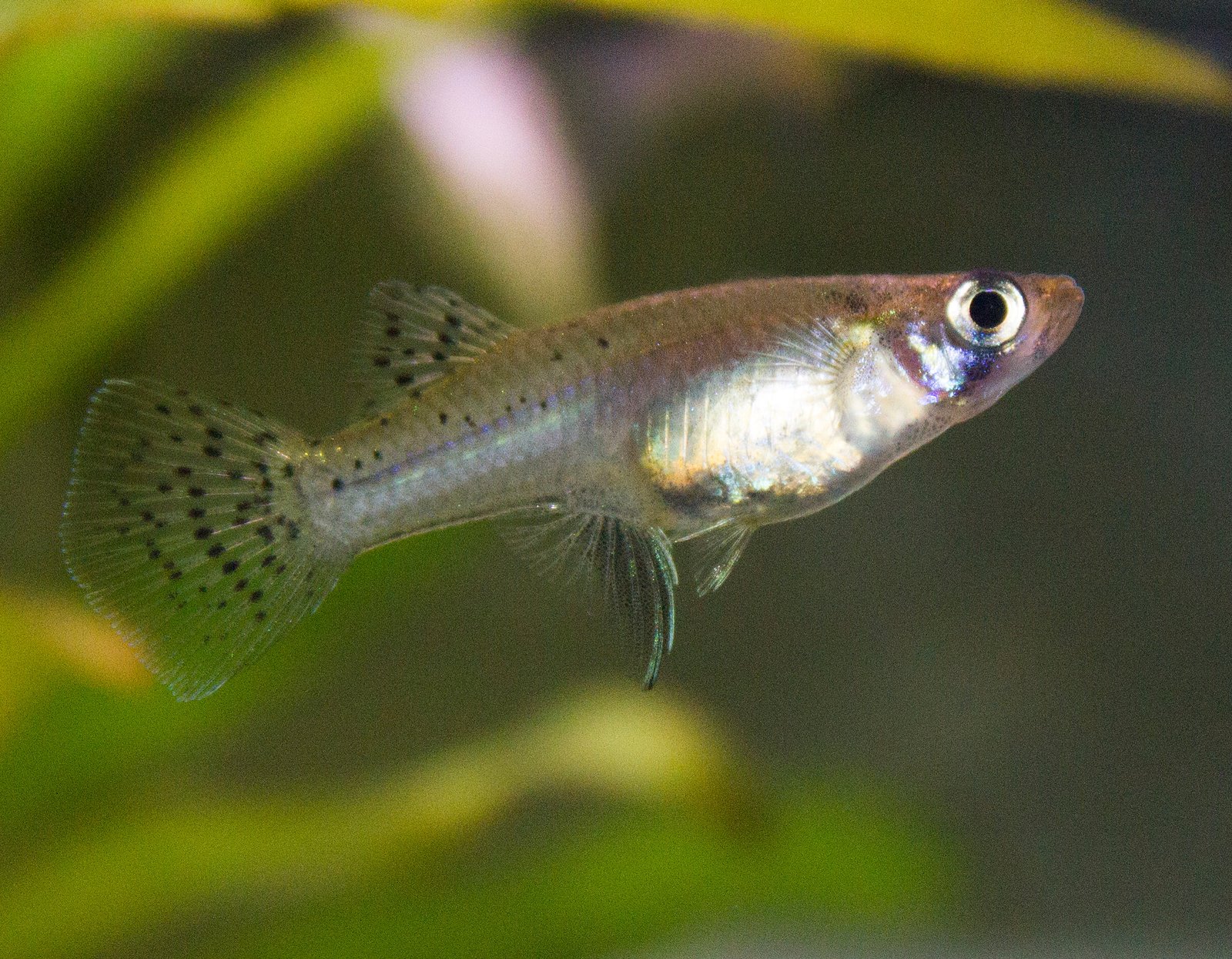
Two closely related species are used in the US: the western mosquitofish (Gambusia affinis) and the eastern mosquitofish (Gambusia holbrooki). Both are small members of the livebearer family Poeciliidae, the same family as guppies, meaning females give birth to live young rather than laying eggs. Adults reach roughly 2 to 3 inches (5 to 8 cm), with females larger than males, and range from silver to a greenish cast with faintly outlined scales that give a cross-hatched look (University of Florida IFAS Extension).
They feed at the water’s surface, which is where mosquito larvae and pupae come up to breathe, and that behavior is the whole reason they are used. One adult mosquitofish can consume up to about 100 mosquito larvae per day (University of Florida IFAS Extension). They also eat other small insect larvae, zooplankton, and some plant material, so their appetite is not limited to mosquitoes, a point that matters for the sections below.
A mosquitofish (Gambusia). The fish pictured represents the genus and is not necessarily the exact species stocked by your local district.
Where they work
Mosquitofish do their best work in standing, contained, artificial water that you control:
- Ornamental and backyard ponds and water gardens
- Unused or unmaintained swimming pools
- Livestock and animal watering troughs
- Fountains and other durable water features
These settings share three traits: the water holds fish year to year, it does not drain into natural waterways, and it is hard to treat by other means. Mosquitofish tolerate a wide range of water quality and need little care beyond protection from garden sprays, chlorine and chloramines, and predators such as raccoons, cats, herons, and egrets (Lake County Vector Control District).
Because they are used for public health, mosquitofish are often provided free of charge by county mosquito and vector control districts for placement on private property. Programs in California, Florida, and elsewhere deliver or hand out fish to residents on request (Lake County Vector Control District; Santa Clara County Vector Control District). Contact your local district rather than buying or moving fish yourself; they will confirm whether your water body is appropriate.
Where NOT to use them
Never release mosquitofish into any natural water. That means no streams, rivers, creeks, lakes, ponds with natural inflow or outflow, wetlands, or drainage that reaches any of these. This is not a cautious suggestion, it is the central limit on the tool.
The reason is that Gambusia is one of the most damaging invasive freshwater fish worldwide. It was spread to more than 50 countries for mosquito control and became a pest across many of them (IUCN Global Invasive Species Database). The documented harms include:
- Predation on the eggs and young of native fish, which can reduce or eliminate their ability to reproduce, contributing to native fish declines and local extirpations (USGS Nonindigenous Aquatic Species; IUCN Global Invasive Species Database).
- Decline of native amphibians, with predation on eggs, embryos, and tadpoles identified as the main mechanism (Oregon State University Extension / Oregon Sea Grant).
- Loss of native aquatic invertebrates, including cases tied to declines of frogs and damselflies where the fish was introduced (IUCN Global Invasive Species Database).
Its aggression compounds the predation: mosquitofish nip fins and harass other fish, which is part of why they outcompete and displace native species. And once established in open water they are extremely difficult to remove. Releasing non-native fish into public waters is also illegal in many states, and stocking private waters may require a permit (Oregon State University Extension). When in doubt, treat any water that is not fully contained as off-limits.
How to use them responsibly
If you have appropriate contained water, a few practices keep mosquitofish useful without creating a wider problem:
- Use them only in fully enclosed, artificial water with no path to natural waterways, even during heavy rain or flooding. Confirm your water body qualifies before stocking.
- Get fish from your local mosquito or vector control district, which can assess the site and supply the right number. Do not collect wild Gambusia or move fish between water bodies yourself.
- Check local rules first. Requirements vary by state and county, and release into or near natural water is often prohibited or permit-controlled (Oregon State University Extension).
- Do not dump unwanted fish. If you drain or close a pool or pond, contact your district about removal rather than releasing fish into a storm drain, ditch, or waterway.
- Protect the fish from chemicals and predators so a stable population keeps the water covered through the season (Lake County Vector Control District).
Alternatives for water you cannot stock
Plenty of mosquito-producing water is not suitable for fish, either because it dries out, drains to natural habitat, or is too small and temporary. For those situations, two approaches carry the load:
- Bti (Bacillus thuringiensis israelensis), a naturally occurring soil bacterium sold as dunks and granules that kills mosquito larvae while sparing most other wildlife. See Bti for mosquito control (placeholder link).
- Source reduction, which means eliminating or regularly emptying the standing water where mosquitoes breed. This is the single most effective long-term step for most yards. See Getting rid of standing water (placeholder link).
For water bodies you are unsure about, your local mosquito control district can recommend the safest option for your specific situation.
Sources
- University of Florida IFAS Extension, “Eastern Mosquitofish, Gambusia holbrooki, for Control of Mosquito Larvae” (publication FA202). Species description, feeding rate of up to 100 larvae per day, deployment settings, and stocking guidance. https://ask.ifas.ufl.edu/publication/FA202 (accessed 20 July 2026)
- IUCN Global Invasive Species Database, species account for Gambusia affinis. Listing among 100 of the world’s worst invasive alien species, spread to more than 50 countries, predation on native fish eggs and invertebrates, and note that it is generally no more effective than native mosquito predators. https://www.iucngisd.org/gisd/species.php?sc=126 (accessed 20 July 2026)
- USGS Nonindigenous Aquatic Species Program, species profile for Gambusia affinis. Native range and documented impacts on native fishes through competition, aggression, and predation on eggs and young. https://nas.er.usgs.gov/queries/greatlakes/FactSheet.aspx?Species_ID=846 (accessed 20 July 2026)
- U.S. Fish and Wildlife Service, Ecological Risk Screening Summary, Western Mosquitofish (Gambusia affinis), High Risk. Federal risk assessment classifying the species as high risk outside its native range. https://www.fws.gov/media/ecological-risk-screening-summary-western-mosquitofish-gambusia-affinis-high-risk (accessed 20 July 2026)
- Oregon State University Extension Service / Oregon Sea Grant, guidance warning against releasing non-native fish for mosquito control. Ineffectiveness in the wild, harm to native amphibians, and illegality of releasing non-native fish into public waterways. https://extension.oregonstate.edu/news/experts-warn-against-releasing-non-native-fish-mosquito-control (accessed 20 July 2026)
- Lake County Vector Control District (California), “Mosquitofish.” Free provision to the public, appropriate placement in ponds, unused pools, and troughs, and basic care. https://www.lcvcd.org/mosquitofish (accessed 20 July 2026)
- Santa Clara County Vector Control District (California), “Request Free Mosquitofish.” Free provision for ornamental ponds, unmaintained pools, and fountains, and warning against placement in natural habitat. https://vector.santaclaracounty.gov/services/request-free-mosquitofish (accessed 20 July 2026)
Related
- Bti for mosquito control (placeholder)
- Getting rid of standing water around your home (placeholder)
- How mosquitoes breed and develop in water (placeholder)
- Working with your local mosquito control district (placeholder)
This page is educational and is not a substitute for guidance from your local mosquito or vector control district. Rules on stocking and releasing fish vary by state and county, so check locally before you act.
Last reviewed 20 July 2026.