The short answer
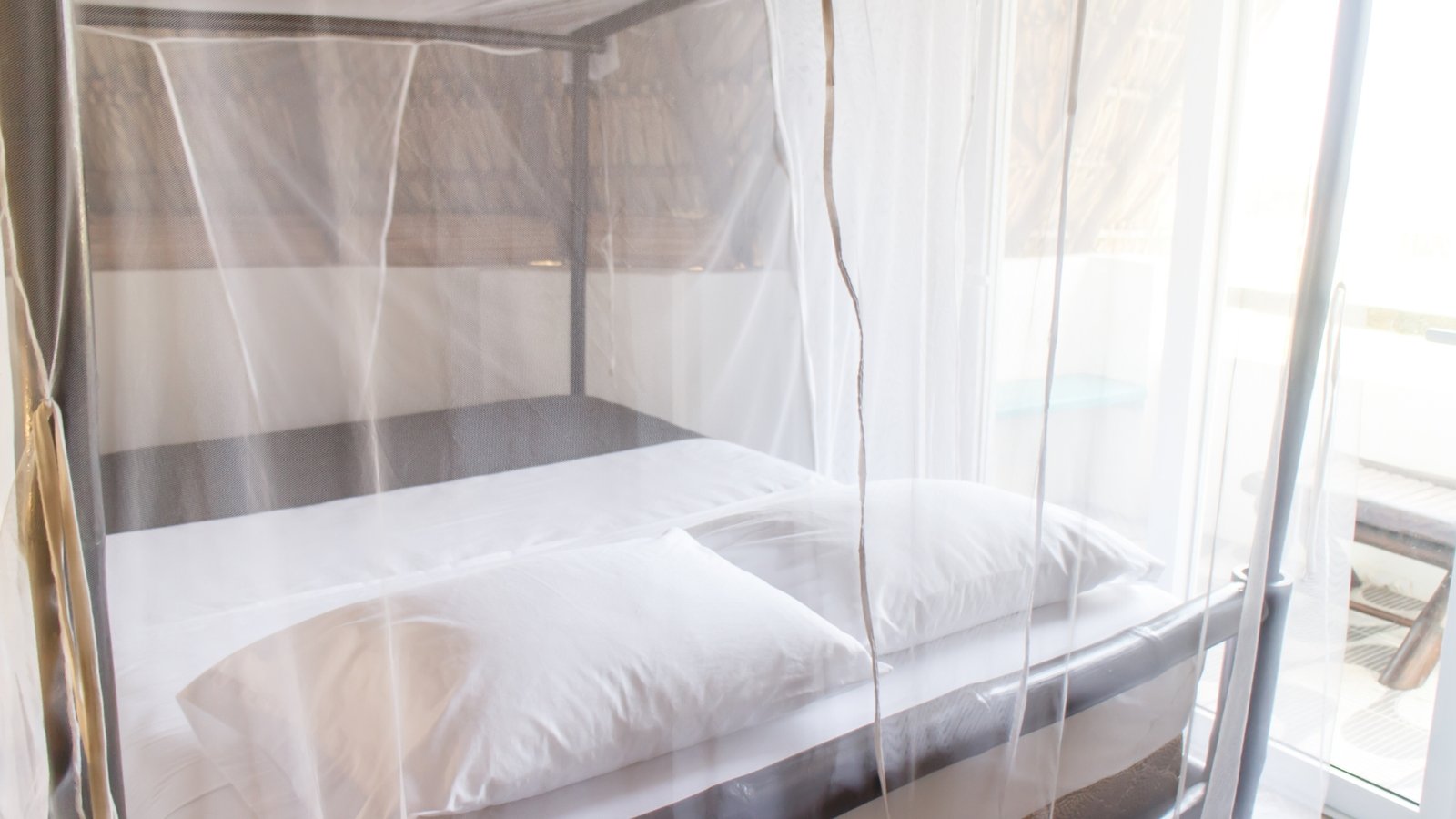
A mosquito net is a simple physical barrier. You hang it over a bed, crib, or sleeping area, and the fine mesh keeps mosquitoes from reaching you while you sleep. It does not use chemicals to work (though many nets add them), and it does not wear off during the night the way a skin repellent can. That makes it most useful in three situations: camping and sleeping outdoors, traveling to places where mosquitoes carry disease, and protecting babies who are too young for repellent (CDC, About Mosquito Nets; CDC, Preventing Mosquito Bites).
Think of a net as protection for the hours you cannot actively defend yourself. When you are asleep, you cannot reapply repellent or swat, so a barrier that works on its own does the job for you.
When you need one at home vs traveling
For most people sleeping indoors at home, a bed net is not necessary. Intact window and door screens usually do the same job for the whole room, keeping mosquitoes out of the space instead of just off the bed (CDC, Preventing Mosquito Bites). If your screens are in good repair and your air conditioning lets you keep windows closed, you are already covered.
A net becomes worth using when those defenses are missing. The CDC advises using a bed net if you cannot stay somewhere with air conditioning or window and door screens, or if you are sleeping outside (CDC, About Mosquito Nets; CDC, Preventing Mosquito Bites While Traveling). In practice that means:
- Camping and sleeping outdoors, where there are no walls or screens between you and the insects.
- Unscreened or open-air rooms, including older buildings, cabins, and porches.
- Travel to areas with mosquito-borne disease, such as regions where malaria, dengue, or other illnesses spread, and where lodging may not have reliable screens or air conditioning.
The disease risk is what raises the stakes when you travel. At home a bite is usually just an itch. In a malaria-endemic region, the same bite can transmit a serious infection, so a barrier during sleep carries much more weight (CDC, Preventing Mosquito Bites While Traveling).
Insecticide-treated nets
A plain net blocks mosquitoes. A net treated with insecticide does more: it also kills or disables mosquitoes that land on it, which protects you even if the mesh has a small gap and helps knock down the local mosquito population over time. The World Health Organization describes an insecticide-treated net (ITN) as one that may repel, kill, or sterilize mosquitoes that touch the treated netting (WHO, Insecticide-treated nets).
The insecticides used are pyrethroids, the same family as permethrin, applied to the fibers of the net. Permethrin-treated nets provide more protection than untreated nets (CDC, About Mosquito Nets). Modern long-lasting insecticidal nets are made so the treatment stays effective for the life of the net without needing to be re-treated (WHO, Insecticide-treated nets).
This is not a minor add-on. WHO recommends insecticide-treated nets as a core intervention for people at risk of malaria, meaning one of the main tools relied on worldwide (WHO, Insecticide-treated nets). The evidence behind that is strong. A large Cochrane review of controlled trials found that insecticide-treated nets, compared with no nets, lowered child deaths by about 17 percent (roughly 5.6 lives saved each year for every 1,000 children protected), cut cases of uncomplicated malaria by nearly half, and reduced severe malaria episodes by about 44 percent (Cochrane, Insecticide-treated nets for preventing malaria). For anyone traveling to a malaria area, choosing a treated net over a plain one is a meaningful upgrade.
Protecting babies
Netting is especially valuable for the youngest children because they cannot use the chemical repellents older kids and adults rely on. The CDC advises against using insect repellent on babies younger than 2 months old (CDC, Preventing Mosquito Bites). That leaves physical barriers as the main way to protect an infant.
For a baby under 2 months, the CDC recommends dressing the child in clothing that covers the arms and legs, and covering the crib, stroller, and baby carrier with mosquito netting (CDC, Preventing Mosquito Bites). A net draped over a carrier or car seat lets you protect an infant on the move, not just in the crib.
One safety point matters here. Pull the netting tight and secure it so a young child cannot pull loose fabric into the crib, which is a choking and entanglement hazard (CDC, About Mosquito Nets). The net should be taut over and around the sleeping space, not loose inside it.
Choosing and using a net
The features that make a net work come down to the mesh, the fit, and how you close it up.
Mesh. The holes need to be small enough to stop mosquitoes. The CDC suggests a net with about 156 holes per square inch, which blocks mosquitoes while still letting air through (CDC, About Mosquito Nets). Too coarse and insects get through; the stated count is a reliable target.
Shape, color, and size. For a bed, the CDC recommends a net that is compact, white, rectangular, and long enough to tuck under the mattress (CDC, About Mosquito Nets). White makes it easier to spot a mosquito that has gotten inside, and a rectangular net gives you room without the mesh resting against your skin, where a mosquito could bite through it.
Tuck it in, leave no gaps. A net only works if it is fully closed. Tuck the edges under the mattress all the way around so there is no opening for mosquitoes to crawl through (CDC, About Mosquito Nets). Check that the mesh is not torn and that it does not press flat against your body anywhere. Over a crib, tuck the netting under the mattress or choose a net long enough to reach the floor (CDC, About Mosquito Nets).
Treat it if you can. Where mosquitoes carry disease, choose a permethrin-treated net or treat a plain one, since treated nets protect better than untreated ones (CDC, About Mosquito Nets).
Sources
- Centers for Disease Control and Prevention (CDC), “About Mosquito Nets.” https://www.cdc.gov/mosquitoes/prevention/about-mosquito-nets.html (accessed 20 July 2026; page returned HTTP 403, claims taken from CDC search-result excerpt). Source for when to use a net, mesh count (156 holes per square inch), net color/shape/size, tucking under the mattress, crib guidance, and permethrin-treated nets providing more protection.
- Centers for Disease Control and Prevention (CDC), “Preventing Mosquito Bites.” https://www.cdc.gov/mosquitoes/prevention/index.html (accessed 20 July 2026). Source for screens at home, no repellent on babies under 2 months, and covering crib, stroller, and baby carrier with netting.
- Centers for Disease Control and Prevention (CDC), “Preventing Mosquito Bites While Traveling.” https://www.cdc.gov/mosquitoes/prevention/preventing-mosquito-bites-while-traveling.html (accessed 20 July 2026). Source for using a net when air conditioning or screens are unavailable or when sleeping outside, and for elevated disease risk while traveling.
- World Health Organization (WHO), “Insecticide-treated nets.” https://www.who.int/groups/vector-control-advisory-group/summary-of-new-interventions-for-vector-control/insecticide-treated-nets (accessed 20 July 2026). Source for how ITNs work (repel, kill, or sterilize mosquitoes), long-lasting insecticidal nets staying effective without re-treatment, and ITNs as a recommended core intervention against malaria.
- Cochrane Database of Systematic Reviews, “Insecticide-treated nets for preventing malaria” (Pryce, Richardson, Lengeler). https://pmc.ncbi.nlm.nih.gov/articles/PMC6418392/ (accessed 20 July 2026). Source for the trial evidence: about 17 percent lower child mortality, roughly 5.6 lives saved per 1,000 children per year, nearly half fewer uncomplicated malaria cases, and about 44 percent fewer severe malaria episodes.
Related
- Permethrin-treated clothing (placeholder)
- Choosing an EPA-registered repellent (placeholder)
- Preventing mosquito bites while traveling (placeholder)
- Protecting babies and young children from mosquitoes (placeholder)
Educational note: This page is general reference information, not medical or travel-health advice. If you are traveling to an area with malaria or other mosquito-borne disease, consult a travel medicine clinic or your health provider about the right protection for you and your children.
Last reviewed 20 July 2026.