The short answer
Several harmless insects get mistaken for mosquitoes. Most of them do not bite at all. The reliable giveaway is the mosquito itself: a true mosquito (family Culicidae) has a long, forward-projecting piercing proboscis and narrow wings lined with scales along the veins and body (UTEP Laboratory for Environmental Biology, ref. 9). Its look-alikes lack one or both of those features. If the insect on your wall is large and spindly, or tiny and clear-winged, or walks around after it lands, it is probably not a mosquito.
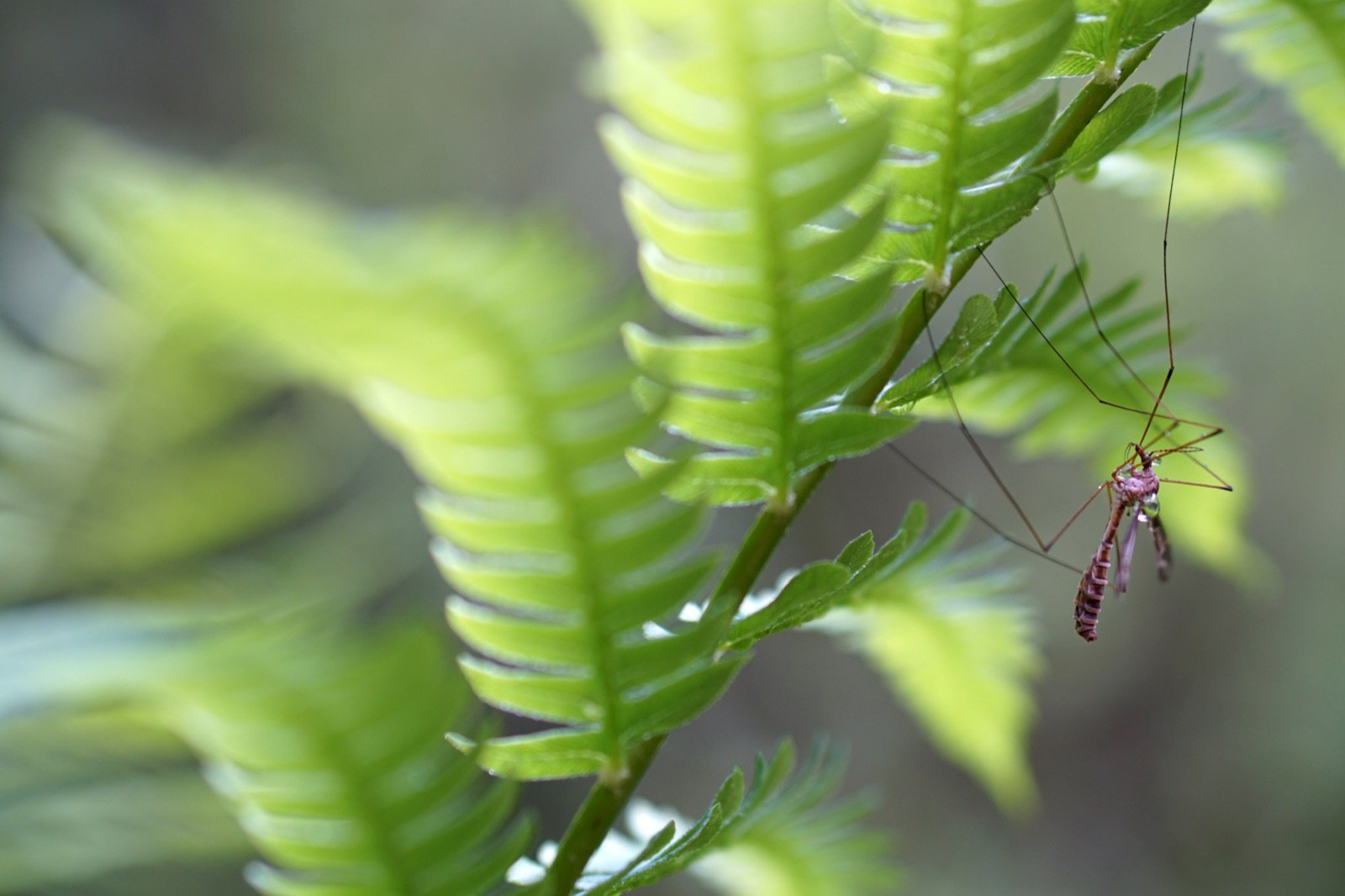
Crane flies
Crane flies look like extra-large, long-legged versions of mosquitoes, which is exactly why people call them “mosquito hawks,” “mosquito eaters,” or “skeeter eaters.” All three names are wrong. Adult crane flies are completely harmless, they do not bite, and they do not hunt or eat mosquitoes (UF/IFAS Extension, ref. 1).
The myth is worth correcting plainly. Matthew Bertone, a crane fly specialist and extension associate at North Carolina State University, put it this way: “There has yet to be found a predatory adult crane fly. They just don’t have the mouthparts for it” (Entomology Today, ref. 2). Many adult crane flies eat very little or nothing at all. Some sponge up dew or take nectar from flowers, and their brief adult lives (a matter of days, up to about two weeks) are spent mostly finding a mate and laying eggs (ref. 1, ref. 2).
Their larvae, called leatherjackets, live in wet soil, streams, pond edges, and rotting vegetation, where they feed on decaying plant matter (ref. 1). A few species can be lawn pests, but the adult flying around your porch light is doing nothing more than looking for a mate.
Midges
“Midge” covers two very different groups, and the difference matters because one bites and one does not.
Non-biting midges (family Chironomidae) are the most mosquito-like of all. In parts of the country they are even nicknamed “blind mosquitoes” because they swarm in mosquito-like clouds but cannot bite (NC State Extension, ref. 4). They lack the piercing proboscis needed to take blood, and they cannot transmit disease-causing pathogens (University of Kentucky Entomology, ref. 3). They also lack the wing scales and elongated mouthparts of a true mosquito (ref. 4). A common tell is the resting posture and the swarms near water at dusk.
Biting midges (family Ceratopogonidae) are the ones that bite. These are the insects known as no-see-ums, punkies, or sand gnats. Most of the biting species belong to the genus Culicoides, which has more than 1,000 species in North America (University of Saskatchewan WCVM, ref. 5). They are tiny, less than about 4 mm long, with a short downward-pointing proboscis. Female biting midges must take a blood meal to lay eggs, and the bites are painful out of proportion to the insect’s size (ref. 5). They can also affect livestock and horses. So “midge” is not automatically harmless: it depends on the family.
Fungus gnats and other small flies
Fungus gnats are small, dark, slender flies with long legs that resemble tiny mosquitoes, usually about 3 to 4 mm long (Utah State University Extension, ref. 8). They do not bite people, and they tend to avoid people entirely (Santa Barbara County Mosquito and Vector Management District, ref. 7).
The most practical way to tell a fungus gnat from a mosquito is to watch what it does after it lands: fungus gnats walk around, while mosquitoes tend to stay put where they land (ref. 7). Fungus gnats are also weak fliers that stay close to their source. Indoors, that source is almost always the moist soil of overwatered potted plants, where the white, legless, black-headed larvae develop (ref. 6, ref. 8). Letting the soil dry between waterings and using yellow sticky cards usually clears them out (ref. 7).
How to tell a true mosquito apart
Three features, taken together, identify a mosquito and rule out the look-alikes (ref. 9, ref. 4):
- Proboscis: a long, thin, forward-projecting tube. It is present in both males and females (only females bite). Look-alikes either have no piercing proboscis at all or a short, downward one.
- Wing scales: mosquito wings are narrow and carry rows of scales along the veins and edges, and scales cover much of the body. Scaling like this is uncommon among flies. Crane flies, chironomid midges, and fungus gnats have clear or plain wings without this scaling.
- Halteres: like all true flies, mosquitoes have a pair of small, knob-like reduced hind wings called halteres, used for balance in flight. This confirms the insect is a fly, but it does not by itself separate a mosquito from a midge or gnat, so pair it with the proboscis and wing-scale checks.
Comparison at a glance
| Insect | Bites people? | Size and look | Quick tell |
|---|---|---|---|
| True mosquito (Culicidae) | Females do | Slender, long piercing proboscis, scaled narrow wings | Forward proboscis plus wing scales; stays put after landing |
| Crane fly (Tipulidae) | No | Very large, extremely long legs | Too big, spindly legs, no biting mouthparts |
| Non-biting midge (Chironomidae) | No | Mosquito-like, clear wings, swarms | No proboscis, no wing scales, “blind mosquito” swarms |
| Biting midge / no-see-um (Ceratopogonidae) | Yes | Tiny, under about 4 mm | Painful bite from an almost invisible insect |
| Fungus gnat (Sciaridae) | No | Small, dark, long legs, ~3 to 4 mm | Walks after landing; comes from potted-plant soil |
Sources
- UF/IFAS Extension, Escambia County. “Weekly ‘What is it?’: Crane flies.” https://blogs.ifas.ufl.edu/escambiaco/2024/03/13/weekly-what-is-it-crane-flies/ (crane flies are harmless, do not bite, do not eat mosquitoes; adults sponge dew or take nectar; short adult lifespan; larvae are leatherjackets in wet soil and vegetation). Accessed 2026-07-20.
- Entomology Today (Entomological Society of America). “Mosquito Hawk? Skeeter Eater? Giant Mosquito? No, No, and No.” https://entomologytoday.org/2015/08/17/mosquito-hawk-skeeter-eater-giant-mosquito-no-no-and-no/ (quote from Matthew Bertone, North Carolina State University, that no predatory adult crane fly exists and they lack the mouthparts; adults live only a few days). Accessed 2026-07-20.
- University of Kentucky Entomology. “Non-Biting Midges and Gnats” (EF632). https://entomology.mgcafe.uky.edu/ef632 (chironomid midges do not bite and cannot vector disease-causing pathogens; biting midges are family Ceratopogonidae, also called no-see-ums, and do bite). Accessed 2026-07-20.
- NC State Extension. “Biology and Control of Non-Biting Aquatic Midges.” https://content.ces.ncsu.edu/biology-and-control-of-non-biting-aquatic-midges (non-biting midges are known as “blind mosquitoes,” lack the piercing proboscis of mosquitoes, and are distinguished by the absence of the wing scales and elongated mouthparts of true mosquitoes; page returned HTTP 403, facts drawn from the publication’s indexed summary text). Accessed 2026-07-20.
- University of Saskatchewan, Western College of Veterinary Medicine. “Culicoides species: biting midges or no-see-ums.” https://wcvm.usask.ca/learnaboutparasites/parasites/culicoides-species-biting-midges-or-no-see-ums.php (Culicoides are less than about 4 mm with a short downward-pointing proboscis; more than 1,000 species in North America; females must blood-feed and produce painful bites). Accessed 2026-07-20.
- UF/IFAS. “Darkwinged Fungus Gnats, Bradysia spp.” (EENY-215/IN372). https://ask.ifas.ufl.edu/publication/IN372 (fungus gnat identification and larval habitat in moist organic media). Accessed 2026-07-20.
- Mosquito and Vector Management District of Santa Barbara County. “Fungus gnats: Mosquito look-alikes.” https://www.mvmdistrict.org/fungus-gnats-mosquito-look-alikes (fungus gnats do not bite; they walk after landing while mosquitoes stay put; indoor sources are potted plants). Accessed 2026-07-20.
- Utah State University Extension. “Fungus Gnats.” https://extension.usu.edu/planthealth/ipm/structural-pest-id-guide/fungus-gnats (adults about 3 to 4 mm, slender dark body, long legs, Y-shaped wing vein; white legless larvae with black heads). Accessed 2026-07-20.
- University of Texas at El Paso, Laboratory for Environmental Biology. “Mosquito Identification: Adults.” https://www.utep.edu/leb/mosquito/mosquitoadult.pdf (adult mosquitoes have a long, forward-projecting proboscis in both sexes, long narrow wings with scales along the veins and body, and knob-like halteres). Accessed 2026-07-20.
Related
- [Mosquito anatomy and identification] (placeholder)
- [No-see-ums and biting midges] (placeholder)
- [Do bug zappers and myths about mosquito predators] (placeholder)
- [Mosquito species of the US] (placeholder)
Educational note: This page is for general reference and identification. It is not pest-control or medical advice. If you have a persistent biting-insect problem, contact your local mosquito control or vector management district or a licensed professional.
Last reviewed 20 July 2026.