Short answer
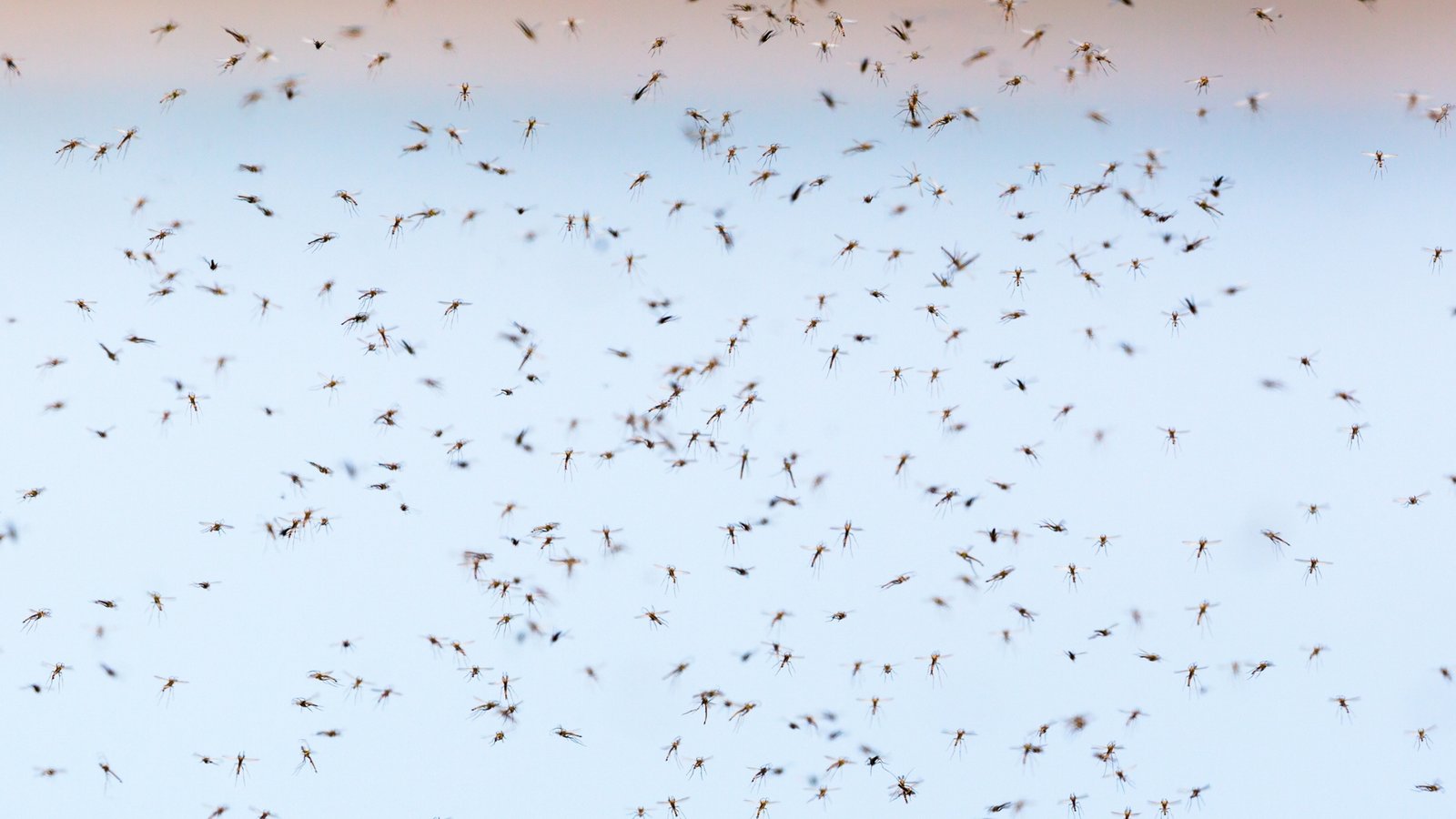
It depends on the species. Many of the mosquitoes that bother people in a backyard are container breeders, and they tend to stay within a few hundred feet of where they hatched. Other groups, especially floodwater and saltmarsh mosquitoes, are strong flyers that can travel several miles from their breeding sites, and in exceptional wind-assisted cases much farther.
That range matters because it tells you where a biting mosquito probably came from. For the species most people deal with at home, the source is usually close by (AMCA FAQ, mosquito.org).
Short-range species: container breeders
The mosquitoes that breed in and around the home are generally weak flyers with short ranges. The American Mosquito Control Association notes that species that prefer to breed around the house, such as the Asian tiger mosquito (Aedes albopictus), have limited flight ranges of about 300 feet (AMCA FAQ, mosquito.org).
The yellow fever mosquito (Aedes aegypti) is similar. A meta-analysis of 38 published studies and 181 individual experiments estimated an average flight distance of about 106 meters (roughly 350 feet), with individual experiments reporting distances from about 12 meters to more than 2,400 meters (Journal of Medical Entomology, 2022; summarized by Entomology Today). The average sits low because these mosquitoes usually do not need to go far. They breed in small artificial containers close to people, so hosts and egg-laying sites are already nearby.
The practical takeaway is that when Aedes aegypti or Aedes albopictus are biting, the water they came from is very likely on the property or next door. See the species pages linked under Related below.
Long-range species: floodwater and saltmarsh mosquitoes
Other groups fly much farther. Floodwater mosquitoes lay eggs in soil that floods intermittently, and when large broods emerge together they can disperse widely in search of hosts.
The inland floodwater mosquito (Aedes vexans) is a well-documented example. Field observations record flight ranges of five to eight miles in Utah, migration of about ten miles in British Columbia, and movements of five, ten, and even fifteen miles from the breeding site in New Jersey (Rutgers Center for Vector Biology). Because of this, nuisance from Aedes vexans can be widespread rather than limited to the immediate area of the larval habitat.
Saltmarsh mosquitoes are stronger still. For the eastern saltmarsh mosquito (Aedes sollicitans), the average distance a brood moves inland before returning to the coast is generally less than five miles, though this is shaped by wind, and young females can move about one mile per day under favorable conditions (Rutgers Center for Vector Biology). The black saltmarsh mosquito (Aedes taeniorhynchus) generally flies two to five miles, and wind-assisted flights of over thirty miles are known (Rutgers Center for Vector Biology).
The American Mosquito Control Association summarizes the broad pattern this way: most species have flight ranges of one to three miles, certain large pool breeders in the Midwest are often found up to seven miles from known breeding spots, and saltmarsh breeders have been known to migrate up to 100 miles in exceptional circumstances, although 20 to 40 miles is much more common when hosts are scarce (AMCA FAQ, mosquito.org).
What affects flight range
Flight range is not a fixed number for a given mosquito. Several factors push it up or down.
- Species. This is the biggest factor. A container breeder and a saltmarsh mosquito are built for very different lives, and their typical ranges differ by orders of magnitude.
- Wind. Long-distance saltmarsh and floodwater dispersal is often wind-assisted, and prevailing wind direction and strength shape how far and which way a brood moves (Rutgers Center for Vector Biology; AMCA FAQ, mosquito.org).
- Host and habitat availability. Mosquitoes fly to find a blood meal and a place to lay eggs. When hosts and egg-laying sites are close, as they are for backyard container breeders, mosquitoes do not travel far. When breeding sites are far from hosts, as with a coastal marsh, mosquitoes cover more ground (AMCA FAQ, mosquito.org; Journal of Medical Entomology, 2022).
Why it matters
For most people, the mosquitoes doing the biting are short-range container breeders, which means a nearby breeding site is usually the source. That is good news, because it puts the fix within reach. Removing standing water from containers, gutters, saucers, and other small habitats on your own property can meaningfully reduce the mosquitoes you encounter, since the ones biting you often hatched close by.
Source reduction has limits with the long-range species. If floodwater or saltmarsh mosquitoes are the problem, the source may be miles away and beyond any one household, which is where organized mosquito control districts operate. Knowing which type you are dealing with helps set expectations. See the Related pages below on breeding sites and standing water.
Sources
- American Mosquito Control Association, Frequently Asked Questions (general flight ranges by group: about 300 feet for house-breeding species like the Asian tiger mosquito, 1 to 3 miles for most species, up to 7 miles for Midwest pool breeders, 20 to 40 and up to 100 miles for saltmarsh breeders). https://www.mosquito.org/faqs/ (accessed 20 July 2026)
- Journal of Medical Entomology (2022), meta-analysis estimating Aedes aegypti average flight distance at about 106 meters across 38 studies and 181 experiments, with a reported range of about 12 to more than 2,400 meters. https://academic.oup.com/jme/article/59/4/1164/6596097 (accessed 20 July 2026)
- Entomology Today, plain-language summary of the Aedes aegypti flight-distance meta-analysis (106-meter average). https://entomologytoday.org/2022/07/07/study-yellow-fever-mosquito-aedes-aegypti-average-flight-range/ (accessed 20 July 2026)
- Rutgers Center for Vector Biology, species profile for Aedes vexans, inland floodwater mosquito (flight ranges of five to eight miles in Utah, about ten miles in British Columbia, five to fifteen miles in New Jersey). https://vectorbio.rutgers.edu/outreach/species/sp13.htm (accessed 20 July 2026)
- Rutgers Center for Vector Biology, species profile for Aedes sollicitans, eastern saltmarsh mosquito (brood movement generally less than five miles, about one mile per day for young females). https://vectorbio.rutgers.edu/outreach/species/sp7.htm (accessed 20 July 2026)
- Rutgers Center for Vector Biology, species profile for Aedes taeniorhynchus, black saltmarsh mosquito (generally two to five miles, wind-assisted flights over thirty miles). https://vectorbio.rutgers.edu/outreach/species/sp10.htm (accessed 20 July 2026)
Related
- Aedes aegypti (yellow fever mosquito) [placeholder]
- Aedes albopictus (Asian tiger mosquito) [placeholder]
- Where do mosquitoes breed? [placeholder]
- How to get rid of standing water [placeholder]
Educational note: This page is a general reference for public education and is not pest-control or medical advice. Flight ranges vary by species, weather, and local conditions. For a mosquito problem you cannot trace to a nearby source, contact your local mosquito control district or a licensed professional.
Last reviewed 20 July 2026.