The short answer
Your risk of catching a mosquito-borne disease rises and falls with mosquito activity. In most of the country, that means the danger is low in winter and early spring, builds through late spring and early summer, and reaches its highest point in late summer and early fall.
For the diseases that cause the most human illness here, the pattern is clear. West Nile virus, the most common mosquito-borne disease reported in the continental US, sees roughly 94 percent of human cases reported from July through September, and the number of people diagnosed typically peaks in late August and early September [1]. If you are going to think seriously about protecting yourself during one stretch of the year, that stretch is roughly mid-July through the end of September.
Why summer and early fall are peak
Three things line up in late summer to push disease risk to its yearly high.
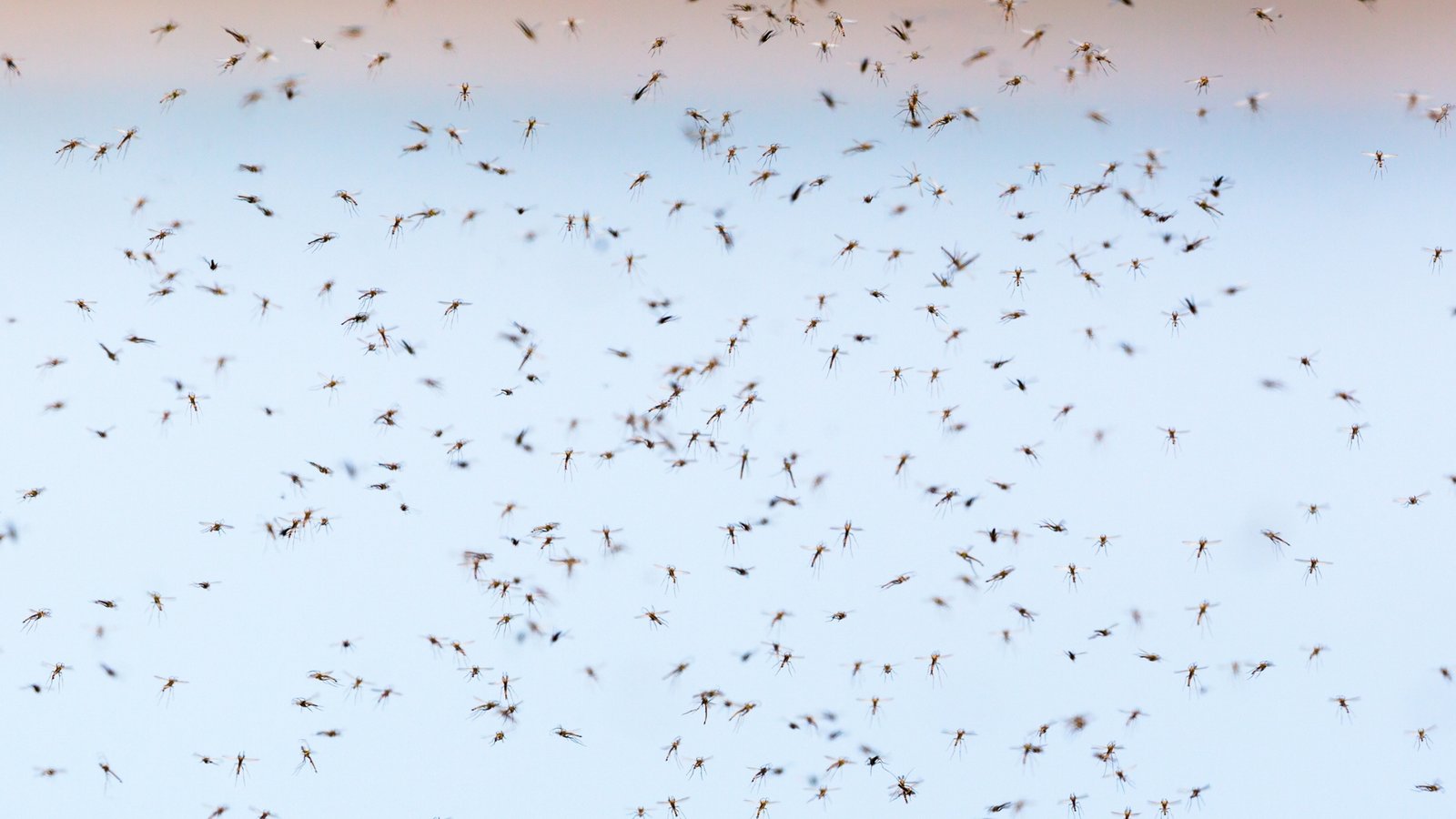
First, mosquito populations are at their largest. Warm temperatures and standing water from summer rain let successive generations of mosquitoes hatch and mature quickly, so the number of biting adults keeps climbing into August.
Second, the viruses themselves have had months to build up. West Nile virus is kept alive in nature by a cycle between Culex mosquitoes and birds. Mosquitoes pick up the virus when they feed on infected birds, then pass it to other birds, and the amount of virus circulating in the local bird and mosquito population grows over the summer. People, horses, and other mammals are what scientists call dead-end hosts, meaning we can get sick but do not carry enough virus to infect a mosquito that bites us [2]. By late summer, so much virus has amplified in the bird-and-mosquito cycle that the chance of a spillover bite reaching a person is at its highest.
Third, warm weather keeps mosquitoes active and speeds the virus along. Temperature drives how fast mosquitoes develop and how quickly a virus multiplies inside them, so the hot weeks of the year are also the most efficient weeks for transmission.
The result is a season that runs, in general terms, from June through October, with the human-case peak concentrated in the six or so weeks around late August [1].
When specific diseases peak
Not every mosquito-borne illness follows the exact same calendar. Here is how the main ones line up.
West Nile virus and the encephalitis viruses (late summer into fall). West Nile human cases cluster in late summer and early fall, peaking in late August and early September [1]. Most people who are infected never feel sick. About 8 in 10 have no symptoms, and roughly 1 in 150 develop severe neuroinvasive disease affecting the brain or spinal cord [3]. Eastern equine encephalitis, a rare but serious virus of the Atlantic and Gulf Coast states and the Great Lakes region, is likewise most common from late spring through early fall, with cases usually peaking in the summer months. It averages about 11 human cases a year nationwide [4].
La Crosse virus (mid-to-late summer). La Crosse encephalitis, spread mainly by a daytime-biting tree-hole mosquito, tends to peak later in the summer, from about July through September, when infected mosquito populations are highest [5]. State health data put the highest-risk window at roughly mid-July through mid-September [6]. Nationwide, 50 to 150 neuroinvasive La Crosse cases are reported each year, mostly in children, in the upper Midwest, mid-Atlantic, and Southeast [7].
Dengue, Zika, and chikungunya (tied to travel and to warm months). For most of the country, these three viruses arrive with travelers who were infected elsewhere, so cases can appear in any month depending on travel patterns. The risk of local, mosquito-to-person spread within the US is a warm-season, warm-place story. The Aedes aegypti mosquito that carries these viruses finds conditions unsuitable across most of the country in the winter months of December through March, except in southern Florida and south Texas, and finds conditions suitable across the country during the peak summer months of July through September [8]. Laboratory and field studies put efficient transmission of all three viruses in a temperature band of roughly 18 to 34 degrees Celsius, with the most intense transmission around 26 to 29 degrees Celsius [9]. In practice, that means the small number of locally acquired cases reported in the continental US have clustered in warm months in the far South [10].
Spring and early summer
Spring is the ramp-up, not the peak. As temperatures rise, overwintering mosquitoes become active again and the first new generations hatch, so you will notice more biting through May and June. But the viruses have not yet amplified to late-summer levels, and reported human disease stays comparatively low this early in the season.
This is the right time to get ahead of the problem rather than the time to relax. Emptying standing water and repairing screens in spring reduces the mosquito population that would otherwise be peaking a few months later.
Winter and the off-season
In winter, human transmission is very low across nearly all of the country. Mosquitoes do not simply vanish, though. In temperate areas, the Culex mosquitoes that carry West Nile virus survive the cold as adult females in a dormant, reproductive-arrest state called diapause, sheltering in protected spots and emerging when temperatures climb again in spring [11]. Some overwintering females can even carry West Nile virus through the winter, which helps the cycle restart the following year.
The practical takeaway is that a hard freeze quiets the season but does not reset it to zero. In the warmest parts of the country, southern Florida and south Texas, mosquitoes can stay active year-round, so the off-season there is shorter and less complete than in northern states.
How climate and weather shift the season
The seasonal calendar above is a baseline, and weather moves it around from year to year and place to place. A warm, wet spring can start the season early; a hot, dry stretch can suppress the mosquitoes that need standing water.
Over longer spans, warming temperatures are lengthening the window in which mosquitoes are active across much of the country, letting the season begin earlier in spring and run later into fall in many regions. One line of research estimates that a 2.5 degree Celsius rise in mosquito-season temperatures could extend the length of the transmission season by up to about 20 percent, though the effect is uneven and the very hottest regions can actually see fewer suitable days when summer heat pushes past what mosquitoes tolerate [12]. For how temperature, rainfall, and region interact with mosquito activity in more detail, see the seasons cluster.
What to do each season
- Winter: Low risk in most areas. Use the quiet months to plan. Clear gutters and remove containers, tires, and other items that will hold spring rain.
- Spring: Populations are building. Empty and scrub anything that holds water at least weekly, repair window and door screens, and start using an EPA-registered repellent once biting picks up.
- Summer and early fall (peak): Highest risk. Use repellent consistently, wear long sleeves and pants when practical, avoid peak biting times for the mosquitoes in your area, and keep dumping standing water after every rain. Pay closest attention from mid-July through the end of September.
- Late fall: Risk falls as nights cool, but do not drop your guard until a sustained cold snap. Mosquitoes stay active on warm days.
Sources
- Centers for Disease Control and Prevention. “Key Messages: West Nile Virus” (94 percent of human cases reported July through September; cases typically peak late August to early September; season generally June through October). https://www.cdc.gov/west-nile-virus/php/outbreak-communication/key-messages.html. Accessed 2026-07-20.
- Centers for Disease Control and Prevention. “About West Nile” (Culex-and-bird enzootic amplification cycle; humans and other mammals are dead-end hosts). https://www.cdc.gov/west-nile-virus/about/index.html. Accessed 2026-07-20.
- Centers for Disease Control and Prevention. “Symptoms of West Nile” (about 8 in 10 infected people have no symptoms; about 1 in 150 develop severe neuroinvasive disease). https://www.cdc.gov/west-nile-virus/symptoms-diagnosis-treatment/index.html. Accessed 2026-07-20.
- Centers for Disease Control and Prevention. “Guidelines for Eastern Equine Encephalitis Virus Surveillance and Control” and “Data and Maps for Eastern Equine Encephalitis” (late spring through early fall, peaking in summer; average of about 11 human cases per year; Atlantic and Gulf Coast states and Great Lakes region). https://www.cdc.gov/eastern-equine-encephalitis/php/surveillance-and-control-guidelines/. Accessed 2026-07-20.
- Centers for Disease Control and Prevention. “Clinical Signs and Symptoms of La Crosse Virus Disease” (most cases occur later in summer, July through September, when infected mosquito populations are highest). https://www.cdc.gov/la-crosse-encephalitis/hcp/clinical-signs/index.html. Accessed 2026-07-20.
- Minnesota Department of Health. “La Crosse Encephalitis Fact Sheet” (highest risk typically mid-July through mid-September). https://www.health.state.mn.us/diseases/lacencephalitis/lc.html. Accessed 2026-07-20.
- Centers for Disease Control and Prevention. “Data and Maps for La Crosse” (50 to 150 neuroinvasive cases reported per year; upper Midwest, mid-Atlantic, and Southeast). https://www.cdc.gov/la-crosse-encephalitis/data-maps/index.html. Accessed 2026-07-20.
- Monaghan AJ, et al. “On the Seasonal Occurrence and Abundance of the Zika Virus Vector Mosquito Aedes aegypti in the Contiguous United States.” PLOS Currents / PMC (conditions largely unsuitable December through March except southern Florida and south Texas; suitable across cities during peak summer, July through September). https://www.ncbi.nlm.nih.gov/pmc/articles/PMC4807952/. Accessed 2026-07-20.
- Mordecai EA, et al. “Detecting the impact of temperature on transmission of Zika, dengue, and chikungunya using mechanistic models.” PLOS Neglected Tropical Diseases / PMC (transmission occurs roughly 18 to 34 degrees Celsius, maximal near 26 to 29 degrees Celsius). https://www.ncbi.nlm.nih.gov/pmc/articles/PMC5423694/. Accessed 2026-07-20.
- Centers for Disease Control and Prevention. “Zika Cases in the United States” (US cases are predominantly travel-associated; local transmission limited to warm-season, far-southern areas). https://www.cdc.gov/zika/zika-cases-us/index.html. Accessed 2026-07-20.
- Nelms BM, et al. “Overwintering Biology of Culex (Diptera: Culicidae) Mosquitoes in the Sacramento Valley of California.” Journal of Medical Entomology / PMC (Culex overwinter as adult females in diapause and can serve as reservoir hosts when cold arrests viral replication). https://pmc.ncbi.nlm.nih.gov/articles/PMC3920460/. Accessed 2026-07-20.
- “The impact of climate change on transmission season length: West Nile virus as a case study.” PMC (a 2.5 degree Celsius rise in mosquito-season temperature could extend transmission season length by up to about 20 percent). https://www.ncbi.nlm.nih.gov/pmc/articles/PMC12324454/. Accessed 2026-07-20.
Related
- West Nile virus: symptoms, risk, and prevention [placeholder]
- La Crosse encephalitis explained [placeholder]
- Dengue and travel-related mosquito viruses [placeholder]
- Mosquito season by region [placeholder]
- How weather and rainfall drive mosquito activity [placeholder]
- Repellents and bite prevention that actually work [placeholder]
This page is for general education and is not medical advice. If you have symptoms of a mosquito-borne illness, contact a healthcare provider. For local risk and control information, consult your state or county health department.
Last reviewed 20 July 2026.