The short answer
Consumer foggers and hose-end or professional barrier sprays kill or repel adult mosquitoes on contact and on treated foliage, but the effect is temporary and they raise real tradeoffs. A fogger clears the adults flying in your yard right now, which can buy a few comfortable hours for a cookout. A barrier spray coats shrubs and other shady resting spots with a residual insecticide that keeps killing for a few weeks. Neither one removes the standing water where the next generation is hatching, so neither one solves a mosquito problem on its own.
Both approaches rely on the same family of chemicals, synthetic pyrethroids, which are broad-spectrum. They do not distinguish between a mosquito and a bee, a butterfly, or a firefly. That is the honest tension at the center of this page: these products work in the short term, and that short-term effect comes with costs to the rest of the insect life in your yard. Public health agencies treat adult spraying as a supporting tactic, not a foundation. Both the CDC and EPA recognize a legitimate need for chemical control of adult mosquitoes, but describe it as most justified “during periods of mosquito-borne disease transmission or when source reduction and larval control have failed or are not feasible” (EPA, Success in Mosquito Control).
Thermal and cold foggers for a yard
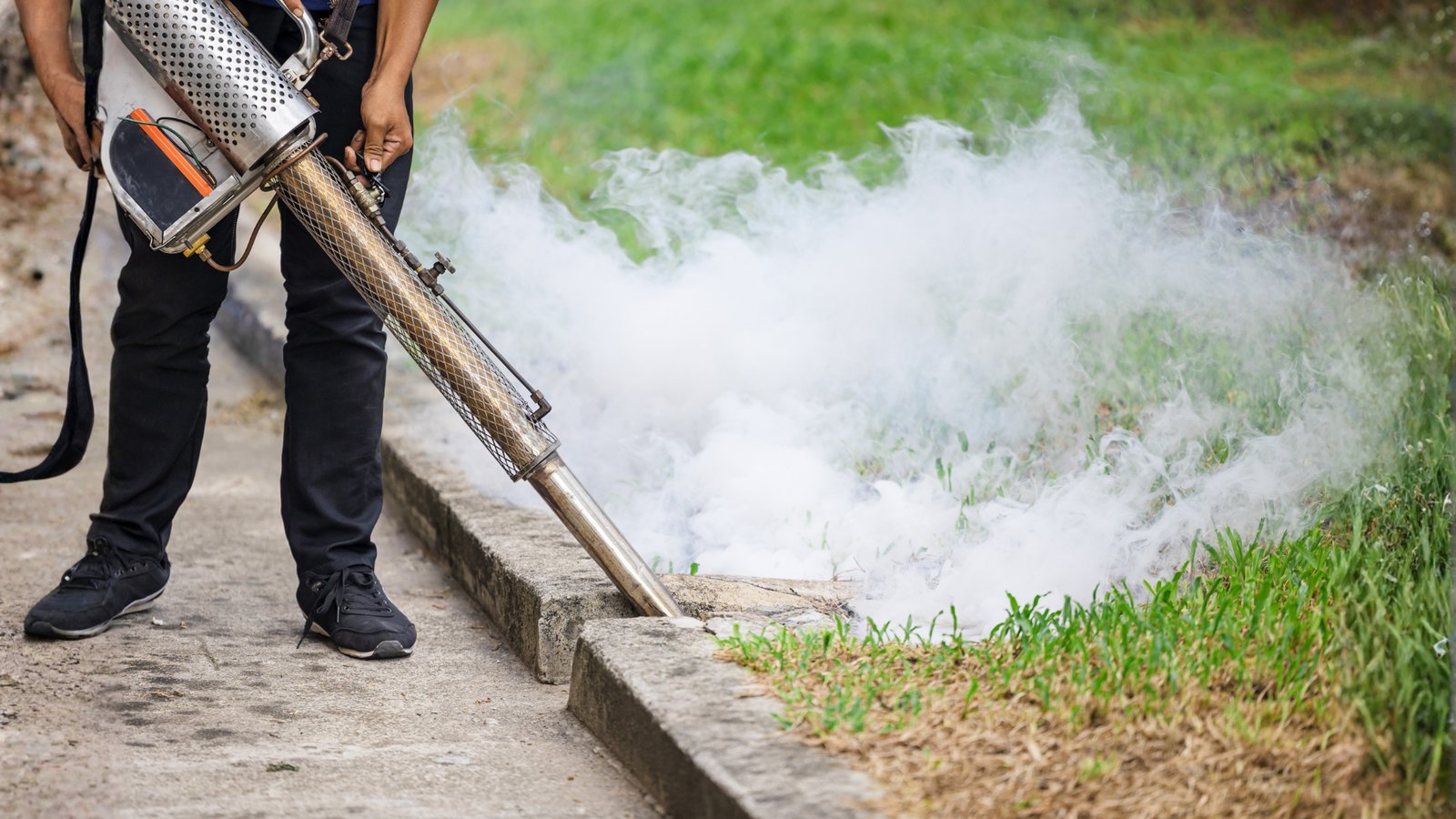
A fogger turns liquid insecticide into a cloud of tiny airborne droplets that drift through the yard and kill adult mosquitoes on contact. There are two mechanisms. A thermal fogger heats an oil-based carrier until it vaporizes, then the hot vapor hits cooler air and condenses into the thick white cloud you see from consumer propane models. A cold fogger, the type used by mosquito control programs, uses air pressure instead of heat. As the EPA describes the professional version, “ULV sprayers dispense very fine aerosol droplets that stay aloft and kill adult mosquitoes on contact,” applied at rates “less than 4 fluid ounces of mixed formulation per acre” (EPA, Synthetic Pyrethroids for Mosquito Control).
The key thing to understand about any fogger is that it is a space spray, not a lasting treatment. It kills the adults that are in the air and on surfaces at the moment of application, and then it dissipates. The AMCA notes that these ULV space sprays “do not leave residues” and that “the chemicals break down within hours” (AMCA, Pollinator Protections). That is good news for pollinator exposure, but it also means the protection is just as short-lived. Once the cloud clears, nothing stops mosquitoes from flying back in from a neighbor’s yard, a nearby ditch, or a shaded corner the fog never reached. A fogger clears adults for a gathering. It does not prevent new ones.
Barrier sprays on foliage
A barrier spray is the residual approach. Instead of a quick-dissipating cloud, a technician (or a homeowner with a hose-end applicator) coats the undersides of leaves, dense shrubs, tall grass, and other shady spots where adult mosquitoes rest during the heat of the day. The insecticide, again usually a pyrethroid such as bifenthrin, lambda-cyhalothrin, or deltamethrin, bonds to the plant surfaces and keeps killing mosquitoes that land there for weeks after application.
How long “weeks” means depends heavily on weather. A field study of pyrethroid formulations applied to outdoor vegetation found more than 80 percent mortality and knockdown lasting 60 days for bifenthrin and 90 days for lambda-cyhalothrin and deltamethrin under dry conditions, but during a rainy period (about 465 mm of rain over 51 days) that window shortened to roughly 42 days (Yougang et al., controlled vegetation study, PMC7156039). Real yards see less consistent coverage, so the practical figure most homeowners and applicators plan around is shorter: a University of Kentucky field trial of two common pyrethroid barrier products in suburban yards found significant reductions in mosquito numbers “for up to six weeks” before reapplication was needed (University of Kentucky field study, reported in PCT). Rain, irrigation, sun on unshaded surfaces, and new plant growth all cut that residual short.
Do they work
Short-term knockdown, yes. Lasting control, no, at least not without source reduction. The University of Kentucky study is the most useful US backyard data point. Across 24 suburban homes, barrier sprays of bifenthrin and lambda-cyhalothrin cut biting-mosquito numbers meaningfully: for the Aedes and Ochlerotatus group, reductions ran about 87 percent at one week, 72 percent at four weeks, and 61 percent at six weeks, with human bite counts down 84, 80, and 71 percent over the same intervals (University of Kentucky field study, reported in PCT). Half of the treated homeowners said they used their yards more, versus 14 percent in the water-only group.
But the same study flagged a serious gap. It found “no significant effect on the Culex mosquitoes,” likely because Culex tend to rest higher in the tree canopy and disperse in from untreated neighboring properties (University of Kentucky field study, reported in PCT). That matters because Culex species are the primary vectors of West Nile virus, one of the diseases homeowners most want to avoid. So a barrier spray can genuinely reduce the daytime-biting Aedes that ruin a backyard evening, while doing little about the mosquitoes that carry the highest-profile local disease risk. And because none of these methods touch the larval habitat, the population rebuilds from any standing water you leave in place. Public health guidance is consistent on the priority order: the EPA calls egg and larva interventions “generally the most effective, least costly, way to control mosquitoes,” and the AMCA describes adulticiding as a last resort after source reduction and larval control (EPA, Success in Mosquito Control; AMCA, Mosquito Control).
The tradeoffs
The central tradeoff is that pyrethroids are broad-spectrum. They kill insects generally, not mosquitoes specifically, so the same spray that clears a yard of mosquitoes also kills bees, butterflies, caterpillars, and other beneficial insects that contact it. The EPA states plainly that “pyrethroids are toxic to fish and to bees” (EPA, Synthetic Pyrethroids for Mosquito Control).
For a quick-dissipating fog applied at dusk when pollinators are inactive, that exposure is limited, which is why professional programs spray before dawn or after dusk and follow label restrictions like “do not apply when flowers are in bloom” (AMCA, Pollinator Protections). Residual barrier sprays are the bigger concern, because the insecticide stays active on foliage for weeks and any pollinator that lands there is exposed long after application. The University of Wisconsin-Madison Insect Diagnostic Lab summarizes the research this way: a 2022 study (Qualls et al.) found honey bees were still harmed 28 days after a barrier treatment, and earlier work by Dr. Karen Oberhauser found monarch caterpillars could be harmed or killed even three weeks after spraying. The lab warns that “if a yard is being sprayed for mosquitoes monthly during the warm season, there are reasons for concern,” and notes a real knowledge gap about longer-term effects on moths, fireflies, and other beneficial insects (University of Wisconsin-Madison Insect Diagnostic Lab).
Two other tradeoffs are worth naming. Drift and overuse: because barrier sprays coat vegetation, wind can carry droplets onto flowering plants, vegetable gardens, or water features you did not intend to treat, and the temptation to re-spray on a fixed monthly schedule multiplies the non-target exposure. Resistance: repeated household use of the same pyrethroid class contributes to the broader problem of mosquitoes evolving resistance to these chemicals, which erodes the effectiveness of the same products relied on for public health emergencies (household aerosol insecticide resistance study, Scientific Reports 2018). The more routinely a neighborhood leans on pyrethroids, the faster that erosion happens.
Using them responsibly, or skipping them
The single highest-value action is not on this page: it is source reduction. Removing standing water, described by the EPA as getting “rid of standing water in rain gutters, old tires, buckets, plastic covers, toys or any other container where mosquitoes can breed,” stops the next generation before it hatches and costs nothing (EPA, Success in Mosquito Control). For water that cannot be drained, such as rain barrels or ornamental features, a larvicide like Bti targets larvae without harming bees. Do that first. It is the part that actually reduces the mosquito population rather than the adults present at one moment.
If you still want a spray, use it as a spot tool, not a routine. A fogger before a specific event, applied to the areas where you will sit, gives you a few hours of relief with minimal residue. If you use a barrier spray, treat only the shady resting areas mosquitoes actually use, keep it off anything in bloom and away from water, spray at dusk when pollinators are inactive, and stretch reapplication intervals as long as the results allow rather than defaulting to monthly. Above all, follow the label. The EPA’s position is that pyrethroids can be used “without posing unreasonable risks to human health when applied according to the label,” and the label directions on rate, timing, and buffer zones are what keep that true (EPA, Synthetic Pyrethroids for Mosquito Control). And it is a fully reasonable choice to skip these products entirely, rely on source reduction, fans, screens, and repellents worn on your body, and accept that a shared outdoor environment includes some mosquitoes.
Sources
- U.S. Environmental Protection Agency, “Permethrin, Resmethrin, d-Phenothrin (Sumithrin): Synthetic Pyrethroids For Mosquito Control” (ULV application method, application rate, toxicity to fish and bees, label restrictions, no unreasonable risk when applied per label). https://www.epa.gov/mosquitocontrol/permethrin-resmethrin-d-phenothrin-sumithrinr-synthetic-pyrethroids-mosquito (accessed 2026-07-20)
- U.S. Environmental Protection Agency, “Success in Mosquito Control: An Integrated Approach” (source reduction and standing water, larval control as most effective and least costly, when adult control is justified). https://www.epa.gov/mosquitocontrol/success-mosquito-control-integrated-approach (accessed 2026-07-20)
- Pest Control Technology, “Research Update: Do Backyard Mosquito Sprays Work?” (University of Kentucky field study of 24 suburban homes; bifenthrin and lambda-cyhalothrin; up to six weeks of reduction; Aedes/Ochlerotatus 87/72/61 percent and bite reduction 84/80/71 percent at one/four/six weeks; no significant Culex control). https://www.pctonline.com/article/-research-update–do-backyard-mosquito-sprays-work-/ (accessed 2026-07-20)
- University of Wisconsin-Madison Insect Diagnostic Lab (PJ Liesch), “Do mosquito yard sprays harm other insects?” (broad-spectrum pyrethroids; Qualls et al. 2022 honey bees harmed 28 days after barrier treatment; Oberhauser monarch caterpillars harmed 3 weeks after; concern over monthly spraying; knowledge gap on non-target insects). https://insectlab.russell.wisc.edu/2022/07/28/do-mosquito-yard-sprays-harm-other-insects/ (accessed 2026-07-20)
- American Mosquito Control Association, “Pollinator Protections” (ULV space sprays leave no residue and break down within hours; application before dawn or after dusk; do-not-apply-when-flowers-in-bloom label language; relative susceptibility of mosquitoes versus bees). https://www.mosquito.org/pollinator-protections/ (accessed 2026-07-20)
- American Mosquito Control Association, “Mosquito Control” (integrated mosquito management; source reduction and larval control before adulticiding; adulticide as a last resort). https://www.mosquito.org/mosquito-control/ (accessed 2026-07-20)
- Peer-reviewed field study of three pyrethroid formulations applied to outdoor vegetation (bifenthrin, lambda-cyhalothrin, deltamethrin; more than 80 percent mortality and knockdown for 60 to 90 days in dry conditions, shortened to about 42 days under heavy rain), NCBI PMC7156039. https://www.ncbi.nlm.nih.gov/pmc/articles/PMC7156039/ (accessed 2026-07-20)
- “Experimental evaluation of the impact of household aerosolized insecticides on pyrethroid resistant Aedes aegypti,” Scientific Reports (2018) (household pyrethroid use and its relationship to mosquito insecticide resistance). https://www.nature.com/articles/s41598-018-30968-8 (accessed 2026-07-20)
Related
- Source reduction: removing standing water [placeholder]
- Larvicides and Bti for standing water you cannot drain [placeholder]
- Repellents that work: what to put on your skin [placeholder]
- Fans, screens, and physical barriers [placeholder]
Educational note: This page is an independent, non-commercial reference and does not endorse or sell any mosquito control product. It is not a substitute for the directions on a pesticide label or the guidance of your local mosquito control district. Always read and follow the product label, which is the law, and contact your local district or extension office for area-specific advice.
Last reviewed 20 July 2026.