The short answer
Anopheles quadrimaculatus, the common malaria mosquito, is historically the most important carrier of malaria in the eastern regions. It is a dark, night-biting mosquito of permanent freshwater with vegetation, and for centuries it moved malaria parasites between people across the eastern and southeastern landscape. Malaria was eliminated from this country in the early 1950s, but the mosquito is still common and still a competent vector, which is why the rare, locally acquired cases seen in recent years matter. If you live near swamps, ponds, or slow freshwater with heavy plant growth, this is one of the mosquitoes you are most likely to meet after dark.
How to identify it
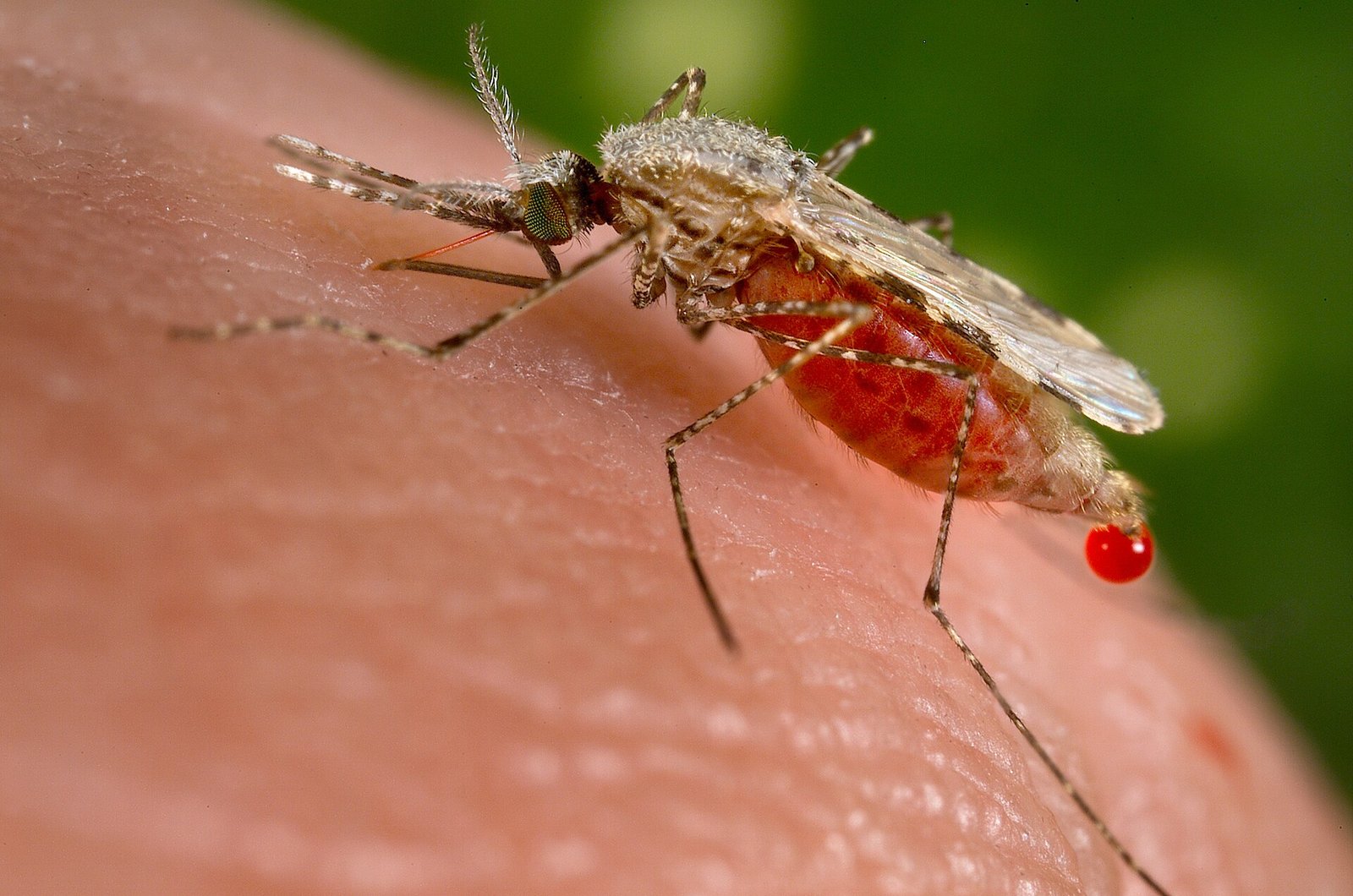
The plain answer: it is a very dark mosquito with four dark spots on each wing, and it rests at the tilted, head-down angle that marks the whole Anopheles genus.
The details:
- Color. Adults are very dark, covered in dark brown to black hairs.
- Wing spots. Dark scales gather into patches that form four darker spots on each wing. This “quadrimaculatus” (four-spotted) pattern is the feature the common name is built on, though the spots can be hard to see without magnification.
- Palps. Like other Anopheles, it has long palps roughly equal in length to the proboscis. Most nuisance mosquitoes (Aedes, Culex) have short palps, so long palps are a quick genus-level clue.
- Resting angle. Anopheline adults rest with the abdomen held at a distinct angle to the surface, so the body points downward toward the wall or skin. Culex and Aedes hold the body roughly parallel to the surface. This head-down stance is the single most useful field cue.
Where it lives
The plain answer: the eastern and central regions, wherever there is permanent or semi-permanent freshwater with aquatic vegetation.
Anopheles quadrimaculatus is primarily an eastern North American mosquito. Its range covers the eastern regions from the Gulf and Atlantic states north into the southern edge of Canada and west toward the Great Plains, and it reaches south into parts of Mexico. It is most abundant in the southeastern regions.
Larvae favor clean, still or slow freshwater with rooted or floating plants. Typical sites include:
- Freshwater swamps and marshes.
- The vegetated margins of ponds, lakes, and reservoirs.
- Slow streams, irrigation ditches, and flooded fields such as rice culture.
The common thread is standing freshwater that lasts long enough to complete a generation and that carries vegetation. The plants matter: they shelter larvae from predators and from wave action and give the surface film the debris the larvae feed on. Heavily polluted or fast-moving water is not preferred.
Behavior
The plain answer: it bites at dusk and through the night, feeds readily on mammals including people, and its larvae lie flat against the water surface.
- When it bites. Feeding happens at night, with flight activity peaking a short period after dark. It readily enters houses, barns, and other shelters to feed and rest. Its bite is less painful than many other mosquitoes and often goes unnoticed.
- What it feeds on. It takes blood from a range of mammals, including people, livestock, and wild animals, with a general preference for larger mammals such as cattle, horses, rabbits, and dogs. Because it will feed on both animals and people, it can bridge blood meals between hosts.
- Larval posture. Anopheles larvae have no breathing siphon. Instead of hanging head-down like Culex or Aedes larvae, they lie horizontally, flat and parallel just beneath the surface film, and breathe through the body wall while filter-feeding on surface material. Seeing larvae lying flat at the surface is a reliable way to tell an Anopheles breeding site from a Culex or Aedes one.
Disease role
The plain answer: this is the mosquito that carried malaria through the eastern regions for centuries, and it remains a competent vector today.
Malaria was a serious, widespread disease across the eastern and southeastern regions for generations, and Anopheles quadrimaculatus was the principal vector spreading the Plasmodium parasites that cause it. A sustained control effort eliminated malaria as an established disease here in the early 1950s. What ended was local transmission, not the mosquito. Anopheles quadrimaculatus is still common across its range and still able to pick up and pass on the parasite if it bites an infected person.
That is why isolated, locally acquired cases still occur. In the summer of 2023 the eastern and southern regions recorded their first locally acquired, mosquito-transmitted malaria in two decades. Health authorities reported eight locally acquired Plasmodium vivax cases in Florida and Texas between mid-May and mid-July 2023 (seven in the Sarasota County, Florida area and one in Texas), plus a separate, unrelated Plasmodium falciparum case in Maryland in August 2023. Before 2023, the last local transmission had been eight cases in Palm Beach County, Florida, in 2003. These events involved local Anopheles mosquitoes acquiring the parasite from infected people; Anopheles quadrimaculatus is among the competent vectors present across the affected eastern range. (For how malaria transmission works, see the malaria page below.)
The takeaway is not alarm but context: the parasite has to be reintroduced by an infected traveler before a local mosquito can spread it, so these clusters stay small and are contained by prompt diagnosis and mosquito control. But the vector never left.
How to control it
The plain answer: manage the water. Because this mosquito depends on lasting freshwater with vegetation, removing or managing that habitat is the most durable control.
- Source reduction. Drain or fill low spots that hold water, ditch or grade marshy areas so water does not stand, and manage irrigation so fields and canals do not sit flooded longer than needed.
- Vegetation management. Clearing rooted and floating vegetation from pond and lake margins removes the shelter and food that larvae depend on and makes the water less suitable.
- Larval control where habitat cannot be removed. In permanent water that has value (reservoirs, managed wetlands), mosquito control programs use larvicides such as Bacillus thuringiensis var. israelensis (Bti) and larva-eating fish such as Gambusia.
- Keep it out of the house. Screens on windows and doors, and standard personal protection (EPA-registered repellent, long sleeves after dark), reduce indoor biting since this species readily enters shelters to feed.
Water management is a job for mosquito control districts as much as individuals, because the productive habitats are often large permanent water bodies rather than backyard containers.
Sources
- UF IFAS Featured Creatures / EDIS, “Common Malaria Mosquito Anopheles quadrimaculatus Say” (EENY-491/IN791), https://edis.ifas.ufl.edu/in791 (accessed via https://ask.ifas.ufl.edu/in791, 2026-07-20). Supports: most important historic malaria vector in the eastern regions; very dark, dark brown to black hairs; four dark spots on the wings; long palps roughly equal to proboscis; anophelines rest at an angle to the surface; range across eastern North America with greatest abundance in the southeast; larval sites are fresh water streams, ponds, and lakes with aquatic vegetation; larvae lie horizontally at the surface and lack a breathing siphon; feeding occurs at night with peak flight after dark; feeds on mammals including humans with preference for ruminants, equines, lagomorphs, and canines; enters houses; bite less painful and often unnoticed; malaria eradicated in the 1950s with occasional autochthonous cases since.
- CDC Health Alert Network, HAN-00494, “Locally Acquired Malaria Cases Identified in the United States,” https://www.cdc.gov/han/2023/han00494.html (accessed 2026-07-20). Supports: 2023 locally acquired Plasmodium vivax cases in Florida and Texas; transmission by local Anopheles mosquitoes.
- CDC Health Alert Network, HAN-00496, “Important Updates on Locally Acquired Malaria Cases Identified in Florida, Texas, and Maryland,” https://www.cdc.gov/han/2023/han00496.html (accessed 2026-07-20). Supports: seven P. vivax cases in Florida (Sarasota County area, last case mid-July 2023) and one in Texas (June 2023); separate unrelated P. falciparum case in Maryland (reported August 18, 2023); last prior local transmission was 2003 (eight P. vivax cases, Palm Beach County, Florida).
- Blackburn D, et al. “Outbreak of Locally Acquired Mosquito-Transmitted (Autochthonous) Plasmodium vivax Malaria, Florida and Texas, May-July 2023.” MMWR Morb Mortal Wkly Rep 2023;72(36):973-978. https://pubmed.ncbi.nlm.nih.gov/37676839/ (accessed 2026-07-20). Supports: eight locally acquired P. vivax cases reported from Florida and Texas during May 18 to July 17, 2023; first autochthonous cases since 2003.
- Rutgers Center for Vector Biology, “The Biology of Anopheles quadrimaculatus Say,” https://vectorbio.rutgers.edu/outreach/mal5.htm (accessed 2026-07-20). Supports: optimum larval environment is clear, unpolluted, neutral to slightly alkaline water with emergent vegetation; larvae in rice fields, irrigation ditches, freshwater marshes, and vegetated margins of lakes, ponds, and reservoirs; source reduction by filling depressions, draining swamps, and ditching marshy areas; water management for irrigation-bred mosquitoes; role of aquatic vegetation as larval refuge.
- CDC, “Larval Source Management and Other Vector Control Interventions” (Malaria), https://www.cdc.gov/malaria/php/public-health-strategy/larval-management.html (accessed 2026-07-20). Supports: larval source management through habitat modification and larviciding as malaria vector control.
Related
- Malaria (disease overview) [placeholder link: /diseases/malaria]
- Genus Anopheles overview [placeholder link: /species/genus-anopheles]
- Anopheles larvae identification [placeholder link]
- Mosquito control and source reduction [placeholder link]
Educational note: This profile is for general reference and is not medical, pest-control, or public-health advice. For a suspected disease exposure, contact a clinician or your local health department; for control on your property, contact your local mosquito control district.
Last reviewed 20 July 2026.