The short answer
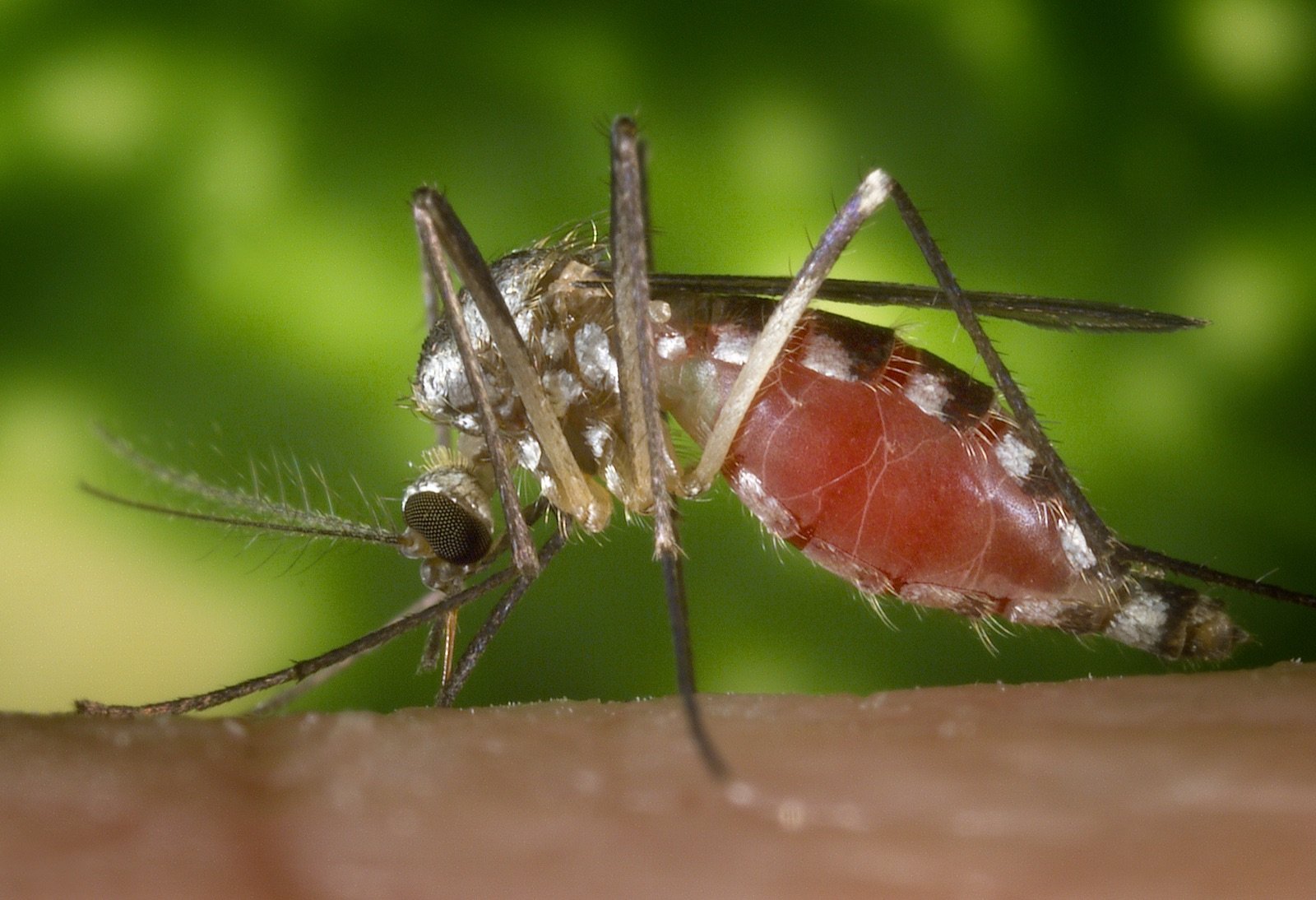
The eastern treehole mosquito (Aedes triseriatus) is a dark, woodland mosquito that breeds in water held inside tree cavities and in artificial containers, and it is the main carrier of the virus that causes La Crosse encephalitis. If a mosquito is biting you in the daytime in shaded eastern hardwood forest, this is one of the likely culprits.
It matters mostly for one reason. Aedes triseriatus is the primary vector of La Crosse virus (LACv), which is the most common cause of arboviral encephalitis in children in North America (UF IFAS Featured Creatures; CDC). Because the virus can pass from a female into her eggs and survive the winter there, this mosquito can carry the virus year after year in the same patch of woods.
How to identify it
Look for a medium-sized mosquito with a mostly dark body marked by narrow silvery-white scales. The proboscis, palps, wings, and legs are covered with dark scales, and the useful field mark is on the sides of the thorax: narrow silvery stripes run along the lateral (side) margins, separated by a broad black stripe down the middle (UF IFAS Featured Creatures; ECDC).
The key contrast is with the two black-and-white daytime container mosquitoes people know best. Unlike the yellow fever mosquito (Aedes aegypti), the eastern treehole mosquito has no pale bands on its legs (UF IFAS Featured Creatures). And unlike the Asian tiger mosquito (Aedes albopictus), it does not carry a single bold bright-white stripe straight down the center of its back; its markings are the two silvery side stripes instead. One caution: it is almost indistinguishable from its close relative Aedes hendersoni, and the two are separated mainly by the absence of pale leg rings and the pale side stripes on the scutum (ECDC).
Where it lives
Aedes triseriatus is a native North American mosquito of eastern hardwood forests. It is broadly distributed across the eastern part of the country and parts of southeastern Canada, ranging from the Florida Keys as far west as Texas and as far north as Ontario, Quebec, and New Brunswick (UF IFAS Featured Creatures; ECDC). That footprint takes in the Appalachian and Midwest regions where La Crosse cases have long been reported.
The common name comes from where the larvae grow. They develop in water-filled cavities in deciduous trees inside hardwood forests (UF IFAS Featured Creatures). The species also readily uses artificial containers that hold standing water, especially discarded tires and plastic containers in shaded spots, which lets it breed in and around wooded yards, not only deep in the forest (UF IFAS Featured Creatures; ECDC).
Behavior
This is a daytime biter of shaded woods. Adults are generally diurnal, with peak activity in the early morning and late afternoon, and they tend to rest in shaded areas during the day, often near their larval habitats (UF IFAS Featured Creatures; ECDC). Its flight range is reported to be limited, on the order of about 200 meters, though some work suggests dispersal may be greater than once thought (ECDC).
It feeds mostly on mammals. Females feed opportunistically on available mammalian hosts such as white-tailed deer, chipmunks, and squirrels, and they bite humans as well, though at lower rates than other mammals (roughly 2 to 10 percent of blood meals) (UF IFAS Featured Creatures).
One feature sets this mosquito apart from most nuisance biters: it can hand the virus down through its own eggs. Aedes triseriatus shows high rates of vertical (transovarial) transmission of La Crosse virus, so an infected female passes the virus into the eggs she lays, and the virus persists inside those eggs through the overwintering period to produce infected adults the following spring (UF IFAS Featured Creatures; ECDC). In laboratory study, virtually all transovarially infected females (98 percent) transmitted the virus to their offspring, and the mean share of infected offspring from an infected female was about 71 percent, a rate that stayed roughly constant from one generation to the next (Watts et al., Journal of Medical Entomology). This is why the mosquito itself can act as a long-term reservoir for the virus.
Disease role
Aedes triseriatus is the primary vector of La Crosse virus, the cause of La Crosse encephalitis and the most common cause of arboviral encephalitis in children in North America (UF IFAS Featured Creatures; CDC). In the wild, the virus cycles between the mosquito and small woodland mammals, especially chipmunks and squirrels, which amplify it; people are infected through the bite of an infected mosquito (CDC; Rutgers Center for Vector Biology).
In the country as a whole, about 30 to 90 La Crosse neuroinvasive disease cases are reported each year, most of them in summer (CDC). Children under 16 are at the highest risk of severe disease, which can include encephalitis, inflammation of the brain (CDC). Historically most cases came from the upper Midwest (states such as Ohio, Wisconsin, Minnesota, Indiana, Illinois, and Iowa), but in recent decades the mid-Atlantic and southeastern Appalachian states, including North Carolina, Tennessee, and West Virginia, have accounted for a growing share (CDC).
For the illness itself, its symptoms, and who is at risk, see the La Crosse encephalitis page.
How to control it
Because this mosquito breeds in small pockets of standing water, the most effective step is to remove that water. This is called source reduction, and for a container and tree-hole breeder it works (UF IFAS Featured Creatures).
- Empty, scrub, cover, or turn over anything in the yard that holds water, especially in shade: buckets, tires, plant saucers, tarps, and toys.
- Deal with used tires, which are a signature breeding site for this species in shaded locations.
- Find and drain or fill water-holding tree holes on the property. A common approach is to fill a rot cavity with sand or mortar, or drain it, so it no longer holds water.
- For water that cannot be removed, use a larvicide labeled for mosquito control and follow the label.
- Because much of the risk is in and near wooded areas, use an EPA-registered repellent and cover up when spending daytime hours in shaded forest during mosquito season.
Sources
- University of Florida IFAS Featured Creatures, “Eastern Treehole Mosquito Aedes triseriatus (Say, 1823),” publication EENY-830/IN1473. https://ask.ifas.ufl.edu/publication/IN1473 (accessed 20 July 2026). Supports: medium-sized, predominantly dark body with silvery-white scales; dark proboscis, palps, wings, and legs; narrow silvery lateral thorax stripes separated by a broad black stripe; lacks pale scale bands on legs (unlike Aedes aegypti); native to eastern North America, distributed from Florida Keys to Texas and north into southeastern Canada; larvae develop in water-filled tree cavities in hardwood forests and in tires and plastic containers, mainly in shaded sites; diurnal with early-morning and late-afternoon activity peaks; feeds opportunistically on mammals including white-tailed deer, chipmunks, and squirrels, and on humans at 2 to 10 percent of blood meals; high rates of vertical transmission of La Crosse virus with persistence in overwintering eggs; primary vector of LACv, the most prevalent cause of pediatric arboviral encephalitis in North America; source reduction as control.
- European Centre for Disease Prevention and Control (ECDC), “Aedes triseriatus, Factsheet for experts.” https://www.ecdc.europa.eu/en/disease-vectors/facts/mosquito-factsheets/aedes-triseriatus (accessed 20 July 2026). Supports: almost indistinguishable from Aedes hendersoni, separated by absence of pale leg rings and two pale-scaled stripes on the sides of the scutum; range from Florida Keys west to Texas and north to Ontario, Quebec, and New Brunswick; larvae in tree holes, tires, and other artificial containers; diurnal with early-morning and late-afternoon peaks; rests in shaded areas near larval habitats; favors mammalian hosts (deer, squirrels) and also bites humans; flight range reportedly limited to about 200 m though dispersal may be greater; primary vector of La Crosse virus with winter survival via transovarial transmission.
- CDC, “About La Crosse Virus” and La Crosse data and maps. https://www.cdc.gov/la-crosse-encephalitis/about/index.html (accessed 20 July 2026; page returned 403 on fetch, claims taken from CDC search-result snippet text). Supports: about 30 to 90 La Crosse neuroinvasive disease cases reported each year, most in summer; children under 16 at higher risk of severe disease including encephalitis; cases historically concentrated in the upper Midwest (Ohio, Wisconsin, Minnesota, Indiana, Illinois, Iowa) with recent increases in mid-Atlantic and southeastern states (North Carolina, Tennessee, West Virginia, and others); Aedes triseriatus as primary vector; virus amplified in chipmunks and squirrels.
- Watts DM, Thompson WH, Yuill TM, DeFoliart GR, Hanson RP, “Vertical Transmission of La Crosse Virus (California Encephalitis Group): Transovarial and Filial Infection Rates in Aedes triseriatus,” Journal of Medical Entomology 14(4):437. https://academic.oup.com/jme/article/14/4/437/1021201 (accessed 20 July 2026). Supports: virtually all transovarially infected females (98 percent) transmitted La Crosse virus to offspring; mean percentage of infected offspring from an infected female was 71 percent, essentially constant across generations.
- Rutgers University Center for Vector Biology, “Aedes triseriatus Say.” https://vectorbio.rutgers.edu/outreach/species/sp9.htm (accessed 20 July 2026). Supports: woodland container and tree-hole breeder; transmission cycle involving small mammals and role as La Crosse virus vector.
Related
- La Crosse encephalitis: what to know [placeholder: la-crosse-encephalitis]
- Aedes albopictus (Asian tiger mosquito) [placeholder]
- Aedes aegypti (yellow fever mosquito) [placeholder]
- Genus Aedes: an overview [placeholder]
- Container and tree-hole source reduction: a step-by-step guide [placeholder]
- Daytime-biting mosquitoes and how to avoid them [placeholder]
Educational note: This page is a general reference for identification and prevention. It is not medical advice. If you have symptoms of a mosquito-borne illness, contact a healthcare provider, and for local control questions contact your regional mosquito control district.
Last reviewed 20 July 2026.