The short answer
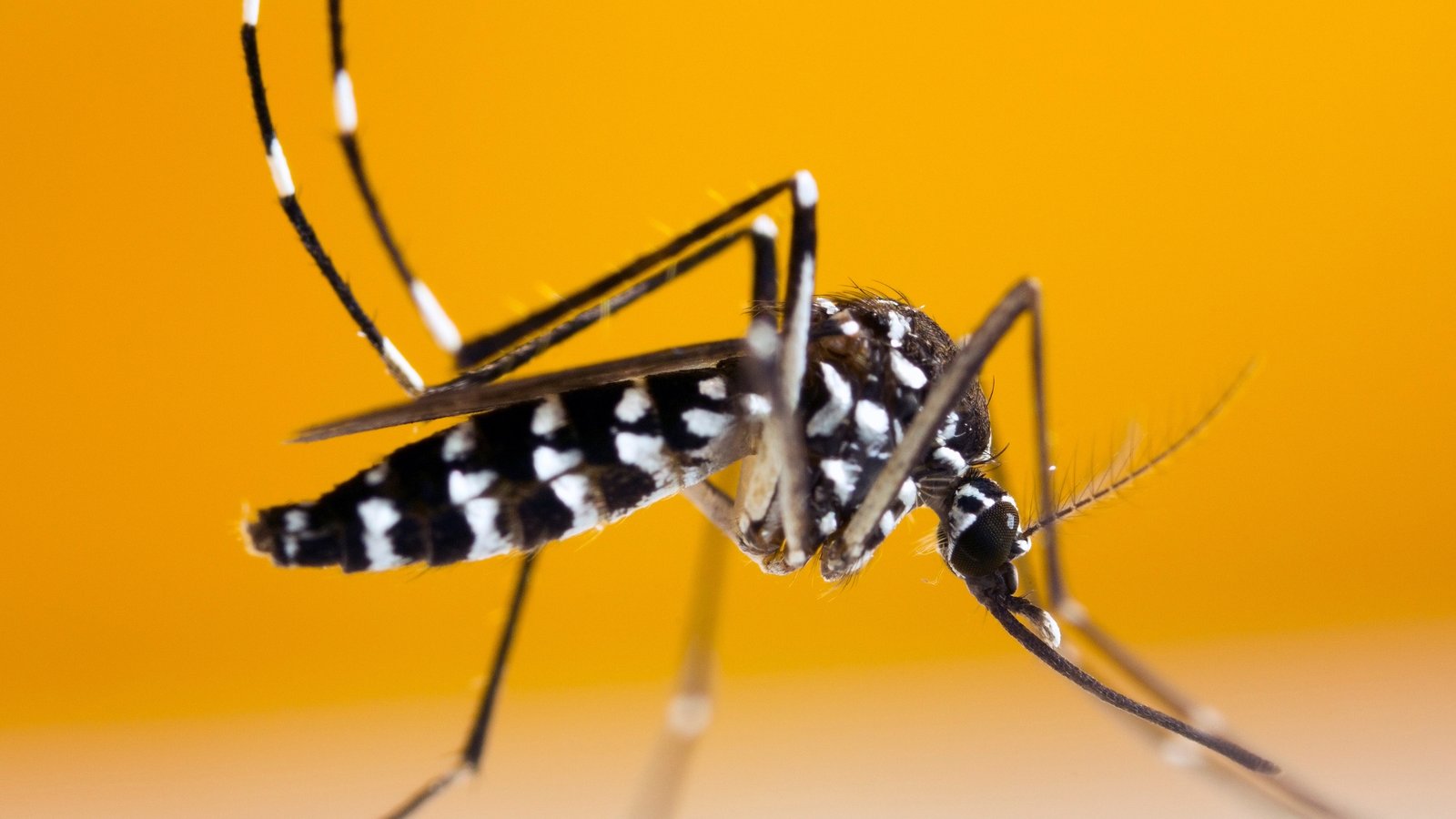
The Asian tiger mosquito (Aedes albopictus) is a small, black-and-white, day-active mosquito that you can pick out by one feature: a single bright white stripe running straight down the center of its back. If you see a striped, silvery-marked mosquito biting you in the daytime near your home, this is very often the one.
It matters for two reasons. It is an aggressive daytime biter that stays close to where people live, breeding in the small water-holding containers around yards and porches. And it is a competent vector of several human viruses, including dengue and chikungunya, so where it becomes abundant it can support local disease transmission.
How to identify it
Look for a small mosquito with bold, shiny black scales broken up by bright silver-white markings. The single most useful field mark is the white stripe. There is one distinct white line down the center of the top of the thorax (the middle body segment), and it begins on top of the head and continues straight back along the thorax (UF IFAS Featured Creatures). The legs are black with a white band at the base of each segment, giving them a striped or “banded” look. Adults are small, roughly 2 to 10 mm long, and males run about 20 percent smaller than females (UF IFAS Featured Creatures).
The easiest confusion is with the yellow fever mosquito (Aedes aegypti), which is also black-and-white and also bites in the daytime. The tell is on the back. Aedes albopictus has that one straight central white stripe. Aedes aegypti instead has curved white scales that form a lyre or violin shape (two curved lines) on top of the thorax (UF IFAS Featured Creatures). If you see a single straight line, you are almost certainly looking at the tiger mosquito.
Where it lives
Aedes albopictus is widespread and still spreading. It was first documented in Texas in 1985 (a Harris County infestation found in August of that year), and reached Florida in 1986 at a tire dump site near Jacksonville (UF IFAS Featured Creatures; CDC MMWR). By 2000 it was established in hundreds of counties across more than two dozen states (UF IFAS Featured Creatures), and it continues to be tracked across much of the eastern and southern country.
Compared with Aedes aegypti, the tiger mosquito reaches noticeably cooler regions. Temperate populations survive winter by laying eggs that enter a dormant state called diapause; European strain eggs have survived cold spells down to about -10 degrees C, well below what tropical strains tolerate (ECDC; PMC winter diapause review). That cold-hardy egg is a big part of why this species has pushed into more northern latitudes than the yellow fever mosquito.
For breeding it is a classic container mosquito. Females lay in small collections of standing water in both artificial and natural containers: discarded tires, buckets, flowerpot saucers, birdbaths, and clogged gutters, plus natural sites like tree holes and rock pools (ECDC; Rutgers Center for Vector Biology). The larvae need very little water, only a fraction of an inch of depth, to complete development (Rutgers Center for Vector Biology).
Behavior
This is an aggressive daytime biter. Adult females bite readily during the day, usually outdoors, with activity peaks in the early morning and late afternoon (UF IFAS Featured Creatures; ECDC). That daytime habit is one reason it is such a persistent yard-and-porch nuisance, since it is active during the hours people are outside.
Its host range is broad. Aedes albopictus is an opportunistic feeder that takes blood from humans and from a wide range of domestic and wild animals, including mammals, birds, reptiles, and amphibians, though it feeds heavily on mammals (UF IFAS Featured Creatures; ECDC). Feeding studies have repeatedly described it as feeding on whatever hosts are locally abundant.
Its flight range is limited, on the order of about 200 meters (ECDC). In practice that means when this mosquito is biting you, it usually hatched very close by. Its longer-distance spread comes not from flying but from people moving its eggs and larvae in containers such as used tires.
Diseases it can carry
Aedes albopictus is a competent vector of several human arboviruses. It can transmit dengue (all four serotypes) and chikungunya, and it is a recognized vector of Zika, though its efficiency for Zika is lower than that of Aedes aegypti (ECDC). It is a competent laboratory vector of a large number of viruses, more than 30 by some counts, and has documented roles with eastern equine encephalitis virus and La Crosse encephalitis virus as well (UF IFAS Featured Creatures). It can also transmit dog heartworm (dirofilariasis) (ECDC).
Context matters here. Where both species are present, Aedes aegypti is generally the more efficient vector and is more likely than Aedes albopictus to drive transmission of viruses like dengue, chikungunya, and Zika (CDC). But in places where Aedes aegypti is absent, the tiger mosquito becomes the principal vector for those viruses, which is why its wide and expanding range is a public-health concern.
For more on the specific illnesses, see the dengue, chikungunya, and Zika disease pages.
How to control it
Because this mosquito breeds in containers and flies only a short distance, the most effective thing you can do is remove its water. This is called source reduction, and for a short-range container breeder it works (UF IFAS Featured Creatures).
- Empty, scrub, cover, or turn over anything that holds water at least once a week: buckets, tires, planter saucers, birdbaths, kiddie pools, tarps, and toys.
- Clear clogged gutters and drill drainage holes in containers that cannot be discarded.
- Store or dispose of used tires, which are a signature breeding site for this species.
- For water that cannot be dumped, such as rain barrels or catch basins, use a larvicide labeled for mosquito control and follow the label.
- Because its flight range is short, coordinating with immediate neighbors on the same steps clears most of the local population.
Sources
- University of Florida IFAS Featured Creatures, “Asian tiger mosquito, Aedes albopictus (Skuse),” publication IN594. https://ask.ifas.ufl.edu/publication/IN594 (accessed 20 July 2026). Supports: white stripe down center of thorax beginning at the head; banded legs with white basal scales; size 2 to 10 mm and males 20 percent smaller; Aedes aegypti lyre/violin shape distinction; first found Texas 1985 and Florida 1986 at a Jacksonville tire dump; established in 866 counties in 26 states by 2000; container breeder; daytime feeder with early-morning and late-afternoon peaks; opportunistic aggressive biter with wide host range; competent laboratory vector of more than 30 viruses including eastern equine encephalitis and La Crosse; source reduction as control.
- CDC, “Potential Range of Aedes Mosquitoes.” https://www.cdc.gov/mosquitoes/php/toolkit/potential-range-of-aedes.html (accessed 20 July 2026; page returned 403 on fetch, claim taken from CDC search-result snippet text). Supports: Aedes albopictus is a vector of dengue, chikungunya, Zika, and yellow fever; Aedes aegypti is more likely than Aedes albopictus to spread these viruses; where Aedes aegypti is absent, Aedes albopictus is the main vector; maps show potential range, not disease risk.
- CDC MMWR, “Current Trends Update: Aedes albopictus Infestation, United States.” https://www.cdc.gov/Mmwr/preview/mmwrhtml/00001007.htm (accessed 20 July 2026). Supports: infestation discovered in Harris County, Texas, in August 1985 and subsequent US spread.
- European Centre for Disease Prevention and Control (ECDC), “Aedes albopictus, Factsheet for experts.” https://www.ecdc.europa.eu/en/disease-vectors/facts/mosquito-factsheets/aedes-albopictus (accessed 20 July 2026). Supports: flight range limited to about 200 m with human-assisted container dispersal; aggressive daytime outdoor biting; blood hosts include humans, domestic and wild animals, reptiles, birds, and amphibians; breeds in tires, barrels, catch basins, tree holes, and rock pools; diapausing eggs survive cold to about -10 degrees C; vector of dengue (all four serotypes), chikungunya, and Zika (lower competence than Aedes aegypti), and dirofilariasis (dog heartworm).
- Rutgers University Center for Vector Biology, “Aedes albopictus (Skuse).” https://vectorbio.rutgers.edu/outreach/species/albo.htm (accessed 20 July 2026). Supports: opportunistic container breeder using natural and artificial containers including tires; larvae complete development in as little as about 1/4 inch of water.
- PMC/PLOS review, “Investigation of temperature conditions … for the overwintering suitability of diapausing Aedes albopictus eggs” and related diapause literature. https://www.ncbi.nlm.nih.gov/pmc/articles/PMC5870348/ (accessed 20 July 2026). Supports: temperate populations overwinter via photoperiod-induced egg diapause, aiding establishment in cooler northern latitudes.
Related
- Aedes aegypti (yellow fever mosquito) [placeholder]
- Dengue: what to know [placeholder]
- Chikungunya: what to know [placeholder]
- Zika: what to know [placeholder]
- Container source reduction: a step-by-step guide [placeholder]
- Daytime-biting mosquitoes around the home [placeholder]
Educational note: This page is a general reference for identification and prevention. It is not medical advice. If you have symptoms of a mosquito-borne illness, contact a healthcare provider, and for local control questions contact your regional mosquito control district.
Last reviewed 20 July 2026.