The short answer
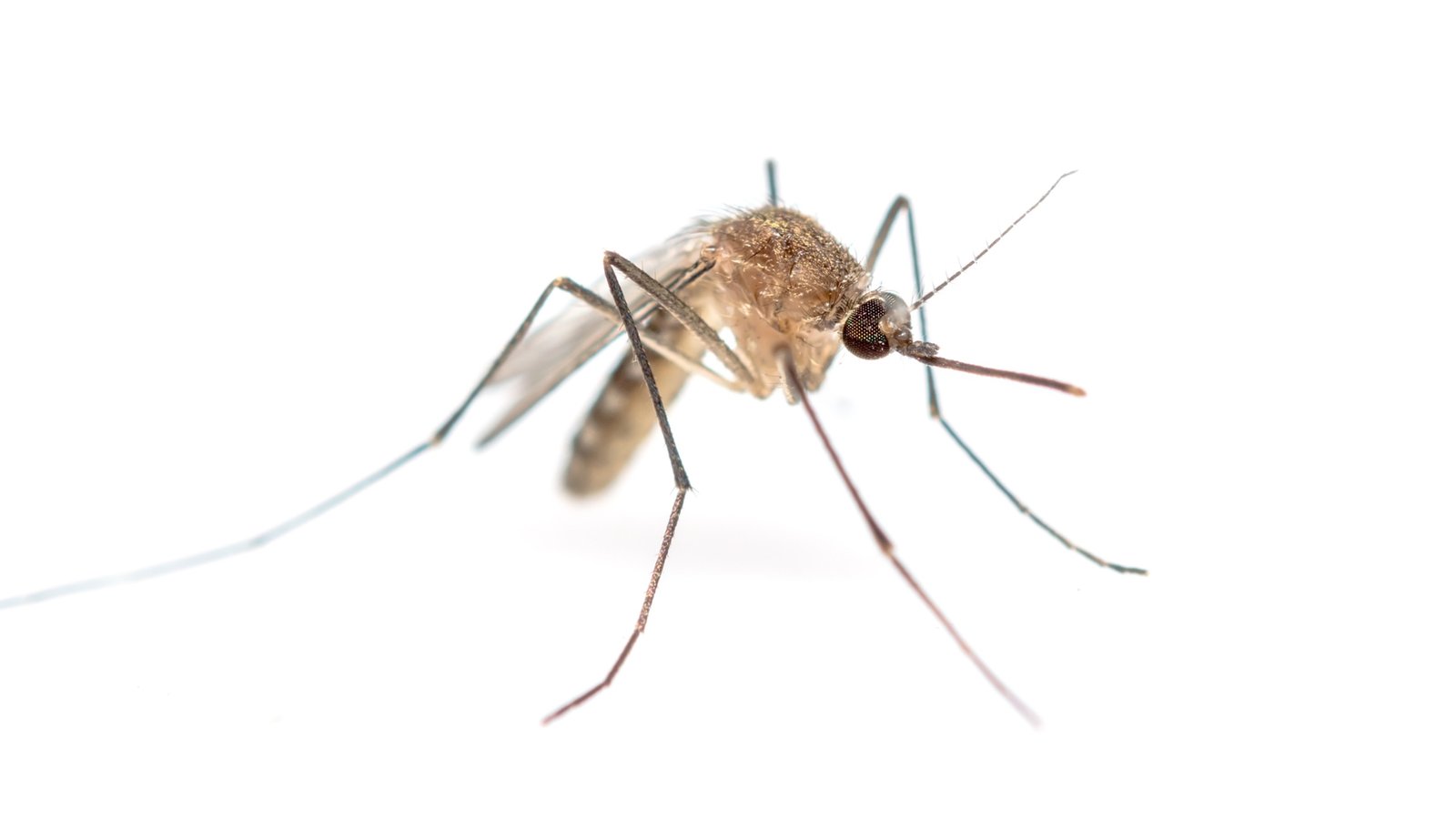
A mosquito has the three body regions common to all insects (head, thorax, and abdomen) plus a long, needle-like proboscis that projects from the head. A female uses that proboscis to bite. Inside its outer sheath is a bundle of six fine stylets. The female works these stylets through the skin, angles the tip toward a small blood vessel, and injects saliva while she draws blood. The saliva keeps the blood flowing, and your body’s reaction to it is what leaves an itchy bump.
Body basics
Like other insects, a mosquito is organized into three regions.
- Head. Carries a pair of large compound eyes, a pair of antennae, and the mouthparts, including the proboscis and the paired maxillary palps beside it.
- Thorax. The middle region, distinctly hump-backed in adult mosquitoes. It bears the legs and a single pair of wings.
- Abdomen. The long rear region, where a blood meal is stored and eggs develop.
One feature separates mosquitoes from most other flies: they carry rows of tiny scales on the body, legs, and along the wing veins. Those scales on the wing veins are a defining trait of the family Culicidae (North Carolina State University, ENT 425). Adult mosquitoes are small, most only a few millimeters long.
The proboscis up close
The proboscis is not a single tube. The part you can see is the labium, a flexible outer sheath. Entomologists describe it as a scabbard, with the piercing parts held inside like a sword (North Carolina State University, ENT 425).
Tucked inside that sheath is a bundle of six slender stylets, together called the fascicle (University of Florida IFAS). The six are:
- Two mandibles, thin blades that help part the tissue.
- Two maxillae, tipped with fine teeth that saw through the skin.
- One labrum, a gutter-shaped stylet that carries the food canal through which blood is drawn. The labrum is the only stylet known to carry sensory organs at its tip, and research shows it makes oriented movements toward blood vessels during feeding (PubMed Central, mosquito labrum review).
- One hypopharynx, a flattened stylet that carries the salivary canal, the channel through which saliva is delivered into the skin (North Carolina State University, ENT 425).
How a bite works step by step
- Landing and probing. The female settles on skin and presses the tip of the proboscis down. As the stylets push in, the soft labium does not enter the wound. It buckles and folds back while its tip stays against the skin surface (PubMed Central, mosquito labrum review).
- Piercing. The toothed maxillae saw through the outer skin while the mandibles help hold the tissue apart. The bundle of stylets probes beneath the surface, and the labrum works its tip toward a small blood vessel.
- Injecting saliva. As the mosquito probes, it pumps saliva down the hypopharynx into the wound. The saliva contains compounds that keep blood from clotting, so it can flow freely into the narrow food canal.
- Drawing blood. Once the labrum reaches blood, the mosquito draws it up through the food canal and into the abdomen.
- Why it itches. Your body reacts to proteins in the injected saliva. That immune reaction, not the puncture itself, is what produces the swollen, itchy bump (CDC). For a fuller explanation of the itch, see why bites itch.
Male vs female mouthparts
Only female mosquitoes bite. Their mouthparts are built for blood feeding, with the full working set of piercing stylets. Males have mouthparts modified for nectar feeding instead, and they do not take blood (University of Florida IFAS).
Both sexes feed on plant nectar and sugars for everyday energy. The difference is reproductive: a female needs the protein in a blood meal to develop her eggs, which is the reason she seeks out a host at all (University of Florida IFAS). For more on that, see why only females bite.
How antennae sense you
The antennae are a mosquito’s main sensing organs, and they differ sharply between the sexes. Male antennae are strikingly feathery, or plumose, while female antennae carry only sparse short hairs (University of Florida IFAS).
Those feathery male antennae are tuned to sound. At their base sits the Johnston’s organ, packed with thousands of sensory units that detect the fine air movements of a nearby female’s wingbeat, which is how a male locates a mate in flight (Journal of the Royal Society Interface).
A female homes in on a host using chemistry rather than sound. Carbon dioxide from your breath is sensed by receptor neurons on the maxillary palps, while acids and other odor compounds from skin are picked up by neurons on the antennae (PubMed Central, mosquito olfaction review). How these cues combine over distance is covered in how mosquitoes find you.
Sources
- North Carolina State University, Department of Entomology and Plant Pathology, General Entomology (ENT 425). Family Culicidae. https://genent.cals.ncsu.edu/insect-identification/order-diptera/family-culicidae/ Accessed 20 Jul 2026. (three body regions, hump-backed thorax, scales on the wing veins, plumose male versus short-haired female antennae, females as the blood feeders)
- North Carolina State University, Department of Entomology and Plant Pathology, General Entomology (ENT 425). Mouthparts (Bug Bytes). https://genent.cals.ncsu.edu/bug-bytes/mouthparts/ Accessed 20 Jul 2026. (the labium as a sheath or scabbard; the six stylets; the food canal on the labrum; the hypopharynx carries saliva)
- U.S. National Library of Medicine, PubMed Central. Multitasking roles of mosquito labrum in oviposition and blood feeding. https://www.ncbi.nlm.nih.gov/pmc/articles/PMC4625056/ Accessed 20 Jul 2026. (the fascicle of six stylets; the labrum carries sensory organs and orients toward blood vessels; the labium buckles and stays outside the wound)
- University of Florida IFAS. Yellow Fever Mosquito, Aedes aegypti (EENY-434). https://ask.ifas.ufl.edu/publication/IN792 Accessed 20 Jul 2026. (male mouthparts modified for nectar and female for blood; both sexes take nectar; females need blood protein for eggs; plumose male antennae versus short-haired female antennae; the fascicle)
- Journal of the Royal Society Interface, via PubMed Central. Auditory sensory range of male mosquitoes for the detection of female flight sound. https://www.ncbi.nlm.nih.gov/pmc/articles/PMC9399701/ Accessed 20 Jul 2026. (the male Johnston’s organ in the antennal pedicel, with thousands of sensory units, detects the female’s flight sound)
- Centers for Disease Control and Prevention. About Mosquito Bites. https://www.cdc.gov/mosquitoes/about/about-mosquito-bites.html Accessed 20 Jul 2026. (the body reacts to mosquito saliva, producing an itchy bump; only females bite) [direct fetch returned HTTP 403; claim confirmed via the published search summary of the same URL]
- U.S. National Library of Medicine, PubMed Central. Olfactory regulation of mosquito-host interactions. https://www.ncbi.nlm.nih.gov/pmc/articles/PMC3100215/ Accessed 20 Jul 2026. (carbon dioxide detected by maxillary palp neurons; skin odor acids detected by antennal neurons)
Related
- Why only females bite
- How mosquitoes find you
- Why bites itch
- The mosquito life cycle
- Common mosquito species
Educational note: This page is a general reference on mosquito biology and is not medical advice. If a bite becomes badly swollen, becomes infected, or is followed by fever or other symptoms, contact a healthcare provider or your local health department.
Last reviewed 20 July 2026.