Short answer
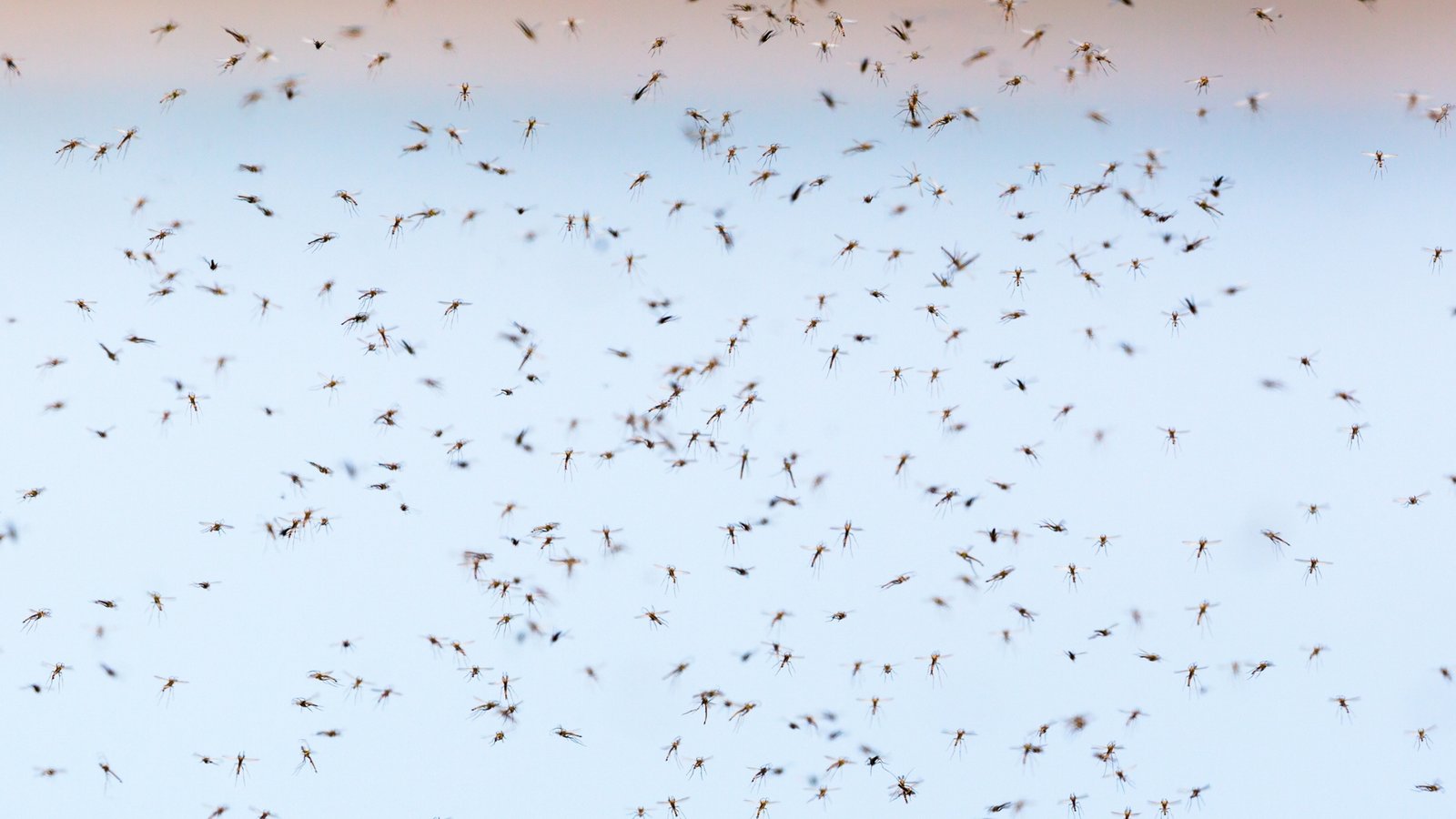
Mosquitoes are not strongly drawn to light the way moths are. They find you mainly by the carbon dioxide in your breath, by body heat, and by the scent of your skin, not by the glow of a porch bulb (American Mosquito Control Association; Caltech). Some species do respond mildly to certain wavelengths, and a few trap designs use light as one ingredient. But the light in those traps works alongside carbon dioxide and other lures, and the effect of light on its own is weak and variable (Parasites and Vectors, 2021; Rutgers Center for Vector Biology). So leaving a light on does not call mosquitoes to your yard the way it pulls in moths and beetles.
Not classic light-seekers
Moths orbit a lamp. Mosquitoes do not behave that way. A host-seeking female locates a warm-blooded target through a sequence of cues, and light is not the trigger.
The American Mosquito Control Association describes it plainly. “Carbon dioxide is the most universally recognized mosquito attractant and draws mosquitoes from up to 35 meters.” Then, “once in the general vicinity of a potential host, other cues predominate, including body odors (sweat, lactic acid, etc.) and heat.” Movement matters too, but as a close-range visual cue rather than a light source (American Mosquito Control Association).
Research from the California Institute of Technology shows how these cues stack up. A mosquito first smells a plume of exhaled carbon dioxide from tens of meters away, and only after that detection does it begin steering toward visual features, and finally toward body heat within about a meter (Caltech). In other words, smell switches on the mosquito’s interest in objects; it is not the light that leads the way. For the full picture of how a mosquito zeroes in on a person, see how mosquitoes find you.
Some light responses exist
Saying mosquitoes ignore light entirely would overstate it. They do have light-sensitive vision, and it is tuned to the shorter end of the spectrum. A 2021 review in Parasites and Vectors reports that biting flies show peaks of spectral sensitivity in the ultraviolet and in the blue and green range, with “minimal sensitivity to longer wavelengths.” It adds that “mosquitoes, Culicoides midges and sand flies have generally been found to be attracted in higher numbers by short wavelengths, such as UV, blue (450 to 495 nm) and green (495 to 570 nm) light,” while “longer wavelengths are usually less attractive to biting flies” (Parasites and Vectors, 2021).
The response is not uniform. It shifts with species, with wavelength, and with brightness. A study on Anopheles mosquitoes found that green light near 520 nm and blue light near 470 nm each pulled in more mosquitoes than a standard incandescent bulb, with green accounting for about 43 percent of the catch and blue about 32 percent (Entomology Today, Entomological Society of America). An entomologist studying insect vision at the University of California, Davis, made the same point about variability, noting that how an insect responds to a given light can depend on the species, on the type of light, and on other factors (KOSU, quoting University of California, Davis). This is why some surveillance traps add an ultraviolet or short-wavelength lamp: it nudges certain species, even though it is far from a universal magnet.
One practical footnote. Ordinary household white LED bulbs tend to be less attractive to biting flies than older incandescent or fluorescent lamps, because they lack the strong ultraviolet and infrared peaks those older lights emit (Parasites and Vectors, 2021).
Do yellow bug lights help?
Yellow or amber “bug lights” are built around this same wavelength science. They shift their output toward longer, warmer wavelengths that many night-flying insects see poorly, so fewer insects gather around them than around a bright white bulb. The American Mosquito Control Association notes that yellow bug lights “do not attract mosquitoes like other incandescent lights” (American Mosquito Control Association).
Here is the honest take. A yellow bulb attracts fewer insects; it does not repel them. It puts out nothing that pushes a mosquito away, and it does nothing about the carbon dioxide, heat, and skin odor that actually guide a mosquito to you (KOSU, quoting University of California, Davis; American Mosquito Control Association). Because mosquitoes were never strongly drawn to your porch light in the first place, swapping in a yellow bulb will not meaningfully cut down on bites. It is a reasonable way to keep moths and other light-seeking insects off the patio, not a mosquito control tool.
Light traps for surveillance
The one place light earns its keep against mosquitoes is professional monitoring. The CDC miniature light trap, a standard tool for public health surveillance, pairs a small light with a source of carbon dioxide, usually dry ice, plus a fan that pulls approaching mosquitoes down into a collection net.
The light by itself is modest. The Rutgers Center for Vector Biology reports that adding dry ice produces “an increase of 400 to 500 percent in overall catch,” and that when dry ice is used, “removal of the light bulb will actually improve the collection by eliminating trash insects.” The carbon dioxide, in other words, does most of the work; the light is a secondary lure that can even get in the way (Rutgers Center for Vector Biology).
Just as important is what these traps are for. They are short-term instruments used to sample which species are present, to track population levels, to check on treatment results, and to gather specimens for disease testing (Rutgers Center for Vector Biology). They are surveillance devices for mosquito control programs, not backyard gadgets that will clear a yard of biting mosquitoes.
What actually works
If light is a weak lever, what should you pull instead? The measures that hold up are the ones aimed at where mosquitoes breed and at the cues they hunt by.
- Remove standing water. Any container that holds water for several days can produce mosquitoes, so empty, cover, or drain them regularly.
- Use an EPA-registered repellent when you are outdoors during active hours. The American Mosquito Control Association calls DEET “the standard by which all other repellents are judged,” and lists picaridin as an odorless alternative that “doesn’t plasticize like DEET” (American Mosquito Control Association).
- Keep window and door screens in good repair to stop resting females from getting indoors (American Mosquito Control Association).
- Skip the bug zapper for mosquito control. Two independent controlled studies at the University of Notre Dame found mosquitoes made up only 4.1 percent and 6.4 percent of the seasonal catch, and, more tellingly, “there was no significant difference in the number of mosquitoes found in yards with or without bug zappers” (American Mosquito Control Association).
Sources
- American Mosquito Control Association, FAQs. Host-seeking cues (carbon dioxide, heat, body odor, movement), yellow bug lights, bug zapper study, and personal protection including DEET, picaridin, and screens. https://www.mosquito.org/faqs/ (accessed 2026-07-20).
- California Institute of Technology, “Mosquitoes Use Smell to See Their Hosts.” Research showing carbon dioxide detection precedes and primes visual and thermal host-seeking. https://www.caltech.edu/about/news/mosquitoes-use-smell-see-their-hosts-47338 (accessed 2026-07-20).
- Parasites and Vectors (2021), “Artificial light and biting flies: the parallel development of attractive light traps and unattractive domestic lights.” Peer-reviewed review of phototaxis, short-wavelength (UV, blue, green) attraction, and lower attractiveness of household white LEDs. https://pmc.ncbi.nlm.nih.gov/articles/PMC7789162/ (accessed 2026-07-20).
- Entomology Today, Entomological Society of America (2017), “Building a Better Light Trap: Study Finds Specific Light Waves Attract Anopheline Mosquitoes.” Green (about 520 nm) and blue (about 470 nm) light outperformed incandescent light for Anopheles capture. https://entomologytoday.org/2017/08/09/building-a-better-light-trap-study-finds-specific-light-waves-attract-anopheline-mosquitoes/ (accessed 2026-07-20).
- Rutgers Center for Vector Biology, “The CDC Trap as a Special Monitoring Tool.” CDC miniature light trap pairs a weak light with dry ice carbon dioxide; dry ice raises catch 400 to 500 percent; used for short-term surveillance, not yard control. https://vectorbio.rutgers.edu/outreach/cdctrap.htm (accessed 2026-07-20).
- KOSU / Oklahoma Ecology Project (2023), “Yellow lights make summers mellow for many Oklahoma insects.” Quotes an insect-vision researcher at the University of California, Davis, that yellow lights attract fewer insects but do not repel them, and that light responses vary by species and light type. Page returned HTTP 403; content drawn from the search-result summary. https://www.kosu.org/energy-environment/2023-07-28/yellow-lights-make-summers-mellow-for-many-oklahoma-insects (accessed 2026-07-20).
Related
- How mosquitoes find you (placeholder)
- Do bug zappers kill mosquitoes (placeholder)
- What actually repels mosquitoes (placeholder)
Educational note: This page is a non-commercial, science-based reference. It does not sell products or services and is not a substitute for guidance from your local mosquito control or public health authority.
Last reviewed 20 July 2026.