Short answer
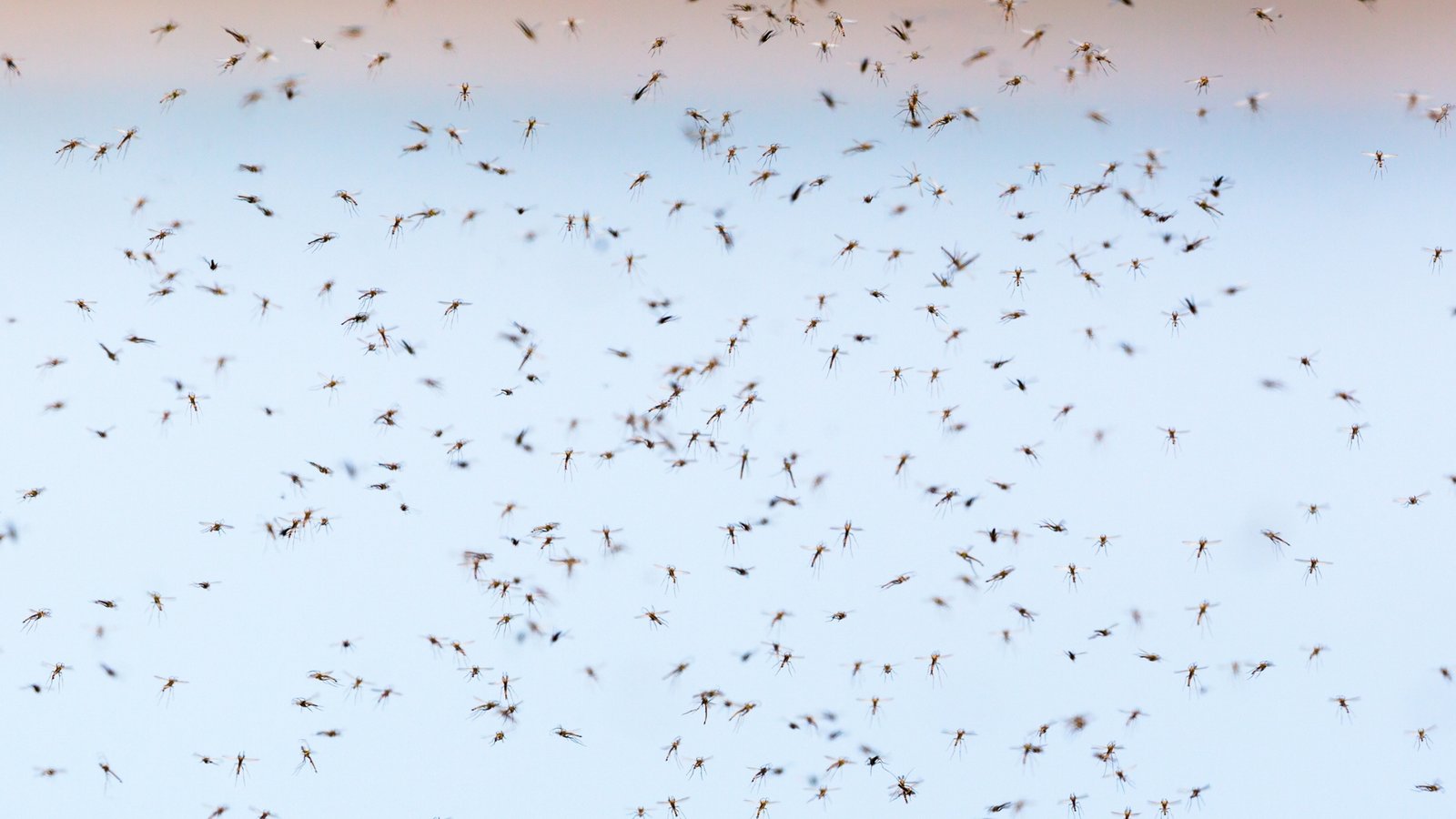
Many mosquitoes mate in flight. Around dusk (and sometimes on warm mornings), males of a single species gather into a swarm above a visual landmark on the ground, called a swarm marker. A female flies into that swarm, a male finds and grasps her, and mating happens on the wing. Much of this is guided by sound. A searching male detects the pitch of the female’s beating wings and homes in on it (Sources 1, 2).
Male swarms
A mosquito swarm is mostly a cloud of males of one species, dancing in the air above a fixed reference point on the ground. Those swarm markers can be rocks, tree stumps, patches of contrasting ground, or the animal that the species prefers to feed on. Swarms typically form at dusk or during warm mornings, when the light is changing (Source 1).
The swarm is a meeting place. Males do not feed on blood, so the swarm is not about biting. It is about reproduction. Males congregate, females fly in from outside the swarm, and pairing happens there. A male may mate with more than one female, and adult males usually live only a few days (Source 1).
The role of sound
Sound does much of the work of finding a mate inside a swarm. Male and female mosquitoes beat their wings at different pitches, and the male’s hearing is tuned to pick out the female. In the malaria mosquito Anopheles gambiae, males in a swarm beat their wings at roughly 850 Hz and females at roughly 550 Hz, so the female tone sits about 300 Hz lower (Source 2).
When a male and female come close, both actively adjust their wingbeat frequencies in a back-and-forth interaction, so that their tones line up in a simple ratio. This is called harmonic convergence. Rather than listening for the female’s tone on its own, the male appears to detect the difference between the two flight tones (an acoustic distortion product created when the two sounds combine) and steers toward it (Source 2).
After mating
Once a female has mated, she generally does not need to mate again. She stores the male’s sperm in an internal organ and draws on that store for the rest of her life, so a single mating can fertilize many eggs (Source 3).
Egg laying is tied to blood, not to further mating. A female needs a blood meal to develop a batch of eggs. After she feeds and the eggs mature, she lays that batch, then seeks another blood meal and lays again, repeating the cycle across her lifespan. A Culex female, for example, lays her eggs stuck together into a floating raft of roughly 100 to 300 eggs, and a female that survives can produce two or more batches (Source 4). How many batches she manages depends on how long she lives (see Related: how long mosquitoes live).
Are swarms dangerous
A column of male mosquitoes dancing over your yard at dusk is a mating swarm, and those males do not bite. Only female mosquitoes bite, and they do so to get the protein for eggs, not as part of swarming (Sources 1, 4). So the swarm itself is not the thing that bites you.
It is also worth knowing that many insects that swarm in tall columns at dusk are not mosquitoes at all. Non-biting midges (family Chironomidae) look a lot like mosquitoes and form towering mating swarms near water, but they lack the piercing mouthparts needed to bite and they do not feed on blood (Sources 5, 6). If you see a big evening swarm and no one is getting bitten, midges are a common explanation (see Related: insects mistaken for mosquitoes).
Sources
- Purdue University, Public Health and Medical Entomology, “Mosquitos” (university extension; swarm behavior, swarm markers, dusk and warm-morning timing, females flying into swarms, males feeding on sugar rather than blood). https://extension.entm.purdue.edu/publichealth/insects/mosquito.html (accessed 2026-07-20)
- Su MP, Georgiades M, Bagi J, et al. “Harmonic convergence coordinates swarm mating by enhancing mate detection in the malaria mosquito Anopheles gambiae.” Scientific Reports, 2021 (peer-reviewed; male vs female flight-tone frequencies, harmonic convergence, acoustic distortion products). https://www.nature.com/articles/s41598-021-03236-5 (accessed 2026-07-20)
- The Rockefeller University, “What we got wrong about mosquito mating” (research news from the Vosshall laboratory; female mates once and stores sperm, single mating fertilizes many eggs, female control of mating). https://www.rockefeller.edu/news/38495-what-we-got-wrong-about-mosquito-mating/ (accessed 2026-07-20)
- Centers for Disease Control and Prevention, “Life Cycle of Culex Mosquitoes” (public health agency; females need a blood meal to produce eggs, egg rafts of about 100 to 300 eggs, multiple batches over a lifespan). https://www.cdc.gov/mosquitoes/about/life-cycle-of-culex-mosquitoes.html (accessed 2026-07-20; page returned HTTP 403, claims verified from the CDC search result snippet)
- American Mosquito Control Association, “Mistaken IDs” (mosquito-science association; midges resemble mosquitoes and produce towering mating swarms, crane flies do not bite). https://www.mosquito.org/mistaken-ids/ (accessed 2026-07-20)
- Virginia Cooperative Extension, “Non-biting Midges” (ENTO-438) (university extension; midges swarm to mate, lack the proboscis needed to bite, do not take blood). https://www.pubs.ext.vt.edu/ENTO/ENTO-438/ENTO-438.html (accessed 2026-07-20)
Related
- How long do mosquitoes live? [placeholder link]
- Insects mistaken for mosquitoes [placeholder link]
- Why only female mosquitoes bite [placeholder link]
- The mosquito life cycle [placeholder link]
Educational note: This page is a non-commercial, science-based reference. It is intended for general understanding of mosquito biology and is not pest-control, medical, or public-health advice.
Last reviewed 20 July 2026.