The short answer
The steps that do the most to reduce mosquitoes around a home are also the cheapest and easiest to do yourself: find and empty standing water every week, and drop a Bti larvicide into any water you cannot empty. These target mosquitoes before they ever fly, and public health agencies treat them as the foundation of any control program (AMCA, source 3; University of Maryland Extension, source 4).
Professional services mostly add one thing on top of that foundation: a barrier spray of adult mosquitoes across your yard’s vegetation. That spray is convenient and it does knock down biting adults for a while, but the effect is temporary, it does not stop new mosquitoes from flying in, and the broad-spectrum insecticides used raise real non-target concerns for bees and other beneficial insects (University of Maryland Extension, source 4; Illinois Department of Public Health, source 5; Anderson et al. / Xerces Society, source 6).
So the honest framing is not DIY versus professional as an either/or. The high-value work is DIY. A professional service is an optional convenience layer that carries trade-offs. This page lays out what each option actually does so you can decide.
What you can do yourself effectively
Four homeowner steps carry most of the benefit, and none of them require a contractor.
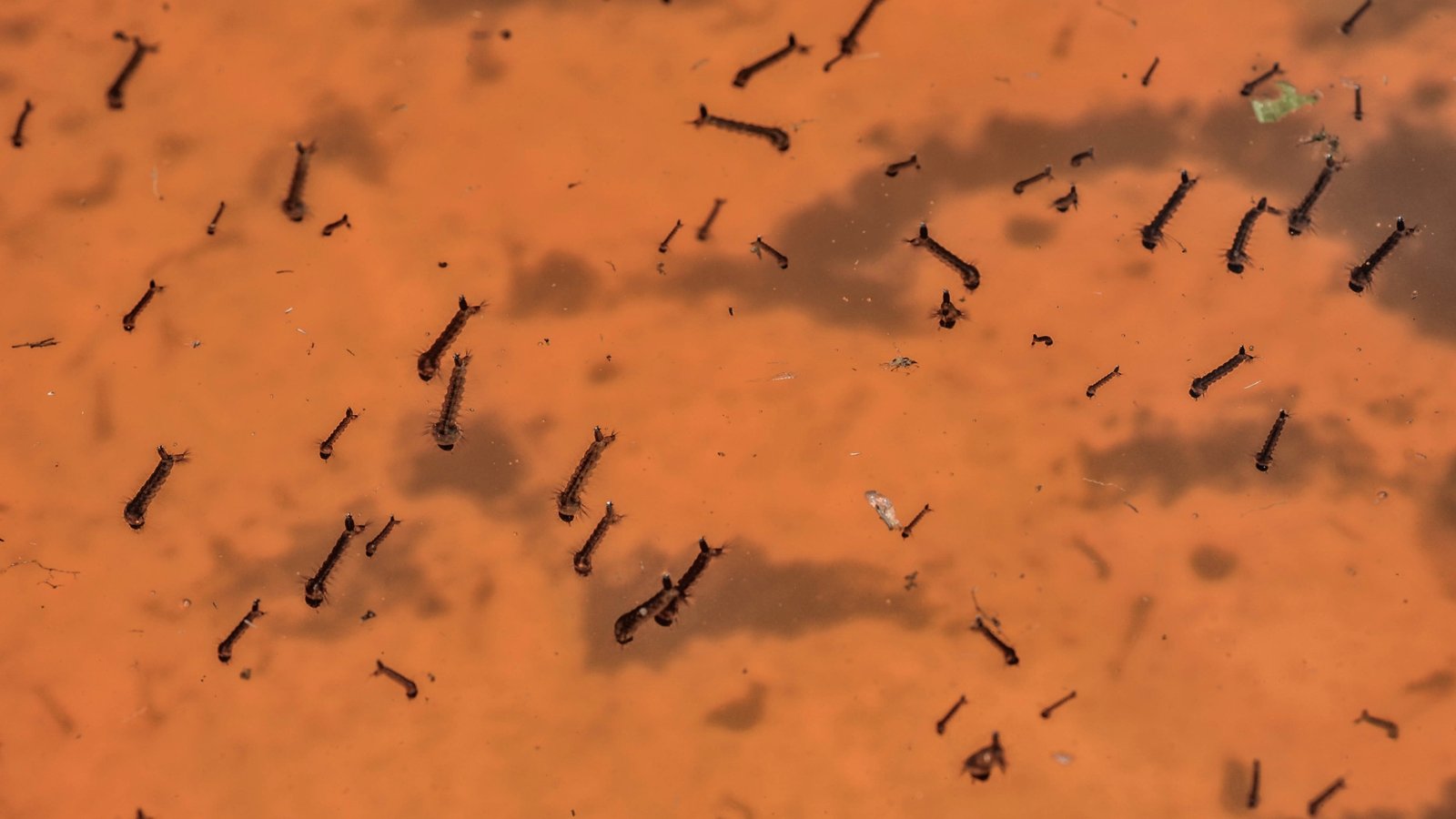
Source reduction (the single most effective step). Mosquitoes breed in standing water, so removing standing water around a home reduces the number of new mosquitoes produced there (University of Maryland Extension, source 4). Walk the property once a week and empty or dump anything holding water: flower pot saucers, buckets, tarps, toys, clogged gutters, bird baths, and old tires. Change bird bath water every few days and check trash cans twice a week (University of Maryland Extension, source 4). This is free, and because it stops larvae before they become adults, it is the method agencies put first (AMCA, source 3).
Bti larvicide for water you cannot drain. Bti (Bacillus thuringiensis subspecies israelensis) is a naturally occurring soil bacterium. It produces toxins that specifically target and only affect the larvae of mosquitoes, black flies, and fungus gnats, and a number of Bti products are sold as homeowner products that are easy and safe to use (EPA, source 1). Per the EPA, Bti has no toxicity to people and is approved for use in organic farming. You apply it (commonly as a dunk or granules) to standing water where larvae grow, such as rain barrels, ponds, and low spots that will not drain (EPA, source 1; CDC, source 2). Because it acts on larvae in the water, it does not harm bees and most other insects the way a broad yard spray does (EPA, source 1).
Screens and physical barriers. Well-fitted window and door screens keep adult mosquitoes out of living space (University of Maryland Extension, source 4). Because mosquitoes cannot bite through clothing, long sleeves and long pants reduce bites outdoors (University of Maryland Extension, source 4).
EPA-registered repellents for personal protection. For time spent outdoors, use a repellent registered with the EPA containing DEET, picaridin (icaridin), or oil of lemon eucalyptus (University of Maryland Extension, source 4).
What professional services typically offer
Most residential mosquito companies are built around a recurring adult-control model. Understanding how that model works makes the trade-offs clear.
Barrier sprays of adults. The core offering is a barrier or “yard” spray, usually a pyrethroid insecticide applied to the vegetation, shrubs, and fence lines where adult mosquitoes rest (University of Maryland Extension, source 4; Anderson et al. / Xerces Society, source 6). This kills adults present at the time of treatment and leaves a residue on foliage.
A recurring schedule, because the effect fades. The reason these services sell seasonal plans rather than one visit is that the effect is short-lived. Area-wide sprays and foggers are only effective temporarily, lasting roughly one to three weeks depending on the chemical, and they do not prevent or protect you from new adult mosquitoes flying in from surrounding areas after the spray is applied (University of Maryland Extension, source 4). A public health department puts it plainly: fogging reduces the local population for a few days but does not prevent mosquitoes from re-entering the area, so backyard spraying is effective only for a short time (Illinois Department of Public Health, source 5). Companies therefore re-treat on a cycle of about every three to four weeks through the season.
Some larviciding and add-ons. Better operators also do what you can do yourself: place larvicide briquettes in standing water and advise on source reduction. Some also install misting systems (fixed nozzles on a timer around a yard), which raise the same non-target and continuous-use concerns as barrier spraying.
Typical cost. Consumer-cost surveys put a one-time barrier spray for an average lot in the range of roughly $75 to $175, and a full-season plan of several treatments commonly at about $350 to $700, which works out to a lower per-visit price (HomeAdvisor, source 7; Angi, source 8). Prices vary with property size and region; treat these as approximate market figures rather than fixed rates.
Side-by-side comparison
| Factor | DIY (source reduction + Bti + screens/repellent) | Professional (recurring barrier spray) |
|---|---|---|
| Cost | Low. Weekly walk-around is free; Bti dunks cost a few dollars each; repellent is inexpensive. | Roughly $75 to $175 per one-time visit, or about $350 to $700 for a season of treatments (HomeAdvisor, source 7; Angi, source 8). |
| Effectiveness | High at the source: eliminating breeding water and larviciding stop new mosquitoes before they fly, the approach agencies rank first (AMCA, source 3; University of Maryland Extension, source 4). Does not instantly clear an existing adult swarm. | Knocks down biting adults quickly but only for about one to three weeks, and does not stop new adults flying in from nearby (University of Maryland Extension, source 4; Illinois Department of Public Health, source 5). |
| Effort | Recurring but simple: a weekly water check plus occasional Bti and repellent. | Minimal homeowner effort; the company returns on a schedule. |
| Environmental impact | Low. Bti is highly target-specific and, per the EPA, does not harm people, bees, or most non-target organisms (EPA, source 1). | Broad-spectrum pyrethroids are not specific to mosquitoes. A 2025 study found every privately sprayed yard held pyrethroid levels lethal to pollinators (over six times the honey bee lethal dose on average), and 75 percent of neighboring yards showed drift contamination (Anderson et al. / Xerces Society, source 6). |
Community mosquito control districts (a third option)
Many parts of the country are served by an organized mosquito control or abatement district, funded publicly rather than by the individual homeowner. This is a distinct third option worth knowing about, because some mosquito problems cannot be solved by individual effort and instead need an organized, area-wide program (AMCA, source 3). Districts run surveillance, do large-scale source reduction and larviciding in wetlands and ditches, and respond to disease risk. Notably, in the 2025 pollinator study, yards in areas served by municipal mosquito control districts showed the lowest pesticide residue levels, lower than yards treated by private companies (Anderson et al. / Xerces Society, source 6).
If you are not sure whether your area has a district, contact your local health department, or use the American Mosquito Control Association’s directory and locator to find a program near you (AMCA Community Resources, source 9).
How to choose
- Start with the DIY foundation regardless of what else you do. Weekly source reduction plus Bti is the highest-value work, it is cheap, and no service replaces it. Even companies that spray recommend it (University of Maryland Extension, source 4).
- Check for a community district first. If your area has one, it may already be handling area-wide larviciding and surveillance, and district-served areas showed the lowest pesticide residues in yards (Anderson et al. / Xerces Society, source 6).
- Consider a professional barrier spray only for a convenience gap. If you have done the source reduction and still want fewer biting adults for a specific event or a heavily used yard, a barrier spray can help temporarily. Go in knowing the effect lasts only one to three weeks and does not stop new arrivals (University of Maryland Extension, source 4; Illinois Department of Public Health, source 5).
- Weigh the non-target cost. If bees, butterflies, and other beneficial insects in your yard and your neighbors’ yards matter to you, the drift and lethality findings are a real reason to lean on larviciding and source reduction over broadcast adult spraying (Anderson et al. / Xerces Society, source 6).
Sources
- EPA, “Bti for Mosquito Control.” https://www.epa.gov/mosquitocontrol/bti-mosquito-control (accessed 2026-07-20). Bti is a naturally occurring bacterium; toxins specifically target only the larvae of mosquitoes, black flies, and fungus gnats; sold as easy, safe homeowner products; no toxicity to people; applied to standing water where larvae are found.
- CDC, “Larvicides.” https://www.cdc.gov/mosquitoes/mosquito-control/larvicides.html (accessed 2026-07-20; retrieved via search snippet, page returned HTTP 403 on direct fetch). Larvicides, including Bti dunks and bits, are applied to standing water to kill developing larvae and can be used by homeowners in yard and community water.
- American Mosquito Control Association, “Mosquito Control” (Integrated Mosquito Management). https://www.mosquito.org/mosquito-control/ (accessed 2026-07-20). Finding and eliminating larval habitat is an efficient way to control mosquitoes; larviciding is directed at a limited targeted water body; adulticiding is expensive and used to rapidly reduce numbers; some problems require an organized area-wide effort.
- University of Maryland Extension, “Controlling Mosquitoes.” https://extension.umd.edu/resource/controlling-mosquitoes (accessed 2026-07-20). Removing standing water reduces new mosquitoes; Bti dunks for ponds and rain barrels; screens and clothing as barriers; EPA-registered repellents (DEET, picaridin, oil of lemon eucalyptus); area-wide sprays and foggers effective only 1 to 3 weeks and do not stop new adults flying in.
- Illinois Department of Public Health, “FAQs: Spraying for Adult Mosquitoes.” https://dph.illinois.gov/topics-services/environmental-health-protection/structural-pest-control/mosquito-spray-faqs.html (accessed 2026-07-20). Fogging reduces the local population for a few days but does not prevent re-entry; backyard spraying effective only for a short time; programs should prioritize identifying and treating breeding sites.
- Anderson et al. (2025), “An initial assessment of risk to pollinators from mosquito control in residential settings,” Stacks Journal (Xerces Society and University of Nevada, Reno), summarized in Xerces Society press release. https://xerces.org/press/study-pesticide-sprays-for-mosquitos-may-kill-pollinators-drift-into-neighboring-yards (accessed 2026-07-20); study: https://stacksjournal.org/article/anderson-25013/ (accessed 2026-07-20). Every privately sprayed yard held pyrethroid levels lethal to pollinators (over 6 times the honey bee lethal dose on average, up to 34 times); 75 percent of neighboring yards showed drift contamination; municipal district-treated yards showed the lowest residues.
- HomeAdvisor, “How Much Does Mosquito Control Cost in 2026?” https://www.homeadvisor.com/cost/environmental-safety/mosquito-control/ (accessed 2026-07-20). Consumer-cost estimates for one-time and seasonal barrier spray service (approximate market figures).
- Angi, “How Much Does Mosquito Control Service Cost? [2026 Data].” https://www.angi.com/articles/cost-mosquito-treatment.htm (accessed 2026-07-20). Consumer-cost estimates for one-time and recurring mosquito treatment (approximate market figures).
- American Mosquito Control Association, “Community Resources” (mosquito control program locator). https://solutions.mosquito.org/community-resources/ (accessed 2026-07-20). AMCA “Find My Mosquito Control Professionals” directory to locate local programs and districts.
Related
- Removing standing water: a room-by-room and yard checklist [placeholder]
- How Bti larvicide works and how to use dunks safely [placeholder]
- Choosing and using EPA-registered mosquito repellents [placeholder]
- What a community mosquito control district does [placeholder]
Educational note: This page is an independent, non-commercial reference. It does not sell or recommend any mosquito control service or product. It is not medical, legal, or pest-control advice; always follow product labels and local regulations. For disease risk in your area, consult your local health department.
Last reviewed 20 July 2026.