The short answer
The Mountain West feels like poor mosquito country, and at altitude it often is. Summers are short, the air is dry, and a hard frost can arrive early. But that impression hides the real story, which plays out down in the valleys, along the rivers, and across irrigated farmland: West Nile virus is a genuine risk here, and Colorado is frequently among the states with the heaviest burden in the country.
The engine of that risk is a single mosquito, Culex tarsalis, the western encephalitis mosquito. It is one of the most efficient carriers of West Nile virus known, it feeds readily on both birds and people, and it thrives in the flood-irrigated fields and river-bottom wetlands that define the low country of the region (Source 1, Source 5). During 1999 through 2016, Colorado recorded roughly 5,285 reported West Nile cases, the third-highest cumulative total of any state, behind only California and Texas, two states with far larger populations (Source 2). The practical takeaway is simple: the danger is not on the peaks, it is in the valleys, and it peaks in late summer after dark.
Mosquito season here
Mosquito season in the Mountain West is short and concentrated. In Colorado it usually runs from June through September, and it can stretch later if a mild, wet fall keeps mosquitoes circulating (Source 3). Elevation compresses the window further. The higher and colder the site, the later mosquitoes emerge in the spring and the sooner they are knocked back by frost, so a mountain town at 9,000 feet may see only a brief nuisance season while a valley farm town sees a longer, more dangerous one.
The disease risk sits tightly inside that window. Most human West Nile cases nationally have their onset from July through September, with a pronounced peak in August (Source 4). In Colorado, the majority of infections are acquired when mosquito numbers are highest, roughly August into September, though cases have been recorded as early as spring and as late as fall (Source 3). Case counts also swing hard from year to year, because how big a season turns out depends on spring moisture, summer heat, and how much the virus amplifies in local birds.
The mosquitoes you meet
Two very different mosquitoes shape the experience here.
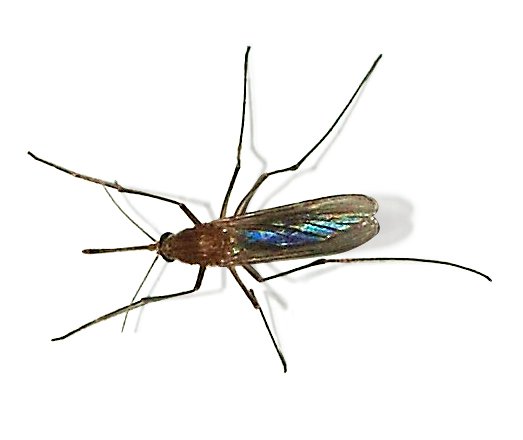
Culex tarsalis (the western encephalitis mosquito) is the one that matters for disease. It is a dark mosquito marked by a pale band across the middle of its proboscis and pale bands on its legs. It is an opportunistic blood feeder with high vector competence for West Nile virus, feeding on birds, which are the reservoir that keeps the virus circulating, and on mammals including people, which makes it the bridge that carries the virus into humans (Source 1). It is a night feeder, most active in the hours after sunset, so the greatest risk of an infectious bite comes from dusk onward (Source 5). It is the most common West Nile vector across the interior West, including Montana and the surrounding states (Source 6). See the species page for Culex tarsalis.
Floodwater Aedes mosquitoes are the ones you are more likely to curse. Species such as Aedes vexans, the inland floodwater mosquito, hatch in large numbers after heavy rain or spring runoff, can fly long distances, and bite people aggressively during the day and evening (Source 7). They are a nuisance far more than a disease threat here, because they feed mostly on mammals and rarely pick up the virus. See the species page for Aedes vexans.
The short version: the mosquito that ruins a cookout is usually not the one that can make you sick, and the one that can make you sick bites quietly after dark.
Disease risk
West Nile virus is the dominant mosquito-borne disease concern in the Mountain West, and Colorado in particular carries one of the heavier burdens in the country (Source 2). The pattern was on full display in 2023, Colorado’s worst season in two decades: the state reported more than 600 human cases and over 50 deaths, the highest case count of any state that year (Source 3, Source 8). Seasons since have been lighter but far from zero, with 76 reported cases in 2024 and 286 cases and 20 deaths in 2025 (Source 3). Culex tarsalis also carries western equine encephalitis and St. Louis encephalitis viruses, but those cause far fewer human cases; West Nile is the one to plan around (Source 1).
Most infections are mild or silent. About 8 in 10 people infected with West Nile virus never develop symptoms at all. Roughly 1 in 5 develop a fever with headache, body aches, and sometimes a rash. About 1 in 150 infected people develop severe neuroinvasive disease, which can bring on meningitis, encephalitis, or paralysis, and roughly 1 in 10 of those severe cases is fatal (Source 9). Adults over 60 and people with weakened immune systems face the highest risk of the severe form. There is no vaccine and no specific antiviral treatment for people, so prevention is the whole game. See the disease page for West Nile virus.
Local control and what to do
Two features of the landscape explain why risk here concentrates where it does: irrigation water and river bottoms. Flood irrigation during dry summers creates broad sheets of shallow, standing water that are ideal larval habitat for Culex tarsalis, and river corridors add more of the same. In the hyperendemic Larimer, Boulder, and Weld county area of north central Colorado, researchers found that the presence of nearby irrigated agriculture was associated with a roughly threefold increase in the odds of West Nile disease, and that disease risk fell off with distance from irrigated land (Source 5). Where you live and work relative to that water matters more than elevation on a map.
What actually reduces your risk, often summarized locally as the Four Ds (Source 10):
- DEET and other repellents. Health officials across the region recommend products containing DEET, picaridin, oil of lemon eucalyptus or para-menthane-diol, or IR3535, applied per the label (Source 10, Source 6).
- Dusk to dawn. Limit time outdoors, or cover up, from dusk through the night, when Culex tarsalis is most active (Source 10).
- Dress. Wear long sleeves and long pants when you are out in the evening in mosquito country (Source 10).
- Drain. Empty and refresh standing water around the home every few days: buckets, tarps, stock tanks, birdbaths, clogged gutters, old tires, and low spots that hold water. On rural and agricultural property, leaky irrigation, ditches, and troughs are common sources (Source 10, Source 6).
Organized mosquito control in the Mountain West is handled by county and local abatement programs, which vary widely from one place to the next, and many rural properties sit outside any district. That puts more of the load on personal protection. Done consistently through August and September, the habits above are the most reliable defense here.
Sources
- “Long-term surveillance defines spatial and temporal patterns implicating Culex tarsalis as the primary vector of West Nile virus,” Scientific Reports, 2019. Identifies Cx. tarsalis as the primary West Nile vector in the western states, an opportunistic blood feeder with high vector competence that also carries western equine and St. Louis encephalitis viruses, associated with irrigated agricultural habitat. https://www.nature.com/articles/s41598-019-43246-y (accessed 2026-07-20)
- Ronca et al., “Cumulative Incidence of West Nile Virus Infection, Continental United States, 1999 through 2016,” Emerging Infectious Diseases / PMC. Reports Colorado’s cumulative reported case total (about 5,285) as third-highest nationally, behind California and Texas. https://pmc.ncbi.nlm.nih.gov/articles/PMC6346444/ (accessed 2026-07-20)
- UCHealth Today, “West Nile virus in Colorado” (Dr. Michelle Barron, UCHealth / University of Colorado Anschutz). States the season runs June through September, that Coloradans see a disproportionately high number of infections, and reports recent yearly figures (2025: 286 cases, 20 deaths; 2024: 76 cases; 2023 the worst year since 1999). https://www.uchealth.org/today/west-nile-virus-in-colorado/ (accessed 2026-07-20)
- Centers for Disease Control and Prevention, “Surveillance for West Nile Virus Disease, United States, 2009 through 2018,” MMWR Surveillance Summaries, 2021. Reports July through September onset with an August peak, and highest average annual neuroinvasive incidence in the northern Plains. Page returned HTTP 403 on direct fetch; figures taken from CDC search snippet. https://www.cdc.gov/mmwr/volumes/70/ss/ss7001a1.htm (accessed 2026-07-20)
- Eisen et al., “Irrigated Agriculture Is an Important Risk Factor for West Nile Virus Disease in the Hyperendemic Larimer-Boulder-Weld Area of North Central Colorado,” Journal of Medical Entomology, 2010. Finds irrigated agriculture, a major producer of Culex tarsalis, associated with roughly threefold elevated odds of WNV disease, with risk decreasing with distance from irrigated land. https://academic.oup.com/jme/article/47/5/939/883457 (accessed 2026-07-20)
- Montana Department of Public Health and Human Services, “West Nile Virus.” States that Culex tarsalis is the most common WNV mosquito vector in Montana, that mosquitoes breed in standing water, and recommends DEET or picaridin repellent, avoiding dawn and dusk exposure, and draining standing water. https://dphhs.mt.gov/publichealth/cdepi/diseases/WestNileVirus (accessed 2026-07-20)
- Vector Disease Control International, “Mosquito of the Month: Aedes vexans, the Inland Floodwater Mosquito.” Identifies Aedes vexans as a dominant floodwater biting nuisance that hatches after heavy water and flies long distances. https://www.vdci.net/blog/mosquito-of-the-month-aedes-vexans-the-inland-floodwater-mosquito/ (accessed 2026-07-20)
- KUSA/9News, “Colorado has most West Nile virus cases in U.S. so far this year, and it’s not even close,” 2023. Reports Colorado leading the nation in West Nile cases during the 2023 outbreak, more than double the second-ranked state. https://www.9news.com/article/news/health/west-nile-virus-colorado-denver-2023-cases/73-4d8594e6-7935-4260-9a48-9c231e1a72f8 (accessed 2026-07-20)
- Centers for Disease Control and Prevention, “Symptoms of West Nile Virus.” About 80% of infections are asymptomatic, roughly 1 in 5 develop febrile illness, about 1 in 150 develop severe neuroinvasive disease, and about 1 in 10 severe cases is fatal. https://www.cdc.gov/west-nile-virus/signs-symptoms/index.html (accessed 2026-07-20)
- Colorado Department of Public Health and Environment, “West Nile virus and your health,” and Larimer County Public Health, “Protect yourself: the Four Ds.” Describe the Four Ds (DEET, dress, drain, dusk to dawn), recommended repellents (DEET, picaridin, IR3535, oil of lemon eucalyptus / para-menthane-diol), and draining standing water around the home. https://cdphe.colorado.gov/animal-related-diseases/west-nile-virus/west-nile-virus-and-your-health (accessed 2026-07-20)
Related
- Species: Culex tarsalis [placeholder]
- Species: Aedes vexans [placeholder]
- Disease: West Nile virus [placeholder]
- Region: Mosquitoes in the Great Plains [placeholder]
- Region: Mosquitoes in the Southwest [placeholder]
Educational note: This page is for general information and prevention awareness only. It is not medical advice. If you develop a high fever, severe headache, stiff neck, confusion, or muscle weakness during mosquito season, contact a health care provider. For local risk levels and current-year case counts, consult your state or county health department.
Last reviewed 20 July 2026.