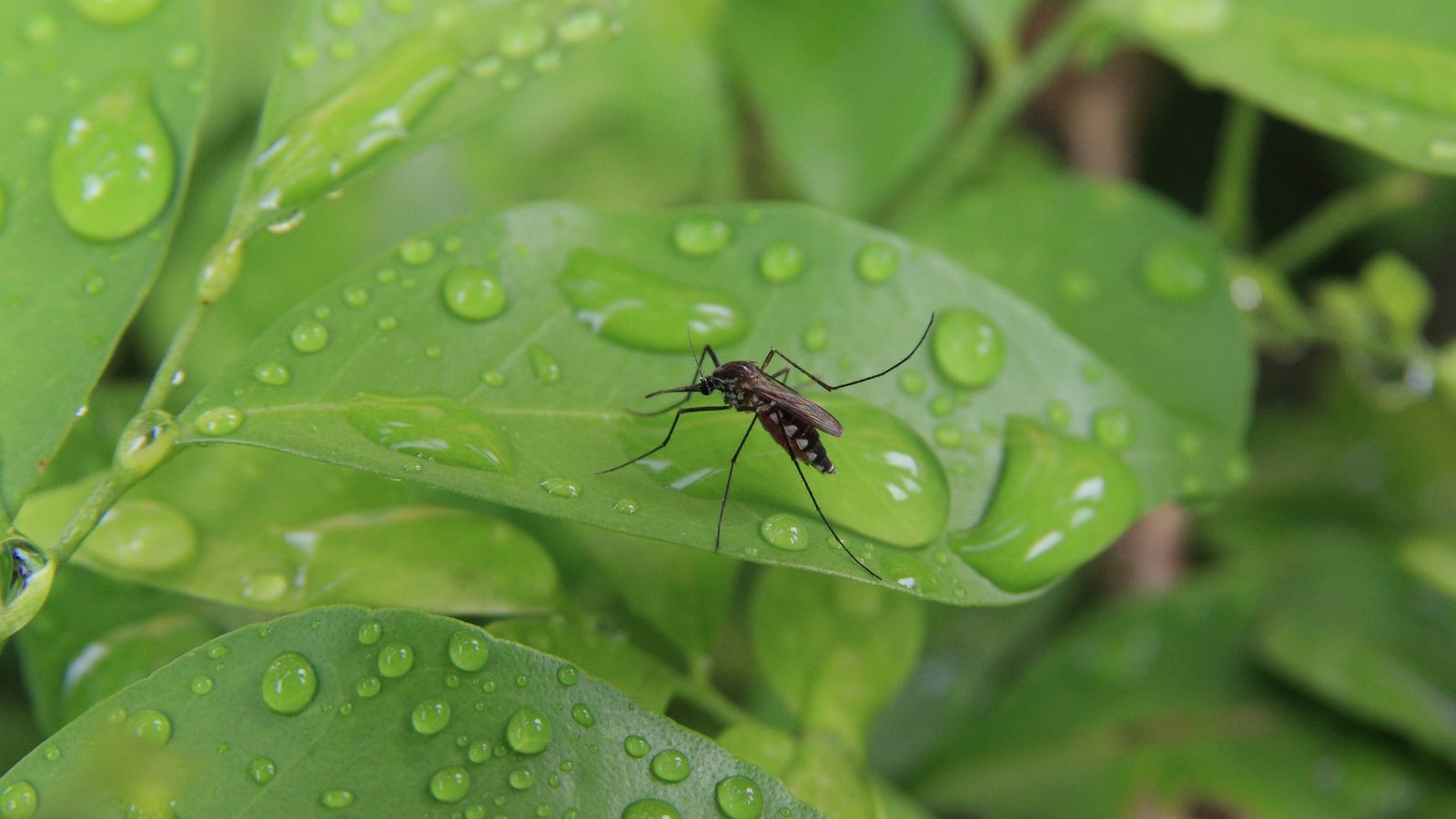
The short answer
The Northeast has a defined warm-season mosquito problem rather than a year-round one. Biting activity climbs through the summer and fades with the first hard frosts. The main disease concern across the region is West Nile virus, which is widespread and turns up in mosquito pools, birds, and people in urban and suburban areas most summers (CT Mosquito Management Program, source 6). The more frightening but far rarer concern is Eastern equine encephalitis, or EEE, which is tied to freshwater swamps and flares up in some years, especially in parts of Massachusetts (Mass.gov, source 4).
For most people, the practical takeaway is simple. Use an EPA-registered repellent, empty standing water around the home, and pay closer attention in late summer and in years when your state announces elevated EEE risk.
Mosquito season here
In the Northeast, mosquito season runs roughly from late spring through early fall, with activity peaking in late summer. Connecticut’s statewide trapping and testing program, coordinated by the Connecticut Agricultural Experiment Station, runs from June 1 through the end of October, which is a good proxy for the active season across the region (CT Mosquito Management Program, source 6).
The late-summer peak is driven by temperature. Warmer conditions shorten the time a virus needs to build up inside a mosquito, so transmission accelerates as summer wears on. West Nile virus activity in the Northeast typically peaks from July through September, and most human cases have onset in August and early September (CT Mosquito Management Program, source 6; CDC West Nile data, source 1). Once nights turn cold and hard frosts arrive, adult mosquito activity drops sharply and the risk window closes for the year.
The mosquitoes you meet
The Northeast is home to several groups of mosquitoes, and they matter for different reasons.
Culex mosquitoes, including Culex pipiens and Culex salinarius, are the main drivers of West Nile virus in the region. Culex salinarius is described as an important vector in the northeastern part of the country (CDC West Nile data, source 1). These mosquitoes often breed in stagnant, organically rich water such as catch basins, ditches, and neglected containers, which is why West Nile activity concentrates in urban and suburban areas. See our species pages for [Culex pipiens] and [Culex salinarius].
Culiseta melanura is the key species behind EEE. It lives and breeds in freshwater hardwood swamps and feeds mainly on birds, which keeps the virus circulating in the bird population. Because it rarely bites people directly, human cases depend on other “bridge” mosquitoes that feed on both birds and mammals (Mass.gov, source 4). See [Culiseta melanura].
Floodwater and container Aedes mosquitoes are aggressive daytime biters and a major nuisance after heavy rain. These include the introduced Asian tiger mosquito in parts of the region. See [Aedes species].
Saltmarsh mosquitoes such as Aedes sollicitans dominate the coast. They breed in temporary pools in the upper reaches of salt marshes, bite fiercely at dusk and during the day, and can disperse inland, generally less than five miles but sometimes farther on the wind. They are a serious nuisance and can carry EEE (Rutgers Center for Vector Biology, source 10). See [Aedes sollicitans].
Disease risk
West Nile virus is the most common mosquito-borne virus in the region and across the country. Most infections cause no symptoms at all. About 8 in 10 infected people feel nothing, roughly 1 in 5 develop a fever with headache, body aches, or other flu-like symptoms, and about 1 in 150 develop severe neuroinvasive disease affecting the brain or spinal cord. Of those who develop severe illness, about 10 percent die (CDC West Nile symptoms, source 2). Older adults and people with certain medical conditions face the highest risk of severe disease.
Eastern equine encephalitis is rare but very serious. Only a handful of human cases are reported nationally in a typical year, on the order of a single-digit average, though the count swings from a few to around two dozen depending on the year (CDC EEE, source 3). Roughly 30 percent of people who develop severe EEE die, and many survivors are left with lasting neurologic problems (CDC EEE, source 3). The Northeast, and Massachusetts in particular, is a recognized focus. Massachusetts sees EEE outbreaks in roughly 10- to 20-year cycles that tend to last two to three years each. The most recent outbreak began in 2019 with twelve cases and six deaths, continued into 2020, and a smaller flare-up occurred in 2024 with four cases and one death (Mass.gov, source 4). EEE risk is concentrated near the freshwater swamps of southeastern Massachusetts and similar swampy areas elsewhere in the region.
Two other viruses circulate at low levels. Jamestown Canyon virus is spread by several mosquito species and can cause fever, headache, and in some cases encephalitis. It is uncommon, with reports concentrated in northeastern and midwestern states (CDC Jamestown Canyon, source 8). La Crosse virus, another California serogroup virus, is a rare cause of encephalitis that is far more common in other regions and is only an occasional concern in the Northeast (CDC Jamestown Canyon transmission, source 8). See our disease pages for [West Nile virus], [Eastern equine encephalitis], [Jamestown Canyon virus], and [La Crosse encephalitis].
Local control and what to do
Northeast states run active surveillance programs that trap and test mosquitoes through the season and share results publicly. Connecticut, for example, operates a network of more than 100 trapping stations across dozens of towns (CT Mosquito Management Program, source 6). When surveillance shows elevated EEE activity, states and local districts may raise risk levels, recommend rescheduling evening outdoor events, and in high-risk years conduct aerial or truck-mounted spraying to knock down adult mosquitoes (Mass.gov, source 5). Public mosquito control programs also focus on source reduction, meaning they drain, ditch, or treat the standing water where larvae grow (CDC mosquito control, source 12).
At home, the two most effective steps are personal protection and source reduction. Use an EPA-registered repellent containing DEET, picaridin, oil of lemon eucalyptus or PMD, IR3535, or 2-undecanone, and follow the label (CDC prevention, source 11). Wear long sleeves and long pants during peak biting times, and keep screens in good repair. Once a week, empty and scrub, turn over, cover, or throw out anything that holds water, including buckets, planters, toys, tires, birdbaths, and flowerpot saucers, and tightly cover rain barrels and water storage (CDC prevention, source 11). During EEE seasons, health officials often advise limiting outdoor activity around dawn and dusk in affected towns.
Sources
- CDC, West Nile Virus, Data and Maps (https://www.cdc.gov/west-nile-virus/data-maps/index.html). Accessed 20 July 2026. National surveillance via ArboNET, July to September peak, Culex vectors in the Northeast.
- CDC, Symptoms of West Nile Virus (https://www.cdc.gov/west-nile-virus/signs-symptoms/index.html). Accessed 20 July 2026. About 8 in 10 infections asymptomatic, about 1 in 150 neuroinvasive, about 10 percent of severe cases fatal.
- CDC, About Eastern Equine Encephalitis Virus (https://www.cdc.gov/eastern-equine-encephalitis/about/index.html). Accessed 20 July 2026. Rarity, single-digit average annual cases, about 30 percent fatality among severe cases.
- Massachusetts Department of Public Health, EEE in Massachusetts (https://www.mass.gov/guides/eee-in-massachusetts). Accessed 20 July 2026. Culiseta melanura, freshwater hardwood swamps, bridge vectors, 10- to 20-year outbreak cycles, 2019, 2020, and 2024 case counts.
- Massachusetts Department of Public Health, Massachusetts Arbovirus Update (https://www.mass.gov/info-details/massachusetts-arbovirus-update). Accessed 20 July 2026. State risk levels and response, including spraying in high-risk years.
- Connecticut Mosquito Management Program / CT Agricultural Experiment Station, Mosquito Monitoring and Surveillance (https://portal.ct.gov/mosquito/surveillance/mosquito-monitoring-and-surveillance). Accessed 20 July 2026. June 1 to October season, trap network, West Nile July to September in urban and suburban areas, EEE more rural.
- Connecticut Mosquito Management Program, 2026 season announcement (https://portal.ct.gov/mosquito/press-room/2026-press-releases/state-mosquito-monitoring-program-begins-testing-for-mosquito-borne-viral-diseases). Accessed 20 July 2026. Season start and trapping program scope.
- CDC, Transmission of Jamestown Canyon Virus (https://www.cdc.gov/jamestown-canyon/php/transmission/index.html). Accessed 20 July 2026. Spread by multiple mosquito species, dead-end human hosts, California serogroup context.
- CDC, About Jamestown Canyon Virus (https://www.cdc.gov/jamestown-canyon/about/index.html). Accessed 20 July 2026. Symptoms including fever, headache, and possible encephalitis.
- Rutgers Center for Vector Biology, Aedes sollicitans species profile (https://vectorbio.rutgers.edu/outreach/species/sp7.htm). Accessed 20 July 2026. Salt marsh larval habitat, inland dispersal generally under five miles, biting behavior, EEE vector role.
- CDC, Preventing Mosquito Bites (https://www.cdc.gov/mosquitoes/prevention/index.html). Accessed 20 July 2026. EPA-registered repellent ingredients and weekly standing-water removal.
- CDC, What Mosquito Control Programs Do (https://www.cdc.gov/mosquitoes/mosquito-control/mosquito-control-programs.html). Accessed 20 July 2026. Surveillance and source reduction by public programs.
Related
- [West Nile virus] (disease page placeholder)
- [Eastern equine encephalitis] (disease page placeholder)
- [Jamestown Canyon virus] (disease page placeholder)
- [Culex pipiens] (species page placeholder)
- [Culiseta melanura] (species page placeholder)
- [Aedes sollicitans] (species page placeholder)
- [How to prevent mosquito bites] (guide placeholder)
Educational note: This page is for general education and is not medical advice. If you have symptoms of a mosquito-borne illness, such as high fever, severe headache, confusion, or a stiff neck, contact a healthcare provider. For current local risk levels and spraying notices, check your state or local health department.
Last reviewed 20 July 2026.