The short answer
Intact screens on your windows and doors are one of the simplest and most effective ways to keep mosquitoes out of your home. The federal guidance is short and direct: use screens on windows and doors, and repair holes in screens to keep mosquitoes outdoors (CDC, Preventing Mosquito Bites). A screen does not repel anything and uses no chemicals. It just puts a physical barrier between you and the mosquitoes trying to get in, which is why it keeps working night after night with almost no upkeep beyond keeping it in good repair.
The catch is in the word “intact.” A screen with a torn corner, a gap around its frame, or a door propped open does very little, because mosquitoes readily enter homes through any open or unscreened gap (CDC, Mosquito Control at Home). The value of a screen comes from covering the opening completely.
Why screens work
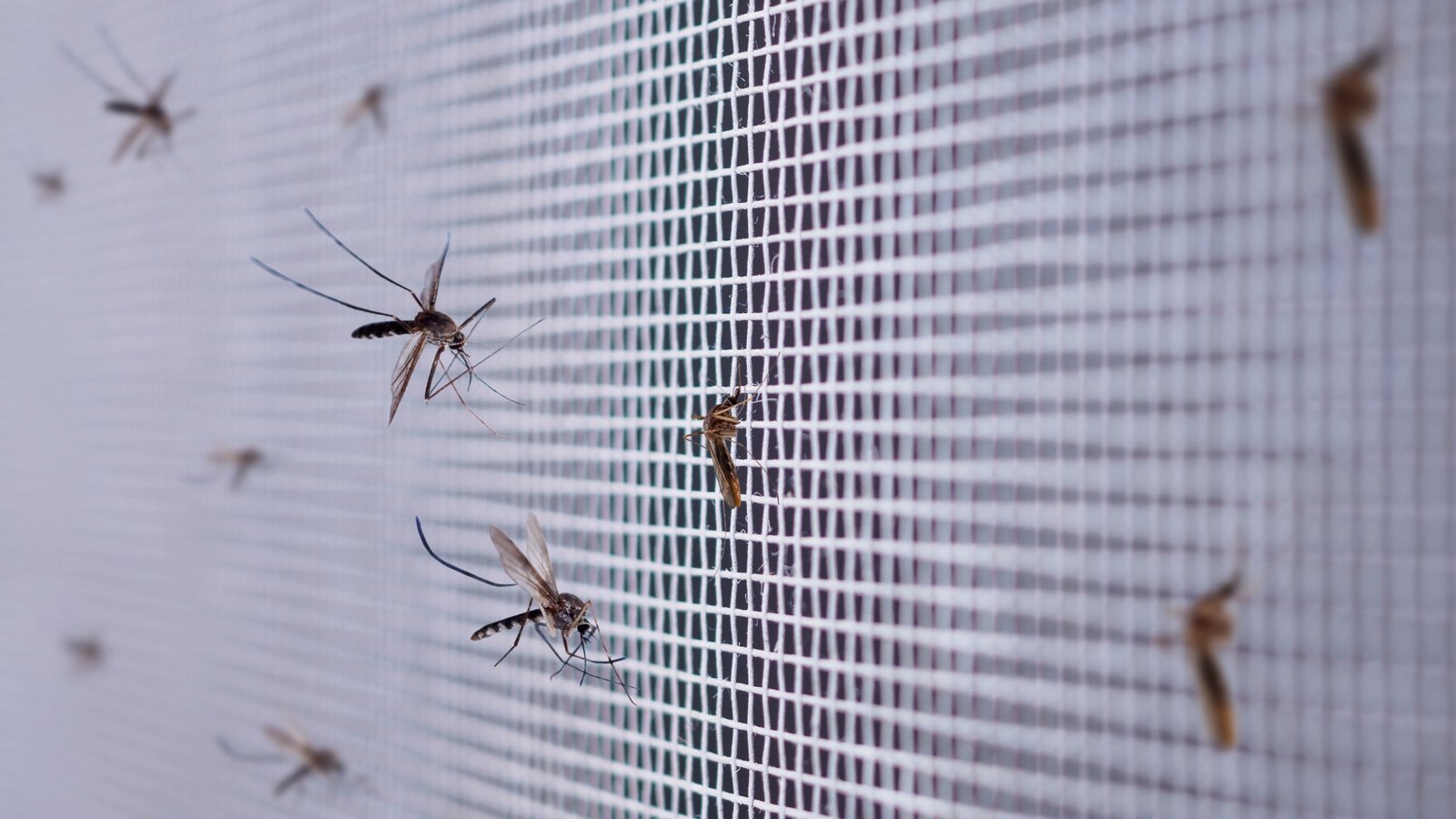
Most mosquitoes that bite people indoors get in the ordinary way, through open or unscreened windows and doors, and their entry can be prevented by covering those openings (CDC, Mosquito Control at Home). A screen works purely as a physical barrier. The mesh openings are smaller than an adult mosquito, so the insect cannot pass through, while air still moves freely (CDC, Mosquito Control at Home).
The practical effect is that screens keep mosquitoes on the outside, where they cannot reach you. This matters most at night. Many mosquitoes are active at dusk and after dark, exactly when windows are open for cooling and people are asleep and not swatting them away. Keeping the insects outdoors during those hours removes most of the indoor biting opportunity.
There is direct evidence that screening a house reduces how many mosquitoes get inside. A Cochrane review of house modifications for preventing malaria found that screening houses lowered the number of mosquitoes caught indoors, with one trial recording about 20 fewer mosquitoes per light-trap per night in screened houses than in unscreened ones, and concluded that screening may reduce malaria transmission and infection among the people living there (Kirby 2009, in Furnival-Adams et al., House modifications for preventing malaria). That research was done in malaria settings, but the mechanism is the same one that keeps nuisance mosquitoes out of a home here: block the entry points and fewer mosquitoes get in to bite you.
Mesh size and materials
For ordinary mosquitoes, standard insect screening is enough. Common residential screen is an 18-by-16 mesh (18 strands per inch one way, 16 the other), and university guidance is that screens should be 16 mesh per inch or finer to exclude mosquitoes (University of Nebraska-Lincoln Extension, Residential Mosquito Control). Standard fiberglass or aluminum window screen from any hardware store meets that standard. You do not need anything special for typical backyard mosquitoes.
The main material choices are fiberglass, which is inexpensive, flexible, and easy to install, and aluminum, which is stiffer and more durable. Either stops mosquitoes as long as the weave is 16 mesh or finer and the screen has no holes.
Finer mesh becomes worth considering only if you are dealing with much smaller biting insects. No-see-ums (biting midges), which are common in coastal and marshy areas, are less than about one-sixteenth of an inch long and can pass through normal 16-mesh window screening (University of Arizona Cooperative Extension, No-See-Um Biting Flies). To keep those out you need a tighter weave, often sold as “no-see-um” mesh, with smaller openings than standard screen (University of Arizona Cooperative Extension, No-See-Um Biting Flies). The trade-off is airflow: the finer the mesh, the more it restricts the breeze, so most homes only use it where tiny biters are actually a problem.
Keeping them effective
A screen only protects you where it is whole and where it seals. The upkeep is simple but it is the whole job.
- Repair holes and tears. Check windows, doors, and screens and keep them in good repair (University of Nebraska-Lincoln Extension, Residential Mosquito Control; EPA, Tips to Prevent Mosquito Bites). Small holes can be closed with a screen patch kit; badly torn or brittle old screens are usually easier to replace than to mend. Federal guidance frames the goal as repairing holes so mosquitoes stay outdoors (CDC, Preventing Mosquito Bites).
- Close gaps around the frame. A screen that does not seal to the window or door leaves a mosquito-sized gap even when the mesh is perfect. Cover gaps in walls, doors, and windows so there is no route around the screen (CDC, Mosquito Control at Home). The aim is for screens to be “bug tight,” with no tears or openings on either doors or windows (CDC, Mosquito Control at Home).
- Use screen doors, and let them close. A doorway is a large opening that gets used constantly. A screen door only helps if it actually shuts. Extension guidance recommends that screen doors open outward and have automatic closing devices and latches so they are not accidentally left ajar (University of Georgia Extension, Controlling Mosquitoes). Note that a security door alone will not keep mosquitoes out, because its openings are far larger than a mosquito (CDC, Mosquito Control at Home).
- Do not rely on an open, unscreened window. If a window has no screen, or the screen is out for cleaning, keeping it closed is the barrier. Mosquitoes will use any open, unscreened window or door as an entrance (CDC, Mosquito Control at Home).
Screens plus other steps
Screens keep mosquitoes from getting into your living space, but they do the most good as one layer among several. Two additions pair naturally with them.
The first is air conditioning. Federal guidance lists using air conditioning, when available, right alongside screens as a way to keep mosquitoes out, partly because a cooled home with the windows closed simply has fewer openings for them to use (CDC, Preventing Mosquito Bites).
The second, and the one that reduces the mosquito problem at its source, is getting rid of the standing water where mosquitoes breed. Screens stop the adults that reach your walls; source reduction means fewer adults are produced nearby in the first place. Empty or change the water in containers, bird baths, and plant trays at least weekly, and clear standing water from gutters, buckets, tires, and toys (EPA, Tips to Prevent Mosquito Bites; UC IPM, Mosquitoes). Used together, screening, cooling, and draining standing water cover far more of the problem than any single step alone.
For more on eliminating breeding sites and on the other layers of protection, see the related pages below.
Sources
- Centers for Disease Control and Prevention (CDC), “Preventing Mosquito Bites.” https://www.cdc.gov/mosquitoes/prevention/index.html (accessed 20 July 2026; page returned HTTP 403, wording taken from CDC search-result excerpt). Source for the core guidance to use screens on windows and doors, repair holes to keep mosquitoes outdoors, and use air conditioning when available.
- Centers for Disease Control and Prevention (CDC), “Mosquito Control at Home.” https://www.cdc.gov/mosquitoes/mosquito-control/mosquito-control-at-home.html (accessed 20 July 2026; page returned HTTP 403, claims taken from CDC search-result excerpt). Source for screens being “bug tight,” wire mesh with holes smaller than an adult mosquito, covering gaps in walls, doors, and windows, mosquitoes entering through open or unscreened openings, and security doors alone not keeping mosquitoes out.
- US Environmental Protection Agency (EPA), “Tips to Prevent Mosquito Bites.” https://www.epa.gov/insect-repellents/tips-prevent-mosquito-bites (accessed 20 July 2026). Source for keeping window and door screens in good working order and for eliminating standing water in containers, gutters, and other sites.
- University of Nebraska-Lincoln Extension, “Residential Mosquito Control” (NebGuide G2037). https://extensionpubs.unl.edu/publication/g2037/na/html/view (accessed 20 July 2026). Source for screens being 16 mesh per inch or finer and for checking doors, windows, and screens to keep them in good repair.
- University of Georgia Extension, “Controlling Mosquitoes.” https://ent.uga.edu/extension/controlling-mosquitoes.html (accessed 20 July 2026). Source for keeping door and window screens in good repair and for screen doors opening outward with automatic closing devices and latches.
- University of Arizona Cooperative Extension, “No-See-Um Biting Flies.” https://extension.arizona.edu/sites/extension.arizona.edu/files/barnesm/No-See-Um.pdf (accessed 20 July 2026; PDF did not render on fetch, claims taken from the University of Arizona Extension search-result excerpt). Source for no-see-ums being under about one-sixteenth inch, passing through normal 16-mesh screening, and needing finer no-see-um mesh.
- University of California Statewide IPM Program (UC IPM), “Mosquitoes.” https://ipm.ucanr.edu/home-and-landscape/mosquitoes/ (accessed 20 July 2026). Source for ensuring doors and windows have screens with holes repaired, and for eliminating small pools of standing water.
- Furnival-Adams J, Olapeju B, Chaki P, et al. (Cochrane review), “House modifications for preventing malaria.” https://pmc.ncbi.nlm.nih.gov/articles/PMC8642787/ (accessed 20 July 2026). Source for evidence that house screening reduces indoor mosquito numbers (about 20 fewer mosquitoes per light-trap per night in one trial, Kirby 2009) and may reduce malaria transmission and infection.
Related
- Source reduction: removing standing water (placeholder)
- Air conditioning and keeping mosquitoes out (placeholder)
- Bed nets and sleeping protection (placeholder)
- Mosquito prevention overview (placeholder)
Educational note: This page is general reference information, not medical or pest-control advice. Follow product instructions for any screening or repair materials, and consult your local mosquito control or vector control district for questions specific to your area.
Last reviewed 20 July 2026.