The short answer
BTI is a naturally occurring bacterium that kills mosquito larvae but is safe for people, pets, fish, and most other wildlife (1, 3). Its full name is Bacillus thuringiensis subspecies israelensis, and it is found in soils (1). When mosquito larvae eat it in the water where they are developing, it destroys their gut and they die before they can grow into biting adults (3, 4).
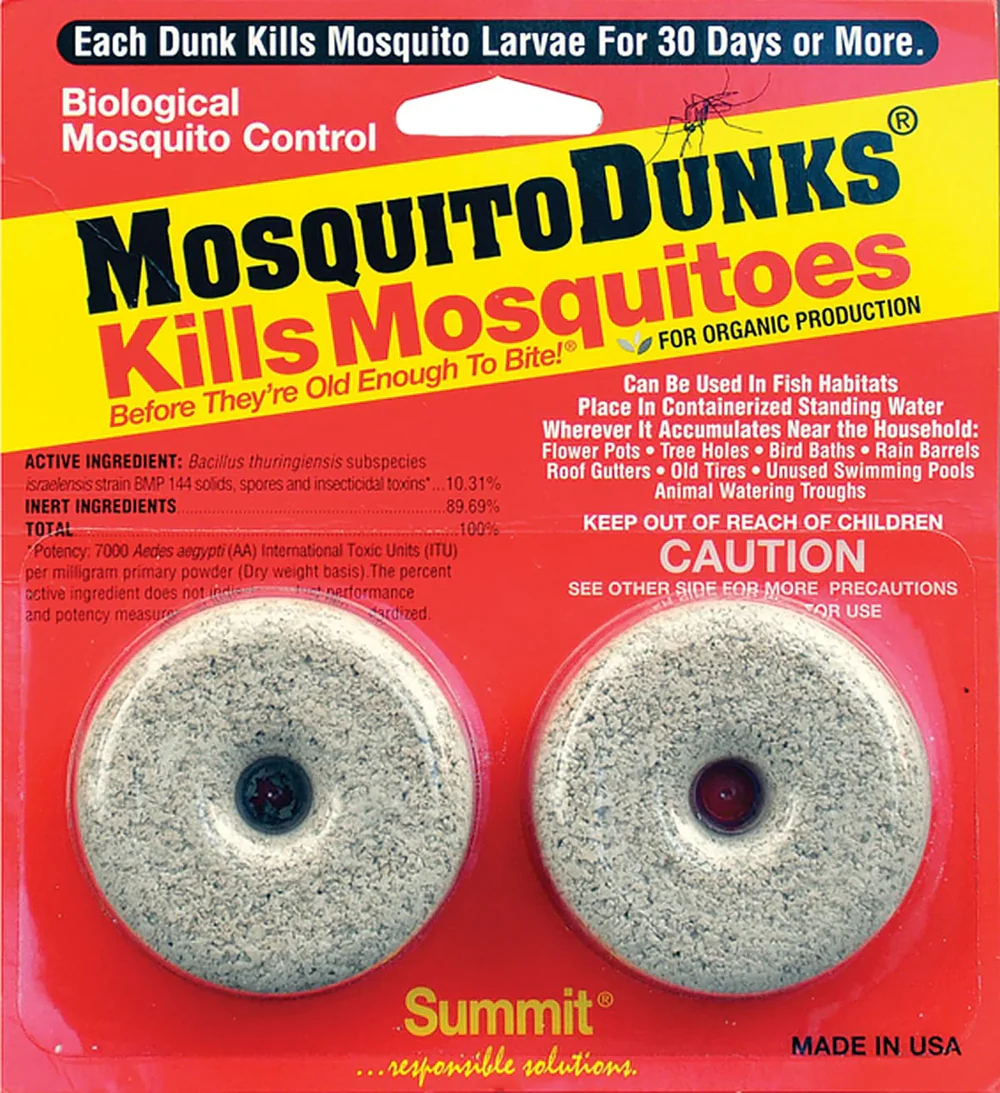
For home use it is sold mainly as floating “dunks,” which are small doughnut-shaped briquettes, and as granules that can be scattered (1, 3). You drop a dunk into standing water that you cannot drain, such as a rain barrel or an ornamental pond, and it slowly releases BTI to keep killing larvae for several weeks (3, 5). Because it targets only the larvae of a narrow group of insects and has essentially no toxicity to people, it is one of the most widely recommended tools for treating water you cannot eliminate (1, 2).
A common form of BTI larvicide, sold as slow-release floating briquettes for standing water.
What BTI is
BTI is one subspecies of a common soil bacterium called Bacillus thuringiensis (1). Different subspecies of that bacterium affect different insects. The israelensis subspecies (the “i” in BTI) is the one that acts on the larvae of mosquitoes, black flies, and fungus gnats, and it does not affect other kinds of insects such as honey bees (1). It was first registered for use in the United States as an insecticide in 1983 (7).
What makes BTI work is not a chemical nerve poison but a set of proteins the bacterium produces (1, 4). The spores contain crystal proteins that are only harmful once they are eaten (1, 3). This is why BTI acts on larvae, which feed by filtering material out of the water, and not on the non-feeding pupa or the flying adult (3).
The killing happens in the gut. After a larva swallows BTI, the alkaline (high pH) environment of its midgut dissolves the crystals and activates the toxins (4). Those toxins bind to specific receptors on the cells lining the gut, punch pores in the cell membranes, and break down the gut wall, so the larva stops feeding and dies (3, 4). Because the toxins depend on that particular gut chemistry and on matching receptors, they act on a narrow range of fly larvae and leave other animals unharmed (1, 4). This multi-toxin mode of action is also why documented resistance to BTI is very rare (1, 4).
Does it work
Yes. BTI has been shown to reduce mosquito larval populations, and public health agencies rely on it as a core larvicide (1, 2). It is most useful for standing water that you cannot drain, cover, or flush out on a regular basis, which is exactly the water where mosquitoes complete their life cycle (2, 5).
The important limit is time. BTI is only effective against actively feeding larvae, and it does not affect pupae or adults (3). It also breaks down in the environment, so a single treatment does not last indefinitely (3). Depending on the product form and on conditions like sunlight, temperature, and how dirty the water is, a treatment may remain effective anywhere from about a day to more than a month (3). Slow-release dunks are formulated to keep working for roughly 30 days or more, which is why they are convenient for water that sits for a whole season (5). To keep a water source protected, you reapply on the schedule the label gives (3).
How to use it
Match the form to the water. Dunks (floating briquettes) suit contained standing water: rain barrels, ornamental ponds and fountains, tree holes, birdbaths, unused swimming pools, animal watering troughs, roof gutters, and planter reservoirs (2, 3, 5). Granular BTI suits larger or intermittent areas, such as low spots that flood after rain; when the area fills with water the granules release BTI and kill any larvae that hatch (3). Liquid formulations also exist and are more often used by mosquito control programs (3).
For a home rain barrel, a common approach is to add a dunk (many people use part of a dunk for a small barrel) and replace it on the schedule the label specifies (5, 6). A dunk can be broken into smaller pieces for a small container such as a birdbath (5). Always follow the specific product label for the amount, because it is written for that product’s strength and is the legal instruction for use.
On timing, treat before and through mosquito season while water is standing, and reapply as the product breaks down (2, 3). Pairing BTI with source reduction works best: empty, cover, or screen containers where you can, and reserve BTI for the water you genuinely cannot get rid of (2, 6). Fitting a tight screen over a rain barrel, for example, both keeps egg-laying females out and keeps the harvested water usable (6).
Safety
BTI has one of the most favorable safety profiles of any mosquito control product. The EPA concluded that BTI has no toxicity to people and does not pose a risk to humans, and it is even approved for pest control in organic farming (1). State health agencies state plainly that BTI is nontoxic to mammals, birds, and fish (3).
It is also easy on beneficial and non-target wildlife. Studies indicate BTI has minimal toxicity to honey bees, and its toxins do not affect other types of insects including bees (1). Because it does not harm fish, it can be used in ornamental ponds that hold fish (3). The EPA notes that no special precautions are needed for applying BTI, although some commercial products may direct applicators to wear a dust or mist mask (1). As with any pesticide, the responsible practice is to use it only where mosquitoes are actually breeding and to follow the label.
Limits
BTI is a larvicide, not an adulticide. It kills larvae in water and does nothing to the mosquitoes already flying and biting (3). If you have a current biting problem, BTI prevents the next generation but does not clear the adults you have now.
It is time-limited and must be reapplied. BTI breaks down in the environment and may need to be reapplied regularly to keep control (3). A dunk that has done its job weeks ago is no longer protecting the water.
It only reaches water you treat. BTI has to be eaten by larvae, so it only works in the specific standing water where you put it. It does not spread on its own to untreated containers, and it is not a barrier against mosquitoes entering an area.
Finally, mind drinking water. Federal law prohibits applying BTI to reservoirs that contain drinking water (3). Some individual products are labeled for certain drinking water sources such as cisterns and others are not, so check that a product’s label specifically permits the water source you have in mind before using it there (1).
Sources
- US EPA, “Bti for Mosquito Control” (BTI is a naturally occurring soil bacterium; spores produce toxins that specifically target and only affect the larvae of the mosquito, black fly, and fungus gnat; no toxicity to people and approved for organic farming; minimal toxicity to honey bees and does not affect other insects including bees; effective at reducing larval populations; no documented resistance; no special precautions needed; some products labeled for certain drinking water sources and others not). https://www.epa.gov/mosquitocontrol/bti-mosquito-control (accessed 2026-07-20).
- CDC, “Larvicides” (larvicides control larvae and pupae in water before they become biting adults; homeowners can apply larvicide to small bodies of water; BTI added to standing water and containers that cannot be emptied, covered, or turned over weekly such as rain barrels, fountains, and ornamental ponds; larviciding as part of source reduction). https://www.cdc.gov/mosquitoes/mosquito-control/larvicides.html (accessed 2026-07-20).
- CDC, “Mosquito Control: What You Need to Know About Bti” (BTI is a naturally occurring soil bacterium; toxic to mosquito larvae when ingested; not harmful to people, pets, honey bees, or the environment when used as directed; no documented resistance; used in standing water that cannot be drained). https://www.cdc.gov/mosquitoes/pdfs/bti-508.pdf (accessed 2026-07-20).
- Silva-Filha, Romao, Nielsen-LeRoux, et al., “Bacterial Toxins Active against Mosquitoes: Mode of Action and Resistance,” Toxins 13(8):523, 2021 (BTI crystals are solubilized in the alkaline pH of the larval gut and activated by proteases; Cry and Cyt toxins bind receptors on midgut cells, oligomerize, and form pores, causing enterocyte death and destruction of the midgut epithelium; the complex multi-toxin mode of action carries a low risk of resistance). https://www.mdpi.com/2072-6651/13/8/523 (accessed 2026-07-20).
- Washington State Department of Health, “Mosquito Larvicide – Bti” (BTI kills mosquito larvae; spores eaten by larvae release toxins into the gut so larvae stop eating and die; specific for mosquitoes and black flies with some toxicity to other dipterans such as midges; only effective against actively feeding larvae and does not affect pupae or adults; available in liquid, briquette, and granular forms; may remain effective from 24 hours to over one month; breaks down quickly and may need reapplication; nontoxic to mammals, birds, and fish; Mosquito Dunks and Bits available for residential use; federal law prohibits application to drinking water reservoirs). https://doh.wa.gov/community-and-environment/pests/mosquitoes/bti (accessed 2026-07-20).
- Rutgers NJAES Cooperative Extension, FS1240, “Rain Barrels and Mosquitoes” (adding BTI, often sold as a Mosquito Dunk, is an effective way to control mosquitoes in rain barrels; dunks are labeled for animal watering troughs, bird baths, rain barrels, and roof gutters; standing water attracts mosquitoes and larvae can develop in a barrel within a week in warm weather; cover the barrel with tight window screening and screen overflow openings). https://njaes.rutgers.edu/fs1240/ (accessed 2026-07-20).
- Pennsylvania Department of Environmental Protection, “Bacillus thuringiensis israelensis (Bti)” (BTI is a naturally occurring soil bacterium used as a microbial insecticide; not a contact poison and must be eaten to be effective; first registered by the US EPA as an insecticide in 1983). https://www.pa.gov/agencies/dep/programs-and-services/bureau-of-labs/vector-management/black-fly/bti (accessed 2026-07-20).
Related
- [How to get rid of standing water around the home] (placeholder)
- [Larvicides versus adulticides in mosquito control] (placeholder)
- [Rain barrels and mosquito breeding] (placeholder)
- [Integrated mosquito management for homeowners] (placeholder)
Educational note: This page is for general reference and is not pest-control advice for a specific situation. Pesticide product labels are the legal instructions for use, so always read and follow the label for the specific BTI product you buy, including the amount, the water sources it is approved for, and how often to reapply. For persistent mosquito problems or disease concerns, contact your local mosquito control district or public health department. Last reviewed 20 July 2026.