The short answer
DEET is the most studied and most reliable broad-spectrum insect repellent available, and when you use it as the label directs it is safe for nearly everyone, including children and people who are pregnant. It does not kill mosquitoes. It keeps them from finding you. Decades of testing and government review back it up, and no other repellent has as long a track record (EPA, DEET; NPIC, DEET General Fact Sheet).
If you want one repellent that works against the widest range of biting insects and lasts for hours, DEET is the default choice.
How it works
Mosquitoes find you by smell. They track the carbon dioxide you exhale and the mix of chemicals your skin gives off, and they use those cues to home in on a place to bite. DEET interferes with that host-detection system. As the EPA puts it, “rather than killing them, DEET works by making it hard for these biting bugs to smell us” (EPA, DEET).
The National Pesticide Information Center describes the same effect from the insect’s side: insects exposed to DEET “are not able to locate a person or animal because they cannot detect them” (NPIC, DEET General Fact Sheet). In plain terms, the mosquito is still there, but you have gone quiet to its senses, so it moves on.
Concentration and how long it lasts
A higher percentage of DEET does not make the product stronger. It makes it last longer. Products sold for skin use in the US range from about 5 percent up to nearly 100 percent DEET (EPA, DEET), and the number on the label mostly tells you how many hours of protection to expect.
A widely cited study by Fradin and Day, published in the New England Journal of Medicine in 2002, measured this directly by timing how long each product kept volunteers bite-free in cages of hungry mosquitoes. Their results:
- About 24 percent DEET (23.8 percent) gave roughly 5 hours of complete protection (mean 301.5 minutes).
- About 20 percent DEET lasted just under 4 hours (mean 234.4 minutes).
- About 7 percent DEET (6.65 percent) lasted close to 2 hours (mean 112.4 minutes).
- About 5 percent DEET (4.75 percent) lasted about an hour and a half (mean 88.4 minutes) (Fradin and Day, 2002).
The trade-off flattens out at the top end. The CDC notes that DEET’s protection tends to plateau at a concentration of about 50 percent, so going higher than that buys little or no extra time (CDC, Yellow Book). For most everyday use, something in the 20 to 30 percent range covers a long evening outdoors without needing to reapply constantly.
Is it safe
DEET has one of the longest safety records of any repellent, and the reassuring answer is that normal use as directed does not present a health concern. The EPA reviewed DEET in 1998 and again in 2014 and “has not identified any risks of concern to human health” from ordinary use, in the general population including children (EPA, DEET). The EPA also classifies DEET as “not classifiable as a human carcinogen,” meaning studies have not found evidence that it causes cancer (NPIC, DEET Technical Fact Sheet).
For children, the American Academy of Pediatrics advises not using DEET on infants younger than 2 months, and recommends that products used on children contain no more than 30 percent DEET (NPIC, DEET General Fact Sheet; AAP, HealthyChildren.org). Above 2 months of age, DEET can be used following the label.
Pregnancy is a common worry, and here the guidance is clear and reassuring. The CDC states that EPA-registered repellents, including DEET, may be used during pregnancy and while breastfeeding, and that doing so can actually lower the risk of insect-borne illnesses that could harm a developing baby (CDC, Preventing Mosquito Bites). A clinical trial in which pregnant women applied 20 percent DEET daily during their second and third trimesters found no increase in birth defects and no problems in the babies’ first year of life (NPIC, DEET General Fact Sheet).
How to apply it correctly
A few simple habits get you the full benefit with none of the avoidable problems.
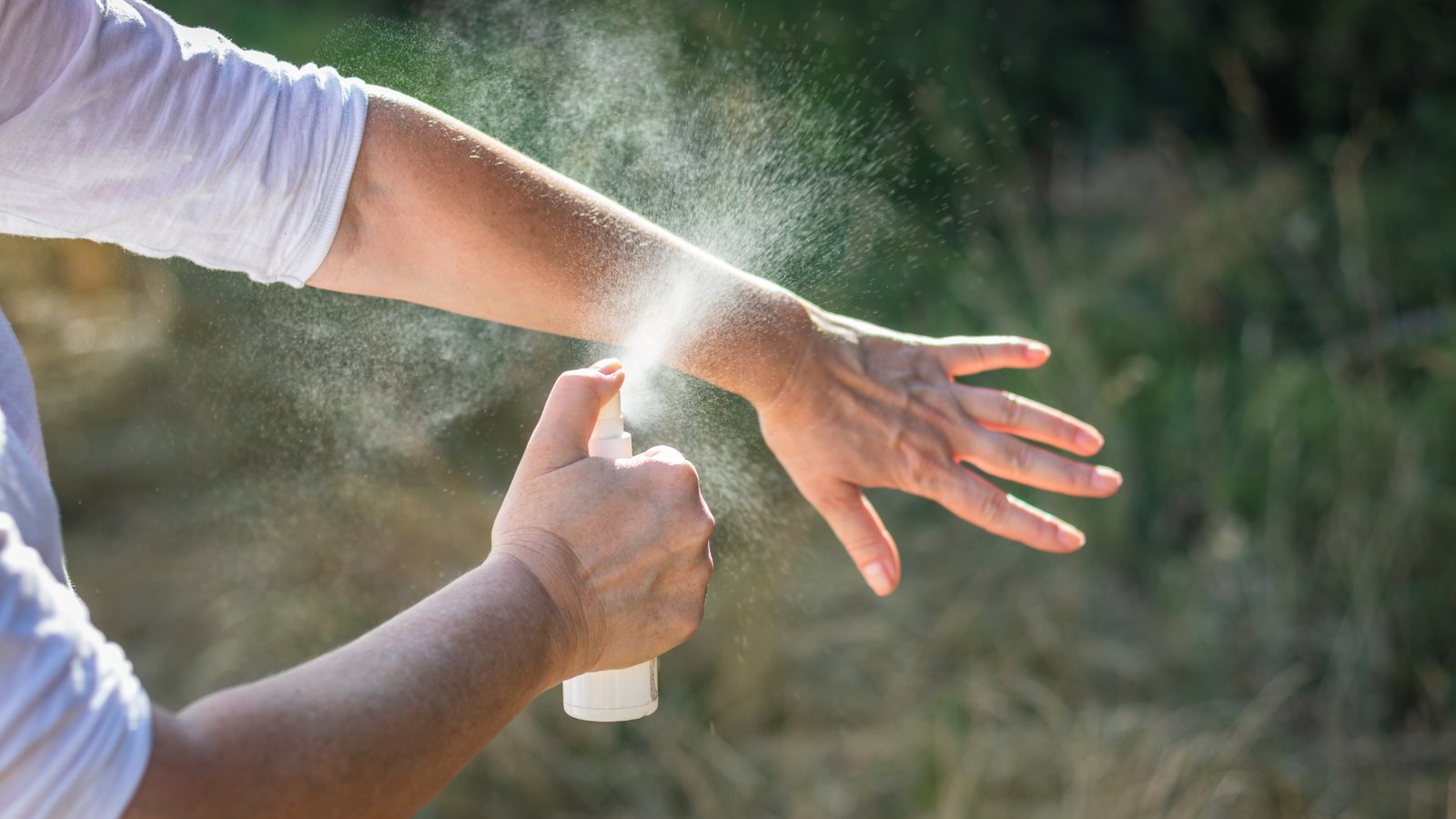
- Apply DEET to exposed skin and, if you like, to the outside of your clothing. Use just enough to cover exposed skin, not a heavy coat (EPA, DEET).
- Do not put it on skin that is under your clothes. Covered skin does not need it, and repellent trapped under fabric is more likely to irritate (NPIC, DEET General Fact Sheet).
- Keep it away from your eyes and mouth, and do not apply it over cuts, wounds, or irritated skin (EPA, DEET).
- For children, an adult should apply it. Do not put it on a child’s hands or near their eyes and mouth, since hands end up in eyes and mouths. Spray it on your own hands first, then rub it onto the child’s face (NPIC, DEET General Fact Sheet; CDC, Preventing Mosquito Bites).
- If you are also using sunscreen, put the sunscreen on first and the repellent second (CDC, Preventing Mosquito Bites).
- When you come back indoors, wash treated skin with soap and water (EPA, DEET).
Downsides
DEET works well, but it has two real drawbacks worth knowing.
First, it can damage certain materials. DEET is a plasticizer, and it can harm plastic, rubber, vinyl, and elastic items such as eyeglass frames and lenses, watch crystals, and painted or varnished surfaces, along with some synthetic and treated fabrics (NPIC, DEET Technical Fact Sheet). It does not damage natural fibers like cotton and wool, so those are safe to spray. The practical lesson is to keep it off your sunglasses, watch face, and synthetic gear where you can.
Second, some people simply dislike how it feels. Higher concentrations can leave skin feeling sticky or oily and carry a noticeable odor. That is a comfort issue rather than a safety one, and a lower concentration or a different formulation often solves it.
Sources
- US Environmental Protection Agency. “DEET.” (Registration and safety reviews, mechanism of action, concentration range, and label application guidance.) https://www.epa.gov/insect-repellents/deet (accessed 20 July 2026).
- National Pesticide Information Center. “DEET General Fact Sheet.” (How DEET works, use on children, pregnancy trial, application precautions.) https://npic.orst.edu/factsheets/DEETgen.html (accessed 20 July 2026).
- National Pesticide Information Center. “DEET Technical Fact Sheet.” (Carcinogenicity classification and material compatibility, plasticizer effects on plastics and fabrics.) https://npic.orst.edu/factsheets/archive/DEETtech.html (accessed 20 July 2026).
- Fradin MS, Day JF. “Comparative Efficacy of Insect Repellents against Mosquito Bites.” New England Journal of Medicine, 2002;347(1):13-18. (Measured complete-protection times by DEET concentration.) https://www.nejm.org/doi/full/10.1056/NEJMoa011699 (accessed 20 July 2026).
- US Centers for Disease Control and Prevention. “Preventing Mosquito Bites.” (Use during pregnancy and breastfeeding, application on children, sunscreen order.) https://www.cdc.gov/mosquitoes/prevention/index.html (accessed 20 July 2026).
- US Centers for Disease Control and Prevention. “Mosquitoes, Ticks, and Other Arthropods” (CDC Yellow Book). (DEET efficacy plateau near 50 percent concentration.) https://www.cdc.gov/yellow-book/hcp/environmental-hazards-risks/mosquitoes-ticks-and-other-arthropods.html (accessed 20 July 2026).
- American Academy of Pediatrics, HealthyChildren.org. “Choosing an Insect Repellent for Your Child.” (Recommendation of no more than 30 percent DEET on children.) https://www.healthychildren.org/English/safety-prevention/at-play/Pages/Insect-Repellents.aspx (accessed 20 July 2026).
Related
- Picaridin: a lower-odor alternative to DEET [placeholder]
- Oil of lemon eucalyptus and plant-based repellents [placeholder]
- Permethrin for treating clothing and gear [placeholder]
- How to protect babies and young children from mosquito bites [placeholder]
Educational note: This page is for general information and is not medical advice. Always read and follow the product label, and talk to a healthcare provider about your specific situation.
Last reviewed 20 July 2026.