The short answer
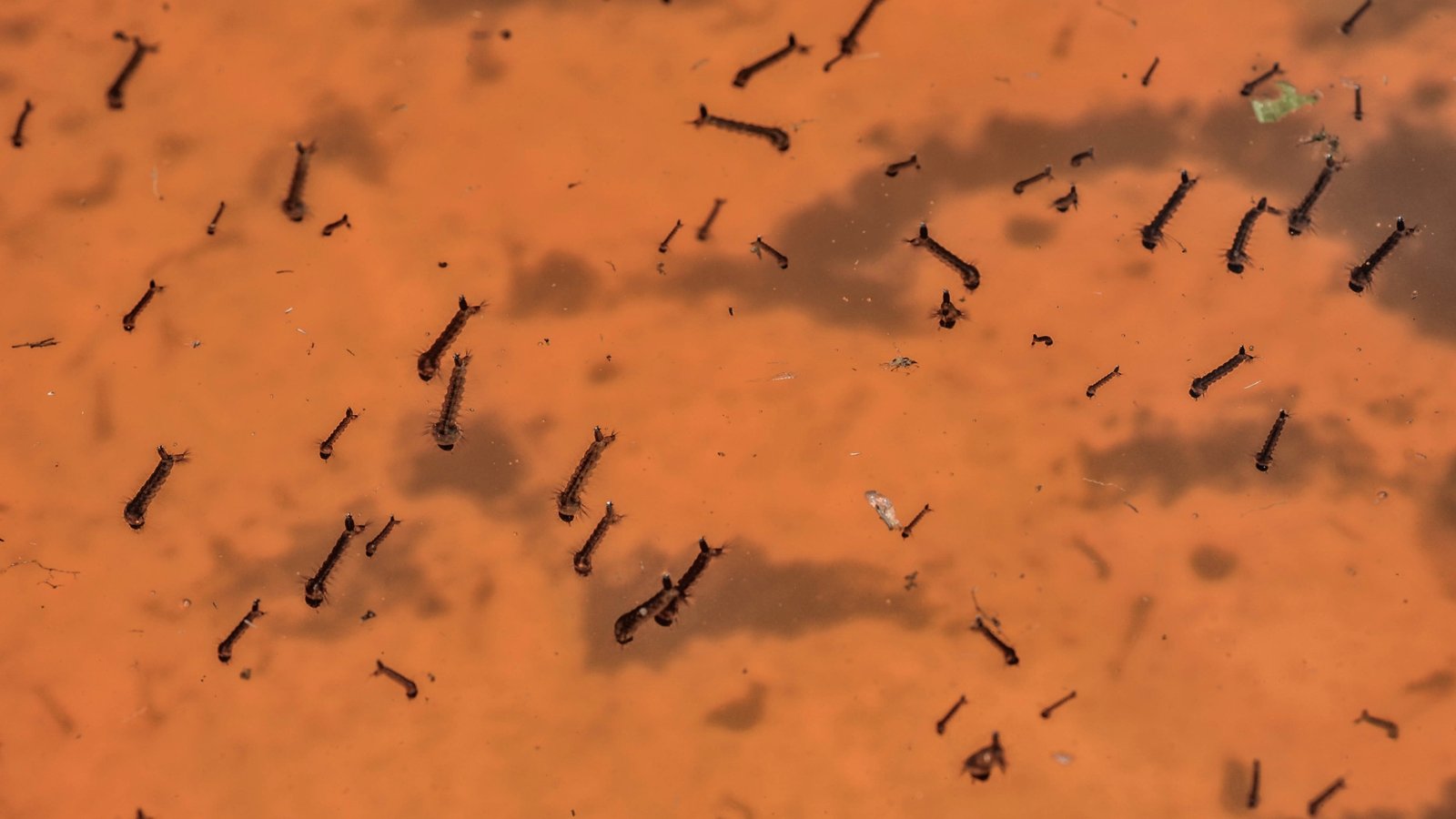
If you find small, active, wormlike creatures in standing water, they may be mosquito larvae. Larvae are the aquatic stage of a mosquito’s life, and they are commonly called wrigglers because of the jerky, side-to-side wriggle they make when you disturb the water (1, 4). They live in water and breathe air from the surface, so you almost always see them near the top (3).
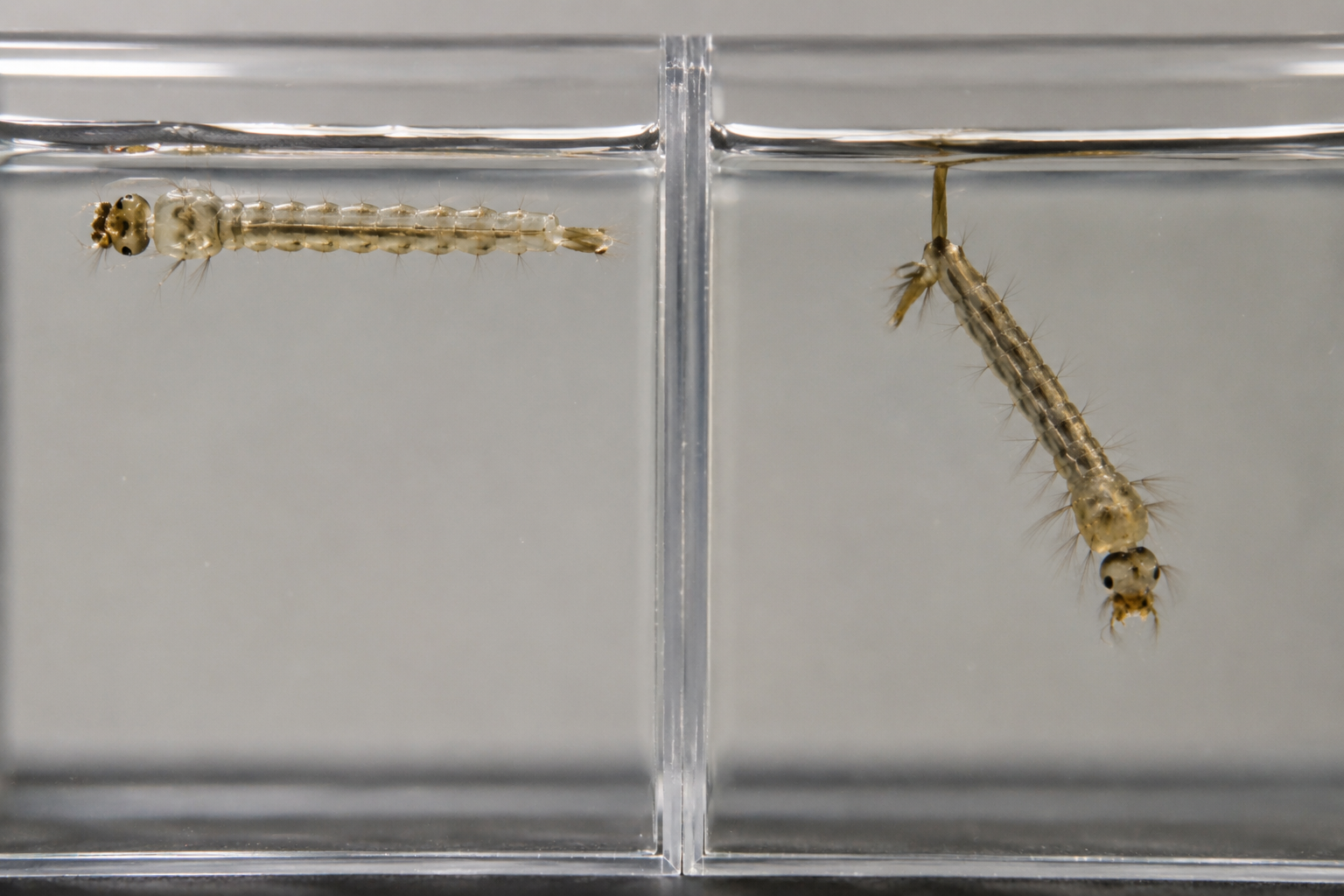
The fastest way to narrow down the type is to watch how a larva hangs at the surface. Larvae in the genus Anopheles lie flat, parallel to the water surface. Larvae in the genera Culex and Aedes hang head-down at an angle, suspended from a breathing tube at the tail end (2, 3). That single difference in resting posture separates the malaria-carrying group (Anopheles) from the two groups that include most nuisance and container-breeding mosquitoes (Culex and Aedes).
What a mosquito larva looks like
A mosquito larva has three body regions: a large, well-developed head, a rounded thorax that is wider than the rest of the body, and a narrow, segmented, wormlike abdomen (1, 4). On the head are brushes around the mouth that the larva uses to sweep small food particles toward it (1). Most larvae also have a breathing tube, called a siphon, at the tail end of the abdomen (2, 3). The larva pushes this tube through the water surface to take in air, which is why you find larvae hanging just below the surface film (4).
Larvae grow by molting, meaning they shed their skin. A mosquito larva molts four times, and the stages between molts are called instars (2, 3). A larva gets larger with each molt, so in one water source you may see wrigglers of several sizes at once.
It helps to know what a mosquito larva is not. Several other small aquatic insects live in the same still water and can be mistaken for wrigglers. Midge fly larvae, for example, have small darkened heads rather than the large prominent head of a mosquito larva, they have fleshy false legs (prolegs) that mosquito larvae lack, and they tend to snake through the water in an S-shaped motion rather than making the mosquito’s up-and-down wriggle (1). If the creature has a large head, a fat thorax, a thin tail, and reacts to a shadow by wriggling down away from the surface, mosquito larva is the strong candidate (4).
The key tell: resting posture
If you remember one thing, remember how the larva rests at the surface.
Anopheles larvae do not have a breathing siphon. Instead of a tube, they breathe through openings and hairs along the abdomen, so they have no tail structure to hang from. As a result, an Anopheles larva lies horizontally, flat and parallel to the water surface, where it filter-feeds on organic material suspended at the top of the water (2, 5). No prominent tube at the tail and a body lying flat along the surface points to Anopheles.
Culex and Aedes larvae do have a siphon. They hang from that tube with the head pointed down and away from the surface, so the body sits at an angle rather than flat (2, 3). Head-down, hanging at an angle from a visible tail tube points to Culex or Aedes rather than Anopheles.
This posture difference is reliable because it reflects a real anatomical difference (presence or absence of the siphon), not just a passing behavior (5). Still, no single trait should settle a formal identification on its own. Mosquito control programs confirm genus and species under a microscope using several features together. Posture is the field shortcut, not the last word.
Genus differences in more detail
Once you have used posture to split Anopheles from the rest, you can look closer at the three common groups. Precise species identification requires magnification and a taxonomic key, so treat the notes below as orientation rather than a final call.
Anopheles. Lies flat and parallel to the surface, with no breathing siphon. Breathes through structures along the abdomen (including palmate hairs) and feeds mainly at the surface (2, 5). This is the group that includes the malaria mosquitoes in the US, such as the common malaria mosquito, Anopheles quadrimaculatus (5).
Culex. Hangs head-down at an angle, suspended from a siphon. Culex larvae tend to have a longer, more slender siphon and spend more of their time filtering or resting in the water column (2, 6). Culex species include house mosquitoes that are important in West Nile virus transmission.
Aedes. Also hangs head-down at an angle from a siphon, but the siphon tends to be shorter and stouter than in Culex, and Aedes larvae often spend more time browsing on detritus lower in the water (6). Aedes includes the container-breeding species such as the yellow fever mosquito and the Asian tiger mosquito, which readily use small artificial water holders around homes (3).
Because Culex and Aedes share the same head-down hanging posture, telling them apart in the field is harder than separating either one from Anopheles. Siphon length and shape, comb-scale patterns, and other microscopic features are what mosquito control technicians use to confirm the difference (6).
Pupae (tumblers) in brief
The stage after the larva is the pupa, commonly called a tumbler. Where larvae are long and wormlike, a pupa is curled like a comma and also hangs just under the water surface (1). The pupa is lighter than water and floats at the top, breathing through two short tubes called trumpets rather than a tail siphon (3). It earns the name tumbler because when disturbed it dives with a jerking, tumbling motion and then floats back up (3).
The pupa does not feed. It is the transformation stage in which the mosquito becomes an adult, which typically takes about two days before the adult emerges (3). Seeing comma-shaped tumblers in the same water as wrigglers is a sign that adult mosquitoes are close to emerging.
Why larval ID matters for control
Knowing that a water source is producing mosquitoes, and roughly which kind, is the starting point for doing something about it. Modern mosquito control uses an integrated approach that focuses on the immature stages (egg, larva, and pupa) in water, before the mosquitoes emerge as biting adults (7, 8). Larvae are confined to their water source and cannot fly away, which makes the larval stage a practical target compared with chasing flying adults (8).
The two main larval tactics are source reduction and larviciding. Source reduction means eliminating or altering the standing water so larvae cannot develop, for example by emptying, draining, or filling the containers and low spots that collect water (7, 8). Larviciding means treating water that cannot be removed with EPA-registered larvicides that kill larvae (7, 8). For a homeowner, the single most useful action that follows from finding wrigglers is source reduction: tip out and scrub the containers, clear the gutters, and drain the puddles that are producing them.
Identifying the larvae also guides where to look next. Container-breeding Aedes point you toward buckets, tires, plant saucers, and clogged gutters around the home, while Culex and Anopheles are more associated with standing water in ditches, ponds, and marshy ground (3, 5). Matching the larva to its likely habitat helps you find and remove the source.
Sources
- Missouri Department of Conservation. “Mosquito Larvae” field guide (larva anatomy: large head and thorax, wormlike abdomen; wrigglers hang just below the surface and wriggle downward when disturbed; pupae are comma-shaped tumblers; distinguishing from midge and crane fly larvae). https://mdc.mo.gov/discover-nature/field-guide/mosquito-larvae (accessed 2026-07-20).
- University of Florida IFAS / EDIS, “Mosquitoes and their Control” and related extension pages (Anopheles larvae lack a respiratory siphon and lie parallel to the surface; Culex and Aedes larvae hang from a siphon). https://ask.ifas.ufl.edu/publication/IN1045 (accessed 2026-07-20).
- American Mosquito Control Association, “Life Cycle” (larvae called wigglers breathe through a siphon; Anopheles larvae have no siphon and lie parallel to the surface; larvae molt four times through instars; pupae called tumblers breathe through trumpets, dive in a tumbling motion, and take about two days to become adults). https://www.mosquito.org/life-cycle/ (accessed 2026-07-20).
- Alameda County Mosquito Abatement District, “Life Cycle” (larvae live in water and breathe air from the surface; most larvae have siphon tubes; Anopheles larvae lay parallel to the water surface; molting and instars; pupae float and breathe through trumpets). https://www.mosquitoes.org/life-cycle (accessed 2026-07-20).
- University of Florida IFAS Featured Creatures, “Common Malaria Mosquito Anopheles quadrimaculatus” (larvae lie horizontally at the water surface, do not possess the breathing siphon present in other genera, and breathe through palmate hairs along the abdomen while filter-feeding at the surface). https://ask.ifas.ufl.edu/publication/IN791 (accessed 2026-07-20).
- Behavioral study of co-occurring container mosquito larvae, PMC (siphon and behavioral differences among Culex and Aedes larvae, including feeding and depth preferences). https://pmc.ncbi.nlm.nih.gov/articles/PMC4011075/ (accessed 2026-07-20).
- US EPA, “Success in Mosquito Control: An Integrated Approach” (integrated control focuses on habitat management and controlling immature stages before adults emerge; source reduction and larvicide). https://www.epa.gov/mosquitocontrol/success-mosquito-control-integrated-approach (accessed 2026-07-20).
- CDC Emerging Infectious Diseases, “Pesticides and Public Health: Integrated Methods of Mosquito Management” (source reduction eliminates or renders larval habitats unsuitable; larval control by environmental modification or larvicides; integrated programs include surveillance, source reduction, larvicide, and biological control). https://wwwnc.cdc.gov/eid/article/7/1/70-0017_article (accessed 2026-07-20).
Related
- [Mosquito life cycle: egg, larva, pupa, adult] (placeholder)
- [Anopheles mosquitoes and malaria] (placeholder)
- [Aedes container-breeding mosquitoes around the home] (placeholder)
- [How to get rid of standing water and mosquito sources] (placeholder)
Educational note: This guide is for general identification and reference. It is not pest-control advice for a specific infestation, and field posture is a shortcut, not a substitute for microscopic confirmation of species. For persistent mosquito problems or disease-vector concerns, contact your local mosquito control district or public health department.
Last reviewed 20 July 2026.