The short answer
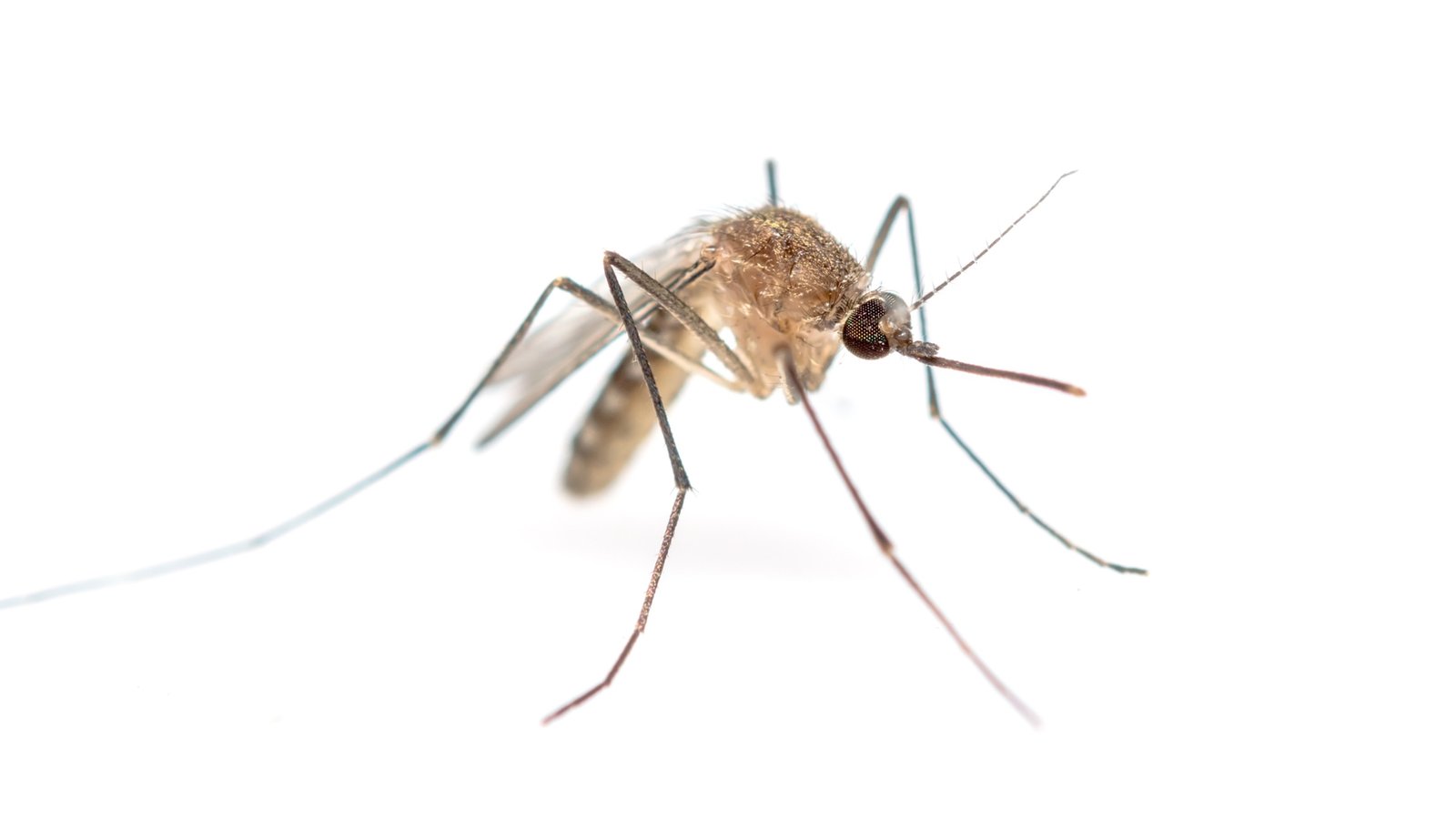
A mosquito is a small, slender fly with one telltale combination of features: a long, needle-like mouthpart (the proboscis) sticking out from the front of its head, a single pair of narrow wings that carry tiny scales along the veins and edges, and six long, thin legs. If an insect has all three of those together, it is almost certainly a mosquito and not a crane fly, a midge, or a gnat.
Once you know it is a mosquito, you can often narrow down the general type by a few visible traits: whether it has bold black-and-white markings, what time of day it is biting, and how it holds its body when it lands. Those clues sort most everyday US mosquitoes into a handful of groups (called genera): Aedes, Culex, Anopheles, and the oversized Psorophora. Pinning down the exact species usually takes a microscope and a trained eye, which is where your local mosquito control district comes in.
Is it even a mosquito
Plenty of harmless insects get swatted every summer because they look mosquito-ish from a distance. Before you try to identify the type, confirm you are looking at a mosquito at all. Three features do the work.
A long proboscis. Mosquitoes carry a long, thin, forward-pointing mouthpart. On females it is a piercing tube used to draw blood. Most lookalikes do not have this. Dixid midges, for example, lack a proboscis and lack scales on their wings, which is exactly why entomologists use those two traits to separate them from true mosquitoes (American Mosquito Control Association).
Narrow wings with scales. A mosquito has one pair of slender wings, and along the veins and back edge of each wing sit small scales. Scales on the wing veins are one of the features that set mosquitoes apart from other flies (mosquito identification guidance, University of Texas at El Paso). To the naked eye the scales can look like a faint dusty or fringed texture. Midges have smooth, scaleless wings that are shorter than the body.
Six long legs and a slender body. Mosquitoes are delicate, long-legged insects. That build invites confusion with two harmless groups:
- Crane flies. Often called “daddy-long-legs” flies, crane flies are many times larger than a typical mosquito, with extremely long legs and no biting proboscis. They do not bite people and do not eat mosquitoes (American Mosquito Control Association). At rest their wings tend to stick out to the sides rather than fold neatly over the body.
- Midges. Non-biting midges are the most widespread and numerous mosquito lookalikes. They are similar in size to a mosquito but have short, non-piercing mouthparts, scaleless wings, and a smoother body, and they often gather in large mating swarms or “clouds” on warm evenings (American Mosquito Control Association; San Gabriel Valley Mosquito and Vector Control District).
So the quick test is: long piercing mouthpart plus scaled wings plus long legs equals mosquito. Missing the proboscis or the wing scales points to a lookalike.
The features that matter
Once you have a mosquito in front of you, these are the parts entomologists actually look at.
| Feature | What to look for | Why it helps |
|---|---|---|
| Proboscis | Long, straight, forward-pointing mouth tube | Confirms it is a mosquito; length relative to the palps helps separate genera |
| Palps | Short paired feelers beside the proboscis | In Anopheles females they are about as long as the proboscis; in Aedes and Culex females they are much shorter |
| Wing scales | Faint scales along veins and wing edges | A mosquito trait; dark and pale scale patches form the visible markings |
| Leg bands | Pale or white rings on dark legs | Banding points toward Aedes and some Psorophora; plain legs point toward Culex |
| Body markings | White or silver scale patches on a dark body | Crisp black-and-white patterning is a hallmark of Aedes |
| Resting posture | Body flat and parallel, or tilted rear-up | A tilted, rear-in-the-air stance flags Anopheles |
Most of these are visible with a hand lens or a sharp close-up photo. Bands and markings come from patches of dark and pale scales, so a rubbed or wet specimen can lose its pattern and become harder to read.
Narrowing to a genus
You do not need a lab to place a mosquito into one of the common US groups. Combine the look with the behavior.
Aedes (patterned, day-biting). Aedes mosquitoes wear crisp black-and-white patterning, produced by white or silver scale patches on a dark body, and often have banded legs. They are active daytime biters, most noticeable in the morning and late afternoon. In the US, Aedes species are the group tied to dengue, Zika, and chikungunya (Target Malaria; CDC, About Mosquitoes in the United States). A mosquito biting you in bright daylight and showing sharp white markings is very likely an Aedes.
Culex (drab, night-biting). Culex mosquitoes are a fairly uniform brown with no bold pattern and generally unbanded legs. They tend to bite from dusk into the night. Culex species are the main carriers of West Nile virus and St. Louis encephalitis in the US (Target Malaria; CDC, About Mosquitoes in the United States).
Anopheles (tilted resting angle). The standout trait for Anopheles is posture. At rest the body tilts so the abdomen points up and away from the surface, rather than lying flat and parallel like Aedes and Culex. Anopheles females also have palps roughly as long as the proboscis. They are mostly night biters. Worldwide, Anopheles is the genus that transmits malaria (Target Malaria; CDC, About Mosquitoes in the United States).
Psorophora (large). If a mosquito looks strikingly big with banded, hairy legs, it may be a Psorophora. The best known is the gallinipper, Psorophora ciliata, one of the largest mosquitoes in North America, with a dark body, lighter or yellow markings, and long legs that appear strongly striped or banded (UF/IFAS Extension; UF/IFAS Featured Creatures). Gallinippers are floodwater mosquitoes: females lay eggs in damp, low-lying soil, and large numbers hatch a week or two after heavy rain floods those spots (UF/IFAS Extension).
| Genus | Markings | Legs | When it bites | Resting posture |
|---|---|---|---|---|
| Aedes | Bold black-and-white | Often banded | Day (morning, late afternoon) | Flat, parallel |
| Culex | Plain brown, drab | Usually unbanded | Dusk to night | Flat, parallel |
| Anopheles | Little obvious pattern | Usually unbanded | Night | Tilted, rear up |
| Psorophora | Dark with pale or yellow | Banded, hairy | Aggressive, day or night | Flat, parallel |
These are field-level clues, not a species key. Exact species identification depends on fine scale patterns, palp and antenna details, and other traits best seen under magnification.
When to get an expert ID
Reach out to your local mosquito control district or county extension office when the answer actually matters, for example when you need to know whether a biting mosquito is a disease vector, when you are seeing a sudden surge you cannot explain, or when you want a specimen identified to species. Many districts will identify mosquitoes submitted by residents and run surveillance traps that track which species are active in your area. A trained entomologist working under a microscope can confirm the species in a way that a photo or a hand lens cannot.
Sources
- American Mosquito Control Association, “Mistaken IDs” (crane flies, midges, dixid midges, and fungus gnats as mosquito lookalikes; dixid midges lack a proboscis and wing scales). https://www.mosquito.org/mistaken-ids/ (accessed 20 July 2026).
- Centers for Disease Control and Prevention, “About Mosquitoes in the United States” (Aedes, Culex, and Anopheles as the main US genera and the diseases each spreads; page returned a 403 on direct fetch, details drawn from the indexed page summary). https://www.cdc.gov/mosquitoes/about/about-mosquitoes-in-the-united-states.html (accessed 20 July 2026).
- Target Malaria, “Anopheles, Aedes or Culex: how to tell mosquito species apart?” (resting posture, palp length, markings, and biting times by genus). https://targetmalaria.org/latest/blog/anopheles-aedes-or-culex-how-to-tell-mosquito-species-apart/ (accessed 20 July 2026).
- San Gabriel Valley Mosquito and Vector Control District, “Mosquito Imposters: Harmless Insects Often Confused for Mosquitoes” (crane flies, midges, and fungus gnats versus mosquitoes; short non-piercing mouthparts of midges). https://www.sgvmosquito.org/mosquito-imposters-harmless-insects-often-confused-for-mosquitoes (accessed 20 July 2026).
- University of Texas at El Paso, “Mosquito ID: Adults” (scales along the wing veins as a mosquito-distinguishing trait). https://www.utep.edu/leb/mosquito/mosquitoadult.pdf (accessed 20 July 2026).
- UF/IFAS Extension Okaloosa County, “When the Rain Brings the Giants” (Psorophora gallinipper size, dark body with yellow markings, banded legs, floodwater breeding). https://blogs.ifas.ufl.edu/okaloosaco/2026/06/24/when-the-rain-brings-the-giants/ (accessed 20 July 2026).
- UF/IFAS Featured Creatures / EDIS, “Gallinipper, Psorophora ciliata” (identification of one of the largest North American mosquitoes). https://ask.ifas.ufl.edu/publication/IN967 (accessed 20 July 2026).
Related
- Aedes mosquitoes: the day-biting patterned group
- Culex mosquitoes and West Nile virus
- Anopheles mosquitoes and malaria
- Gallinippers and other large mosquitoes
- Mosquito lookalikes: crane flies, midges, and gnats
Educational note: This guide is for general reference and identification learning only. It is not medical, pest control, or public health advice. For a confirmed species identification or a disease-risk assessment, contact your local mosquito control district or county extension office.
Last reviewed 20 July 2026.